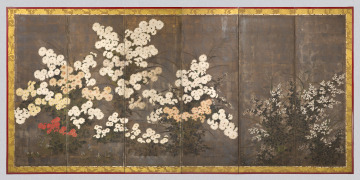
Chrysanthemums and Autumnal Plants

Culture
Japanese
Date
late 17th–early 18th century
Classification
Furniture, paintings
Collection
Asian Art
Current Location
Not on view
Dimensions
overall: 67 1/8 × 140 in. (170.5 × 355.6 cm)
Credit Line
Gift of William K. Bixby
Rights
Public Domain
Object Number
963:1920
NOTES
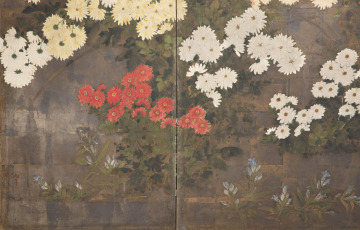
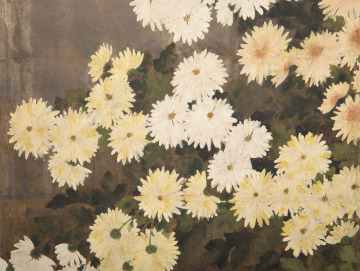
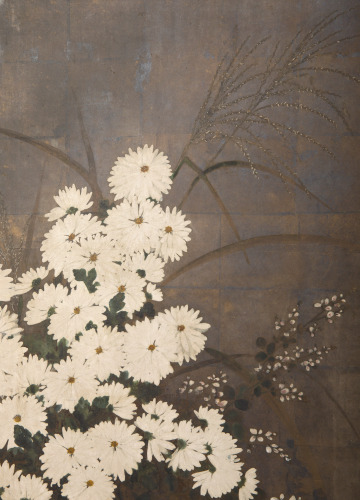
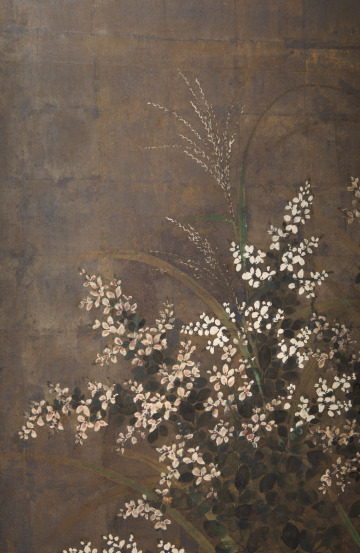
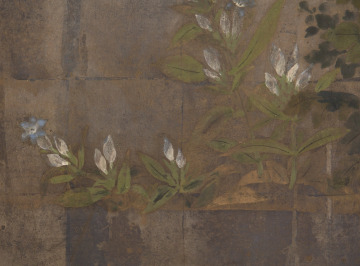
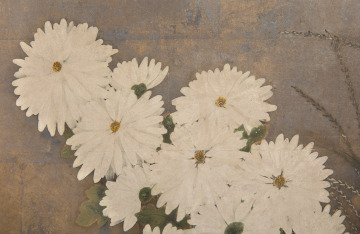
The principal subjects of this screen are several varieties of chrysanthemum (kiku), a flower closely associated with the imperial family of Japan. The white chrysanthemums are rendered in a raised technique (moriage) using pigment ground from oyster shells. Several autumnal plants (akikusa, literally “autumnal grasses”) are also depicted in a grouping at the far right and elsewhere around the chrysanthemums. One of them is a white-flowering variety of the bush clover (shirohagi; Lespedeza japonica). Another is Japanese silver grass (susuki; Miscanthus sinensis), with its gracefully arching leaves and seed heads. At the lower portions of the two far left panels are Chinese bellflowers (kikyō; Platycodon grandiflorus).

The silver-leaf background indicates that the flowers and plants are being viewed under moonlight. Tawaraya Sōtatsu (c.1570–c.1640), one of the founders of the Rinpa school of Japanese painting, introduced a technique of overlapping wet pigments that blur at the edges (tarashikomi). The artist of this folding screen applied the effect for the chrysanthemums’ leaves. At the lower left corner is a round seal impressed in red reading I’nen. This seal continued to be employed by Sōtatsu’s workshop for some time after his death.

We regularly update records, which may be incomplete. If you have additional information, please contact us at provenance@slam.org.