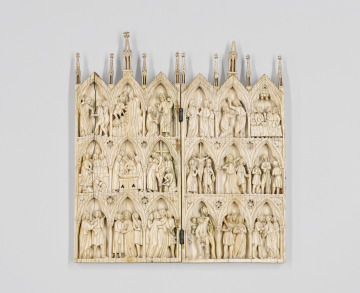
Diptych with Scenes of the Passion and Afterlife of Christ
- Culture
- French
- Date
- 1250–70
- Material
- Elephant ivory with traces of paint
- made in
- Île-de-France region, France, Europe
- Classification
- Ivories, sculpture
- Collection
- European Art to 1800
- Current Location
- On View, Gallery 237
- Dimensions
- 3/8 x 8 3/16 x 7 1/16 in. (1 x 20.8 x 17.9 cm)
- Credit Line
- Museum Purchase
- Rights
- Public Domain
- Object Number
- 183:1928
NOTES
This diptych, or two-panel work, exemplifies the outstanding quality and elegant forms found in ivory carving during the reign of Louis IX (1226–1270). This carving is distinctive for its narrow towers, or pinnacles, atop the architectural frame and the sophisticated treatment and clarity of its narrative.
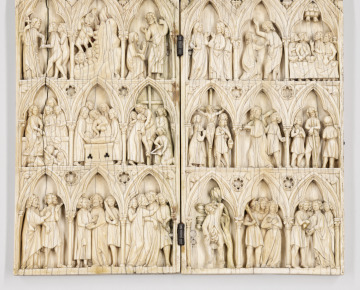
The artist reduced most of the depicted scenes to two or three figures, and often placed Jesus, as both infant and adult, in the center to make the scenes easier to interpret. The location of the figures further enhances the narrative flow. For example, in the first scene on the lower left, Judas, the apostle who helped the Roman authorities arrest Jesus, faces right and directs the viewer’s gaze in the direction of the continuing storyline. This sculpture was originally painted; visible traces of pigment include red on the Mouth of Hell (top row), blue on the tomb (middle), and green on the foliage of the architectural frame.
The artist reduced most of the depicted scenes to two or three figures, and often placed Jesus, as both infant and adult, in the center to make the scenes easier to interpret. The location of the figures further enhances the narrative flow. For example, in the first scene on the lower left, Judas, the apostle who helped the Roman authorities arrest Jesus, faces right and directs the viewer’s gaze in the direction of the continuing storyline. This sculpture was originally painted; visible traces of pigment include red on the Mouth of Hell (top row), blue on the tomb (middle), and green on the foliage of the architectural frame.
Provenance
by 1890 -
Frédéric Spitzer (1815-1890), Paris, France [1]
1893/04/17
In sale of the Frédéric Spitzer collection at Chevallier et Mannheim, Paris, France, beginning on April 17, 1893, lot no. 131 [2]
- 1928
Arnold Seligmann, Rey & Co., New York, NY, USA
1928 -
Saint Louis Art Museum, purchased from Arnold Seligmann, Rey & Co. [3]
Notes:
[1] Listed in the 1891 catalogue of Spitzer's collection ["Le Collection Spitzer." Vol. I Paris, 1891, p. 56, cat. no. 96]. Spitzer was born in Austria, and lived in Vienna until 1852 when he relocated to Paris, and began to actively collect numerous art objects from renowned collections. At the time of his death in 1890, his residence at 33 rue Villejust was known as the Musée Spitzer, which housed over 4,000 objects. Spitzer's collection of antiquities, metalwork, sculpture, etc., was dispersed at a Paris auction hailed as the 'Sale of the Century' with over 3000 lots. The auction, which included the enamel and its pendent, was held from April 17 - June 16, 1893, at Spitzer's Paris home with Paul Chevailler and Charles Mannheim presiding over the extensive auction ["Catalogue des Objets d'Art et de Haute Curiosité: Antiques, du Moyen Age, and de la Renaissance." Vol. 1. April 17 - June 16, 1893, lot no. 131; Truman, Charles. "Frédéric Spitzer," Oxford University Press, accessed May 17, 2004,].
[2] See note [1].
[3] Minutes of the Administrative Board of Control of the City Art Museum, December 26, 1928.
Frédéric Spitzer (1815-1890), Paris, France [1]
1893/04/17
In sale of the Frédéric Spitzer collection at Chevallier et Mannheim, Paris, France, beginning on April 17, 1893, lot no. 131 [2]
- 1928
Arnold Seligmann, Rey & Co., New York, NY, USA
1928 -
Saint Louis Art Museum, purchased from Arnold Seligmann, Rey & Co. [3]
Notes:
[1] Listed in the 1891 catalogue of Spitzer's collection ["Le Collection Spitzer." Vol. I Paris, 1891, p. 56, cat. no. 96]. Spitzer was born in Austria, and lived in Vienna until 1852 when he relocated to Paris, and began to actively collect numerous art objects from renowned collections. At the time of his death in 1890, his residence at 33 rue Villejust was known as the Musée Spitzer, which housed over 4,000 objects. Spitzer's collection of antiquities, metalwork, sculpture, etc., was dispersed at a Paris auction hailed as the 'Sale of the Century' with over 3000 lots. The auction, which included the enamel and its pendent, was held from April 17 - June 16, 1893, at Spitzer's Paris home with Paul Chevailler and Charles Mannheim presiding over the extensive auction ["Catalogue des Objets d'Art et de Haute Curiosité: Antiques, du Moyen Age, and de la Renaissance." Vol. 1. April 17 - June 16, 1893, lot no. 131; Truman, Charles. "Frédéric Spitzer," Oxford University Press, accessed May 17, 2004,
[2] See note [1].
[3] Minutes of the Administrative Board of Control of the City Art Museum, December 26, 1928.
We regularly update records, which may be incomplete. If you have additional information, please contact us at [email protected].
Related Content
Pages
Audio Guide