NOTES
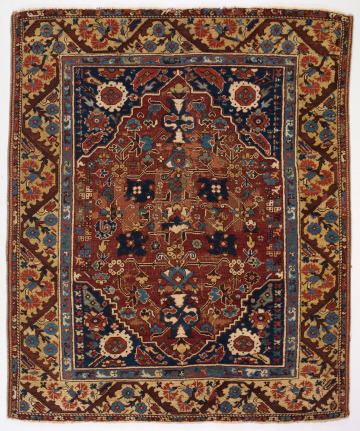
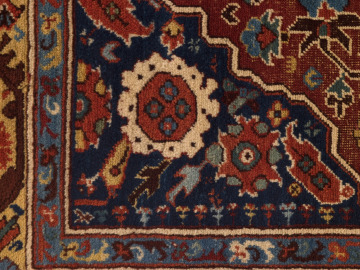
This carpet features a striking yellow border, consisting of a meandering vine adorned with blue cornflowers and bright red carnations, punctuated by three-lobed hyacinths and red tulips. This border is distinctive to carpets produced in the 19th century village of Demirci, in the Kula district of western Anatolia (present-day Turkey.) This floral style evolved from mid-16th century Ottoman carpets, and became a “brand” or trademark of Ottoman work.
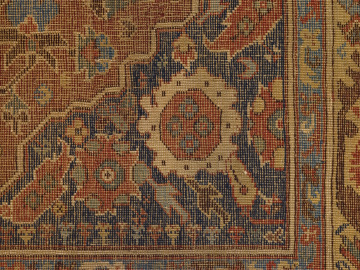
The central field of this carpet reflects the so called “Transylvanian” layout which consists of bilateral symmetry in both vertical and horizontal directions. In keeping with this symmetry, there is a V-shaped prayer niche at both top and bottom. A stylized double lamp hangs from the center of each niche. Many double niche carpets adorned Protestant churches in Transylvania (now central Romania) in the 15th-17th centuries, due to the region’s location on a major East-West trade route, and the high regard for these textiles in the West.