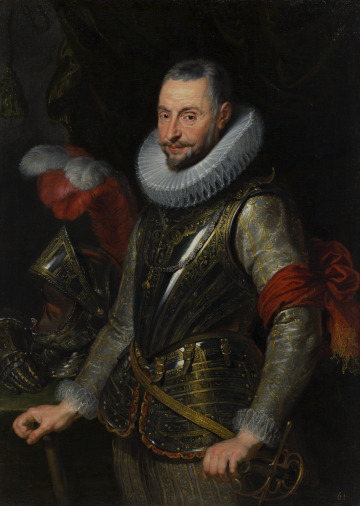
Marquis Ambrogio Spinola
- Studio of
- Peter Paul Rubens, Flemish, 1577–1640
- Date
- c.1630
- Material
- Oil on canvas
- made in
- Antwerp, Antwerpen province, Belgium, Europe
- Classification
- Paintings
- Collection
- European Art to 1800
- Current Location
- Not on view
- Dimensions
- 46 3/8 x 33 1/2 in. (117.8 x 85.1 cm)
framed: 59 1/4 x 46 5/8 x 5 3/4 in. (150.5 x 118.4 x 14.6 cm) - Credit Line
- Museum Purchase
- Rights
- Public Domain
- Object Number
- 33:1934
NOTES
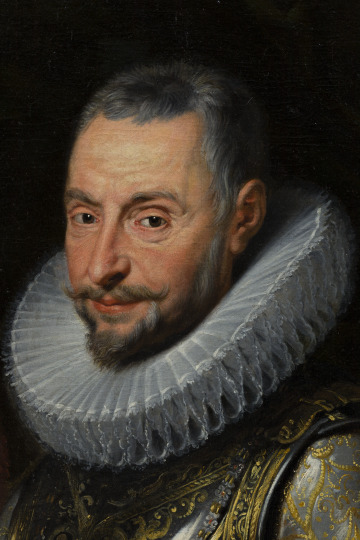
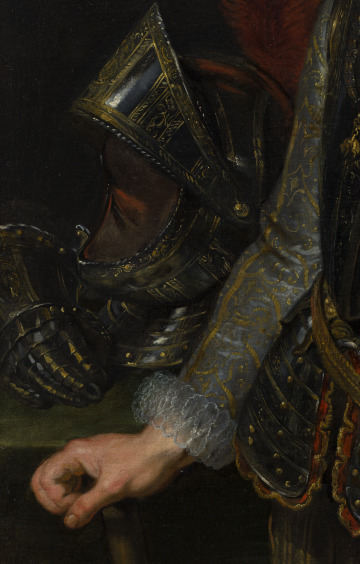
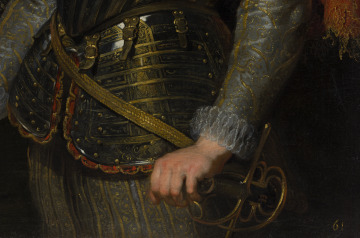
Ambrogio Spinola was a Genoese military officer who commanded the Spanish army in the Netherlands. Wearing parade armor, the man is posed in such a way as to create a diagonal from the back left to the near right, infusing the picture with dynamism. Rubens himself painted a portrait of Spinola in 1625; this version is one of two copies that came from his studio, very likely under his direction.
Provenance
Giovanni Francesco Arese (1642-1721), Milan, Italy [1]
1810 - 1824
1st Duke Eugéne de Beauharnais von Leuchtenberg (1781-1824), Munich, Germany [2]
1824 - 1835
2nd Duke Auguste Karl Eugen Napoleon von Leuchtenberg (1810-1835), Munich, Germany, by inheritance [3]
1835 - 1852
3rd Duke Maximilian Josephe Eugéne von Leuchtenberg (1817-1852), Munich, Germany, by inheritance [4]
1852 - 1876
Duchess Marie Nicolaievitch von Leuchtenberg (1819-1876), Munich, Germany; St. Petersburg, Russia, by inheritance [5]
1876 - 1890
4th Duke Nicholas von Leuchtenberg (1843-1890), St. Petersburg, Russia, by inheritance [6]
1890 - still in 1904
5th Duke Georgi Nicolaievitch von Leuchtenberg (d.1928), St. Petersburg, Russia, by inheritance [7]
Private Collection, Berlin, Germany
by 1932 - 1933
Dr. Fritz Heinemann, Berlin, Germany; Munich, Germany, acquired from private collection, Berlin [8]
1933 - 1934
M. Knoedler & Co., Inc., New York, NY, USA, purchased from Dr. Fritz Heinemann [9]
1934 -
Saint Louis Art Museum, purchased from M. Knoedler & Co. [10]
Notes:
[1] The painting is listed in the inventories of Giovanni Francesco Arese [letter from Alessandro Morandotti, December 16, 2003, SLAM document files].
[2] Beauharnais purchased the Arese Collection in 1810 (see note [1]). The portrait is listed in a posthumous inventory of Duke Eugène de Beauharnais von Leuchtenberg [Muxel, J.N. "Catalogue des tableaux de la Galerie de feu Son Altesse Royale Monseigneur le Prince Eugène, Duc de Leuchtenberg à Munich." Munich: La Galerie, 1825, cat. no. 105]. The painting was incorrectly indexed as van Dyck.
[3] Auguste was the first son of Duke Eugéne de Beauharnais von Leuchtenberg [Muxel, J.N. "Collection in Munich of the Royal Highness the Dom Augusto, Duke of Leuchtenberg." Munich, 1841, cat. no. 105].
[4] Maximilian was the second son of Duke Eugéne de Beauharnais von Leuchtenberg [Muxel, J.N. "Catalogue des tableaux de la Galerie de feu Son Altesse Royale Monseigneur le Prince Eugène, duc de Leuchtenberg à Munich." Munich: Chez Mey et Widmayer 1845, cat. no. 107].
[5] Duchess Marie Nicolaievitch von Leuchtenberg was the wife of Duke Maximilian Josephe Eugéne von Leuchtenberg [Waagen, G.F. "The Collection of the Imperial Hermitage in St. Petersburg, with remarks concerning other collections there." Munich 1864, p. 383, cat. no. 107]. In 1863 the collection was moved from Munich to St. Petersburg [Miller, Dwight W. "A Note on the Collection of the Duke of Leuchtenberg." Paragone 24 (489) Nov. 1990].
[6] Nicholas was the son of Duke Maximilian Josephe Eugéne von Leuchtenberg [Rooses, Max. "L'oeuvre de P. P. Rubens: histoire et description de ses tableaux et dessins, par Max Rubens." Antwerp 1890, p. 271, cat. no. 1061].
[7] Georgi Nicolaievitch was the son of Duke Nicholas von Leuchtenberg. According to a 1934 statement by Knoedler's [SLAM document files], the painting was reproduced as a heliogravure and listed in the collection of the Duke Georg Nikolaus of Leuchtenberg in 1904 ["Les Trésors d'Art en Russie," 1904, pl. 2].
[8] In the catalogue raisonné by Vlieghe, the painting is listed as in the collection of Dr. Heinemann, Munich in 1932 [Vlieghe, Hans. "Corpus Rubenianum Ludwig Burchard, Part XIX Portraits, II Antwerp, Identified Sitters". New York: Oxford University Press, 1987, cat. no. 150]. Dr. Fritz Heinemann, who visited the Saint Louis Art Museum on November 6, 1974, said that he bought this painting as a university student in Berlin and sold it to Knoedler's in 1933 to help finance his first trip to America [Note by Nancy W. Neilson, SLAM document files]. His statement implied that he had owned the painting for quite some time. At the time of this statement, Heinemann was living in Lugano, Switzerland.
[9] According to Julia Armstrong-Totten from the Getty Research Institute, the Knoedler stockcard (A 1464) lists the painting as being purchased from D. Heinemann, Munich [Letter from January 31, 2002, SLAM document files].
[10] Minutes of the Administrative Board of Control of the City Art Museum, October 4, 1934.
1810 - 1824
1st Duke Eugéne de Beauharnais von Leuchtenberg (1781-1824), Munich, Germany [2]
1824 - 1835
2nd Duke Auguste Karl Eugen Napoleon von Leuchtenberg (1810-1835), Munich, Germany, by inheritance [3]
1835 - 1852
3rd Duke Maximilian Josephe Eugéne von Leuchtenberg (1817-1852), Munich, Germany, by inheritance [4]
1852 - 1876
Duchess Marie Nicolaievitch von Leuchtenberg (1819-1876), Munich, Germany; St. Petersburg, Russia, by inheritance [5]
1876 - 1890
4th Duke Nicholas von Leuchtenberg (1843-1890), St. Petersburg, Russia, by inheritance [6]
1890 - still in 1904
5th Duke Georgi Nicolaievitch von Leuchtenberg (d.1928), St. Petersburg, Russia, by inheritance [7]
Private Collection, Berlin, Germany
by 1932 - 1933
Dr. Fritz Heinemann, Berlin, Germany; Munich, Germany, acquired from private collection, Berlin [8]
1933 - 1934
M. Knoedler & Co., Inc., New York, NY, USA, purchased from Dr. Fritz Heinemann [9]
1934 -
Saint Louis Art Museum, purchased from M. Knoedler & Co. [10]
Notes:
[1] The painting is listed in the inventories of Giovanni Francesco Arese [letter from Alessandro Morandotti, December 16, 2003, SLAM document files].
[2] Beauharnais purchased the Arese Collection in 1810 (see note [1]). The portrait is listed in a posthumous inventory of Duke Eugène de Beauharnais von Leuchtenberg [Muxel, J.N. "Catalogue des tableaux de la Galerie de feu Son Altesse Royale Monseigneur le Prince Eugène, Duc de Leuchtenberg à Munich." Munich: La Galerie, 1825, cat. no. 105]. The painting was incorrectly indexed as van Dyck.
[3] Auguste was the first son of Duke Eugéne de Beauharnais von Leuchtenberg [Muxel, J.N. "Collection in Munich of the Royal Highness the Dom Augusto, Duke of Leuchtenberg." Munich, 1841, cat. no. 105].
[4] Maximilian was the second son of Duke Eugéne de Beauharnais von Leuchtenberg [Muxel, J.N. "Catalogue des tableaux de la Galerie de feu Son Altesse Royale Monseigneur le Prince Eugène, duc de Leuchtenberg à Munich." Munich: Chez Mey et Widmayer 1845, cat. no. 107].
[5] Duchess Marie Nicolaievitch von Leuchtenberg was the wife of Duke Maximilian Josephe Eugéne von Leuchtenberg [Waagen, G.F. "The Collection of the Imperial Hermitage in St. Petersburg, with remarks concerning other collections there." Munich 1864, p. 383, cat. no. 107]. In 1863 the collection was moved from Munich to St. Petersburg [Miller, Dwight W. "A Note on the Collection of the Duke of Leuchtenberg." Paragone 24 (489) Nov. 1990].
[6] Nicholas was the son of Duke Maximilian Josephe Eugéne von Leuchtenberg [Rooses, Max. "L'oeuvre de P. P. Rubens: histoire et description de ses tableaux et dessins, par Max Rubens." Antwerp 1890, p. 271, cat. no. 1061].
[7] Georgi Nicolaievitch was the son of Duke Nicholas von Leuchtenberg. According to a 1934 statement by Knoedler's [SLAM document files], the painting was reproduced as a heliogravure and listed in the collection of the Duke Georg Nikolaus of Leuchtenberg in 1904 ["Les Trésors d'Art en Russie," 1904, pl. 2].
[8] In the catalogue raisonné by Vlieghe, the painting is listed as in the collection of Dr. Heinemann, Munich in 1932 [Vlieghe, Hans. "Corpus Rubenianum Ludwig Burchard, Part XIX Portraits, II Antwerp, Identified Sitters". New York: Oxford University Press, 1987, cat. no. 150]. Dr. Fritz Heinemann, who visited the Saint Louis Art Museum on November 6, 1974, said that he bought this painting as a university student in Berlin and sold it to Knoedler's in 1933 to help finance his first trip to America [Note by Nancy W. Neilson, SLAM document files]. His statement implied that he had owned the painting for quite some time. At the time of this statement, Heinemann was living in Lugano, Switzerland.
[9] According to Julia Armstrong-Totten from the Getty Research Institute, the Knoedler stockcard (A 1464) lists the painting as being purchased from D. Heinemann, Munich [Letter from January 31, 2002, SLAM document files].
[10] Minutes of the Administrative Board of Control of the City Art Museum, October 4, 1934.
We regularly update records, which may be incomplete. If you have additional information, please contact us at provenance@slam.org.