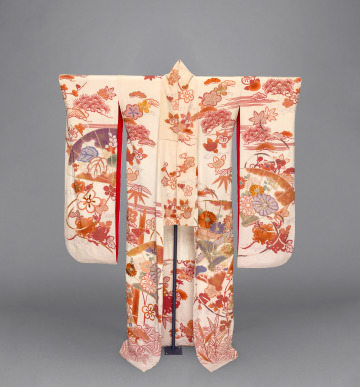
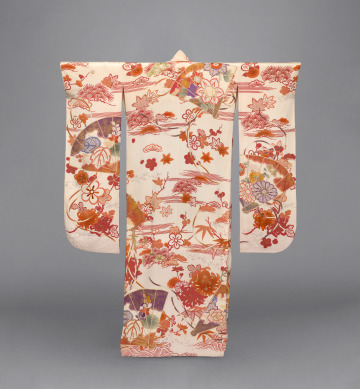
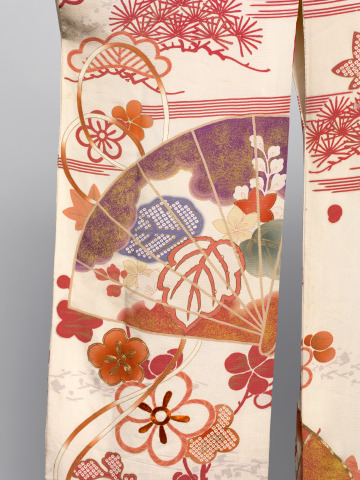
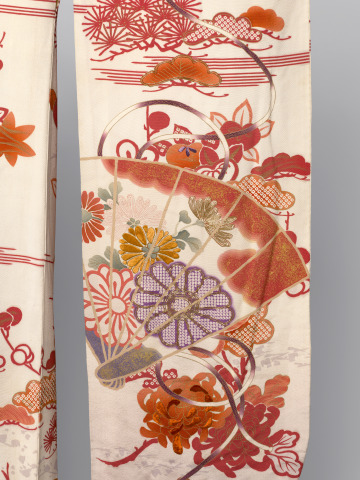
Woman’s Long-sleeved Robe (furisode) with Design of Autumnal Flowers, Leaves, Fans, and Waves
- Culture
- Japanese
- Period
- Edo period, 1615–1868
- Date
- early to mid-19th century
- Classification
- Costume & clothing, textiles
- Collection
- Asian Art
- Current Location
- Not on view
- Dimensions
- 68 1/2 in. × 51 in. (174 × 129.5 cm)
- Credit Line
- Gift of George R. Boyle
- Rights
- Public Domain
- Object Number
- 348:1958
NOTES
The Japanese term for this garment, furisode (“swinging sleeves”), refers to the long sleeves traditionally worn by younger and unmarried women. The sleeves are attached to the body of the robe only at the shoulder, with the inner edge left open past the shoulder. This allows the underrobe (juban) to show when worn and also permits the sash (obi) to be tied above the hips.
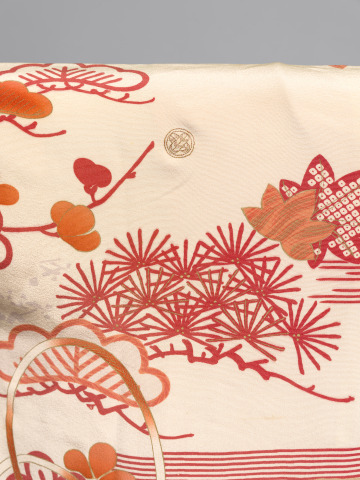
This furisode is made from a white silk plainweave crêpe. The fabric is generously decorated with autumnal flowers, fruits, and leaves. These motifs were created using stencil-resist, handdrawn paste resist dyeing, and embroidery. The bright colors reflect the wearer’s youth.
We regularly update records, which may be incomplete. If you have additional information, please contact us at [email protected].