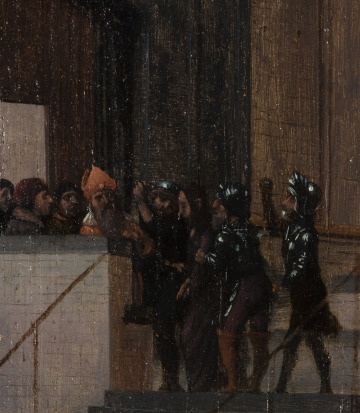
Christ Shown to the People
- Date
- c.1515
- Material
- Oil on panel
- made in
- Netherlands, Europe
- Classification
- Paintings
- Collection
- European Art to 1800
- Current Location
- On View, Gallery 222
- Dimensions
- 21 15/16 x 18 5/8 in. (55.7 x 47.3 cm)
framed: 27 1/2 x 24 1/2 in. (69.9 x 62.2 cm) - Credit Line
- Museum Purchase
- Rights
- Public Domain
- Object Number
- 207:1946
NOTES
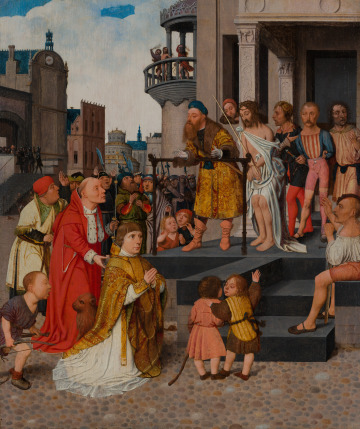
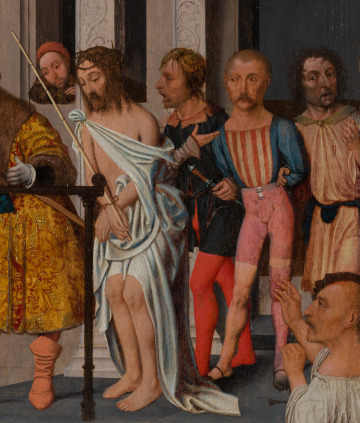
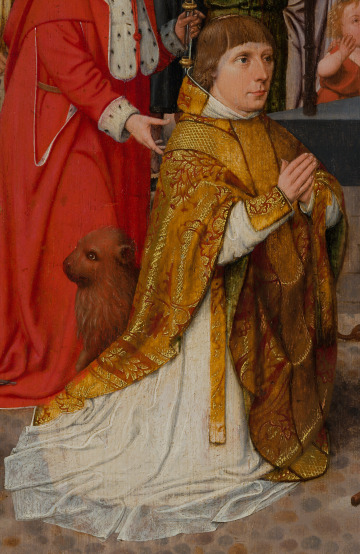
Pontius Pilate, the governor of Judaea (located in modern-day Israel), offers a noisy crowd the choice of saving Jesus, believed by Christians to be the savior, or Barabbas, a thief dressed in red stripes and flanked by two soldiers. In the left foreground, the donor who commissioned the painting wears priestly vestments and kneels beside the red-robed St. Jerome (depicted alongside the lion he aided). The donor is shown praying to convey his piety. Jan Mostaert’s masterful composition incorporates striking Italian architecture and a variety of individual character types often used in 16th-century northern European painting.
Provenance
- 1937
Private Collection, Germany
1937 - still in 1938
Julius Böhler Kunsthandlung, Munich, Germany, acquired from private collection; Böhler and Steinmeyer, Inc. New York, NY, USA, by transfer and exchange [1]
- 1946
Durlacher Brothers, New York, NY
1946 -
Saint Louis Art Museum, purchased from Durlacher Brothers [2]
Notes:
[1] According to the Julius Böhler Kunsthandlung stock card for this work, a copy of which is in the Archives of the Getty Research Institute, the painting was purchased by Julius Böhler Kunsthandlung in 1937 from a painter named Rossmann in Munich [copy of stock card, SLAM document files]. Correspondence with Julius Böhler Kunsthandlung in February 2002 indicates that they purchased the painting from Rossmann on December 4, 1937 [letter dated February 8, 2002, SLAM document files].
In a letter to the Museum's former director, Perry T. Rathbone, Julius Böhler stated: "We bought the picture in 1934 in Munich. It was brought to our firm there by an agent, who would not disclose the name of the former owner. ... As the agent has since died it is also impossible to ask him again. ...So all one can say with certainty is that the picture comes from an aristocratic family in South Germany, because that agent was a local man who did not travel" [letter dated October 31, 1950, SLAM document files]. It is possible that Böhler confused the year of the acquisition, and that it was Rossmann who was acting as agent to the private collector at that time. A second inventory card, also at the Getty Research Institute, lists the painting as being transferred to the affiliated branch, Böhler and Steinmeyer, New York, on January 11, 1938 in exchange for a work by Tiepolo [copy of stock card, SLAM document files].
[2] Invoice from Durlacher Brothers dated December 14, 1946 [SLAM document files]. Minutes of the Administrative Board of Control of the City Art Museum, December 12, 1946.
Private Collection, Germany
1937 - still in 1938
Julius Böhler Kunsthandlung, Munich, Germany, acquired from private collection; Böhler and Steinmeyer, Inc. New York, NY, USA, by transfer and exchange [1]
- 1946
Durlacher Brothers, New York, NY
1946 -
Saint Louis Art Museum, purchased from Durlacher Brothers [2]
Notes:
[1] According to the Julius Böhler Kunsthandlung stock card for this work, a copy of which is in the Archives of the Getty Research Institute, the painting was purchased by Julius Böhler Kunsthandlung in 1937 from a painter named Rossmann in Munich [copy of stock card, SLAM document files]. Correspondence with Julius Böhler Kunsthandlung in February 2002 indicates that they purchased the painting from Rossmann on December 4, 1937 [letter dated February 8, 2002, SLAM document files].
In a letter to the Museum's former director, Perry T. Rathbone, Julius Böhler stated: "We bought the picture in 1934 in Munich. It was brought to our firm there by an agent, who would not disclose the name of the former owner. ... As the agent has since died it is also impossible to ask him again. ...So all one can say with certainty is that the picture comes from an aristocratic family in South Germany, because that agent was a local man who did not travel" [letter dated October 31, 1950, SLAM document files]. It is possible that Böhler confused the year of the acquisition, and that it was Rossmann who was acting as agent to the private collector at that time. A second inventory card, also at the Getty Research Institute, lists the painting as being transferred to the affiliated branch, Böhler and Steinmeyer, New York, on January 11, 1938 in exchange for a work by Tiepolo [copy of stock card, SLAM document files].
[2] Invoice from Durlacher Brothers dated December 14, 1946 [SLAM document files]. Minutes of the Administrative Board of Control of the City Art Museum, December 12, 1946.
We regularly update records, which may be incomplete. If you have additional information, please contact us at [email protected].