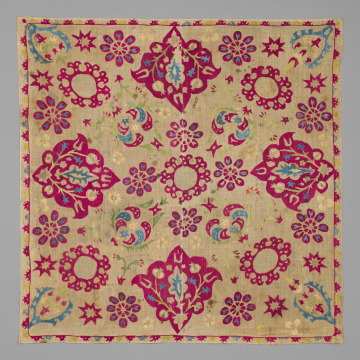
Man’s Turban Cover (kavuk örtüsü) with Design of Floral Motifs

Culture
Turkish
Date
18th century
Material
Silk on linen
made in
Turkey, Asia
Classification
Textiles
Collection
Islamic Art
Current Location
Not on view
Dimensions
37 1/4 × 37 1/4 in. (94.6 × 94.6 cm)
Credit Line
Gift of Mrs. Frank H. Cook
Rights
Public Domain
Object Number
174:1952
NOTES
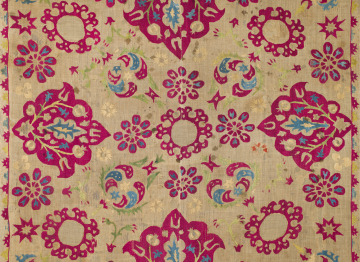
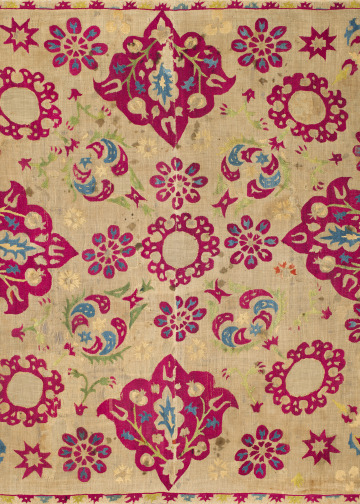
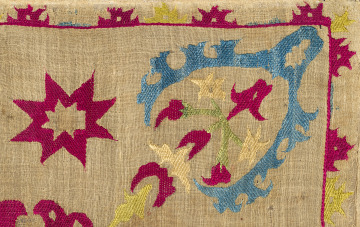
This linen textile with silk embroidery has an edging of palmettes in red, blue, and green. The ground is symmetrically covered with floral palmettes and round medallions with scalloped edges as well as large artichoke motifs containing flowers, rosettes, and three-ball patterns. From the 1720s onward, Ottoman embroidery no longer copied woven designs and instead became a truly creative art form with the introduction of new and naturalistic floral motifs. Textiles such as this were made to cover a "kavuk"-style turban, a formal type of turban that was never unwound. When not worn, the turban was kept on a stand and protected with a special cover. These covers are square in shape and usually feature a circular design at the center, as seen here. Turbans were worn in Ottoman society as status symbols; a turban’s shape and form indicated the rank and profession of the man who wore it.

We regularly update records, which may be incomplete. If you have additional information, please contact us at provenance@slam.org.