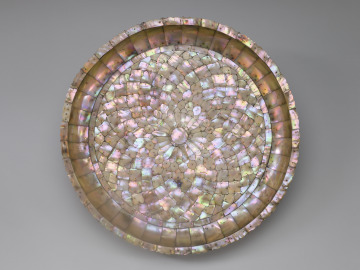
Dish with Design of Foliate Motifs

Culture
Indian
Date
c.1600
Classification
Bone & shell, containers
Collection
Islamic Art
Current Location
Not on view
Dimensions
diameter: 17 3/4 in. (45.1 cm)
Credit Line
Edwin and Betty Greenfield Grossman Endowment
Rights
Public Domain
Object Number
432:2018
NOTES
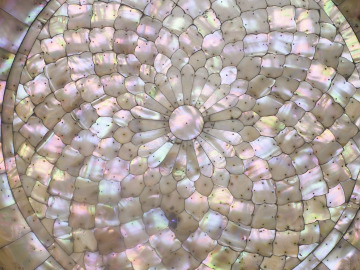
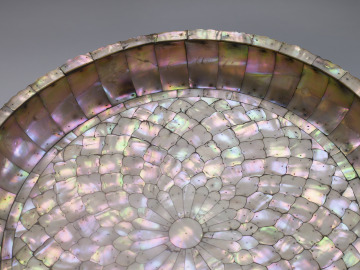
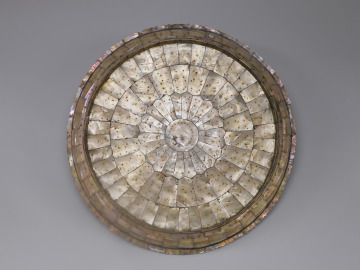
This shallow dish has a thin teakwood body covered on both sides with shaped plaques of mother-of-pearl, which come from the green turban shell (Turbo marmoratus). There may also be inserts of one or two other marine shells, namely the button shell (Trochus niloticus) or the pearl oyster (Pinctada margaritifera), or both. The main body of the dish is decorated with a central multi-petaled flower head with radiating small-shaped plaques of increasing size. These radiating shapes are framed by a narrow circular border around the edge of the bowl. The concave sides are decorated with vertical plaques following the shape of the dish with a narrow undulating rim.

Gujarat, in western India, was the center for artisanal mother-of-pearl production during the 16th and 17th centuries. The allure of this material lay in its versatility, its strength, and above all in its lustrous and beautiful iridescent surface, which reflected light and varied color. Objects covered in mother-of-pearl were given to foreign rulers as diplomatic gifts and were exported to the east coast of Africa, Turkey, and Europe.

We regularly update records, which may be incomplete. If you have additional information, please contact us at provenance@slam.org.