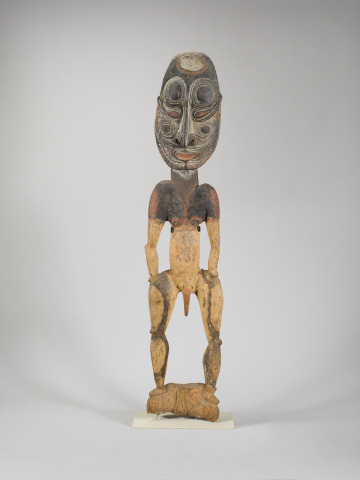
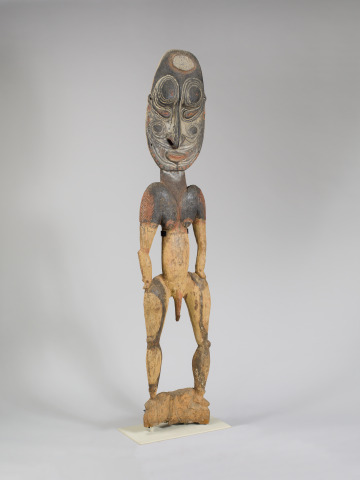
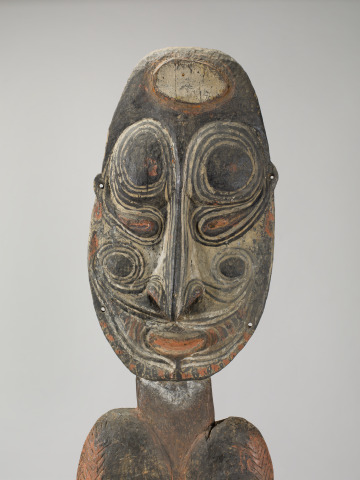
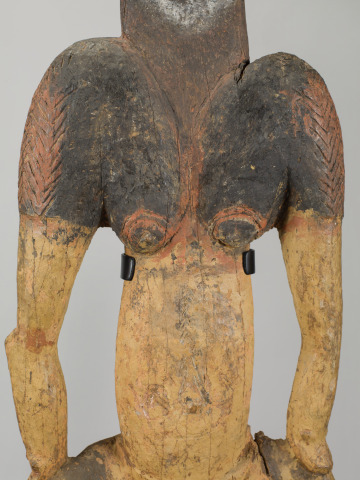
Male Figure
- Culture
- Iatmul artist
- Date
- early to mid-20th century
- Material
- Wood, pigment
- Classification
- Sculpture, wood
- Collection
- Arts of Africa, Oceania, and the Americas
- Current Location
- On View, Gallery 107
- Dimensions
- 72 1/16 x 27 9/16 x 2 15/16 in. (183 x 70 x 7.5 cm)
- Credit Line
- Gift of Morton D. May
- Rights
- Public Domain
- Object Number
- 27:1977
NOTES
Details of this imposing figure suggest it represents an ancestor. The scarifications on the shoulders, identical to those worn by Iatmul men, and the large shell disc headband support this theory. The figure would have been attached to a structural post inside a men’s ceremonial house, where it served as an observer of debates and a reminder to those gathered to respect the laws and traditions of the community.
A men’s ceremonial house, accessed exclusively by men, is located at a village’s center, set majestically on a wide passageway. The men’s house is a place devoted to meetings, discussions, ceremonies, and rituals. The interior is visually impressive. In addition to ancestral figures such as this one along each post, objects like masks and musical instruments are safeguarded there. During rituals such as initiations or during wars, the house is considered “hot.” In this activated state, the ancestral spirits, who are the guardians of tradition and social norms, may manifest in multiple forms, including as masks and music.
Provenance
- 1973
Everett Rassiga, New York, NY, USA
1973 - 1977
Morton D. May (1914-1983), St. Louis, MO, purchased from Everett Rassiga [1]
1977 -
Saint Louis Art Museum, given by Morton D. May [2]
Notes:
[1] A letter dated March 8, 1973 from Morton D. May to Everett Rassiga documents the purchase of this object, listed as "Sepik Figure" [SLAM document files].
[2] A letter dated March 1, 1977 from Morton D. May to James N. Wood, director of the Saint Louis Art Museum, includes the offer of this object as part of a larger donation [SLAM document files]. Minutes of the Acquisitions Committee of the Board of Trustees, Saint Louis Art Museum, April 14, 1977.
Everett Rassiga, New York, NY, USA
1973 - 1977
Morton D. May (1914-1983), St. Louis, MO, purchased from Everett Rassiga [1]
1977 -
Saint Louis Art Museum, given by Morton D. May [2]
Notes:
[1] A letter dated March 8, 1973 from Morton D. May to Everett Rassiga documents the purchase of this object, listed as "Sepik Figure" [SLAM document files].
[2] A letter dated March 1, 1977 from Morton D. May to James N. Wood, director of the Saint Louis Art Museum, includes the offer of this object as part of a larger donation [SLAM document files]. Minutes of the Acquisitions Committee of the Board of Trustees, Saint Louis Art Museum, April 14, 1977.
We regularly update records, which may be incomplete. If you have additional information, please contact us at provenance@slam.org.