Normal light
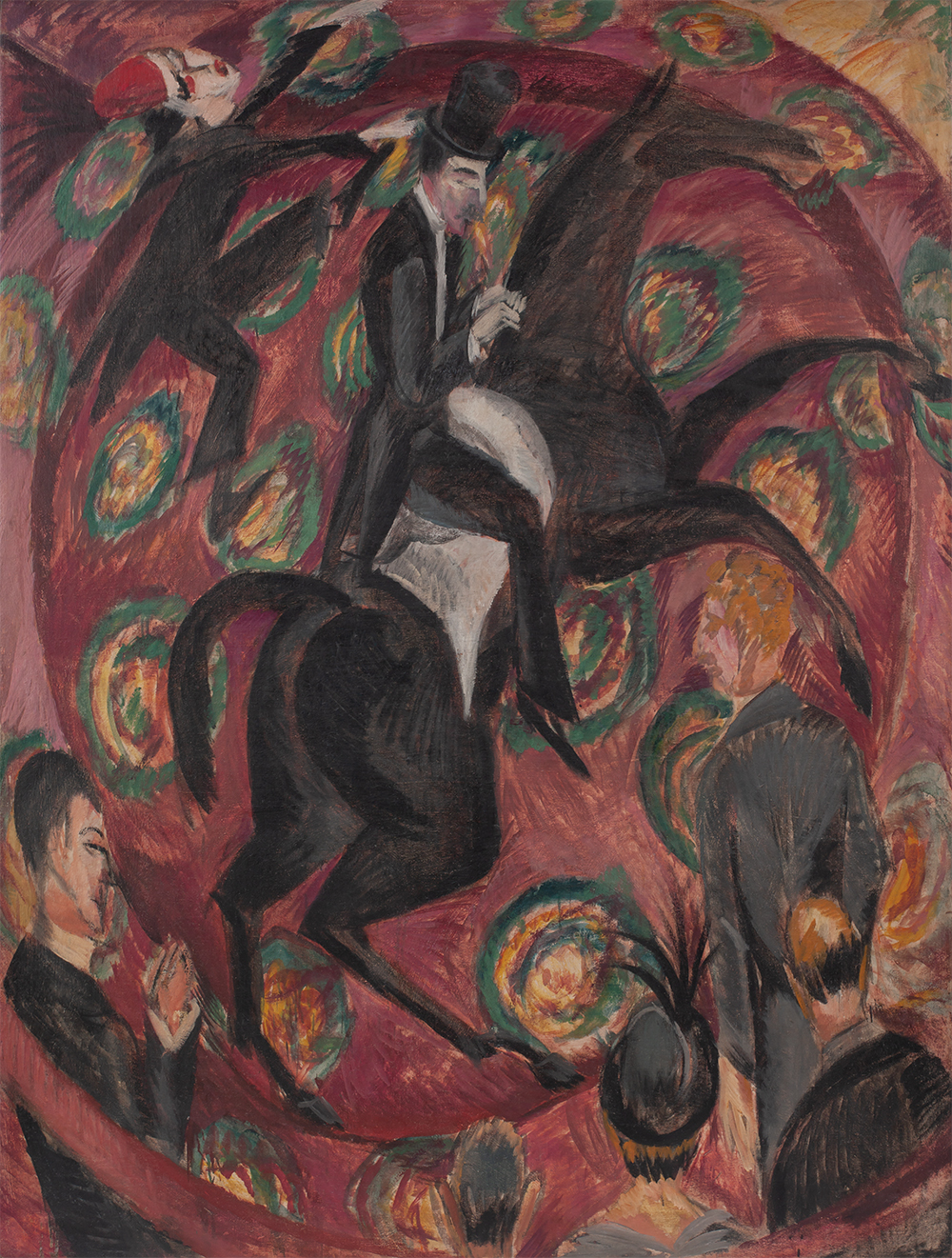
One of Ernst Ludwig Kirchner’s most iconic paintings and a masterpiece of his Berlin style, Circus Rider hides a secret. It is painted on the back of an early, lost painting, Dancers with Castanets.
Technical analysis paired with archival research retells the story of why and how Dancers with Castanets became obscured. Historic conservation treatments may have best preserved Circus Rider, but they came with the cost of covering the reverse with a canvas lining. The combination of this treatment, paired with the fragility of a century-old painting, presents a challenge for future conservators—one that calls for further research.
Ernst Ludwig Kirchner, German (active Switzerland), 1880–1938; Circus Rider (recto), Dancers with Castanets (verso), 1914 (recto) / 1910 (verso); oil on canvas; 79 x 59 7/16 inches; Saint Louis Art Museum, Bequest of Morton D. May 904:1983
Infrared, back of painting
Circus Rider is documented to have a painting executed on its reverse. If a painting is suspected of having artwork on both sides of one canvas, infrared reflectography may help see through a canvas liner. In the infrared image of the back of the painting, the shadowy dancing figures start to emerge. Kirchner painted Circus Rider on the reverse of Dancers with Castanets (1910) in 1914. Archival conservation records and further imaging techniques help explain why the painting was covered.

Archival image
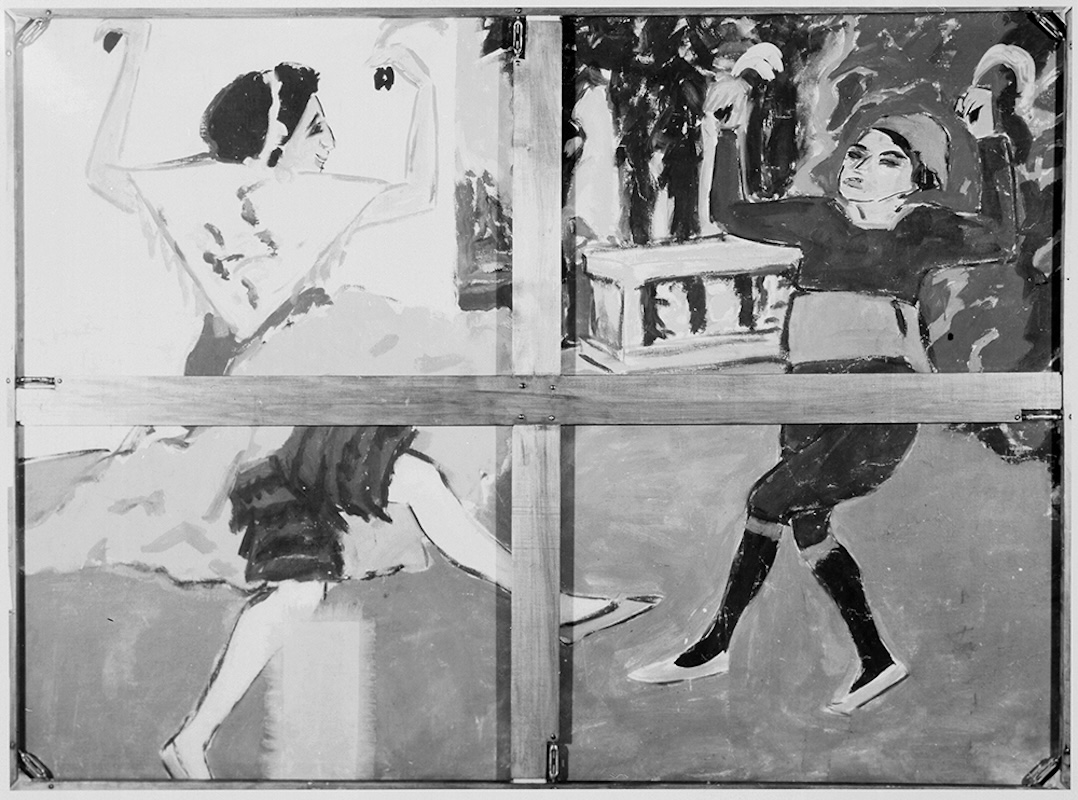
An archival black-and-white image captures Dancers with Castanets prior to the attachment of the lining canvas in 1979.
Together with Circus Rider on one fabric support, the painting suffered a tear in the canvas, approximately 15 inches in length. The tear is covered by a paper patch in the lower left of the image, below the dancer’s ruffled bloomers. Such a large damage weakens the ability of the canvas to retain adequate tension—risking further extension of the tear, warped deterioration of the canvas, and puckering; plus loss of the surrounding paint and ground layers. The 1957 conservation treatment attempted to prevent these effects from worsening but proved insufficient, leading to the full lining treatment of 1979.
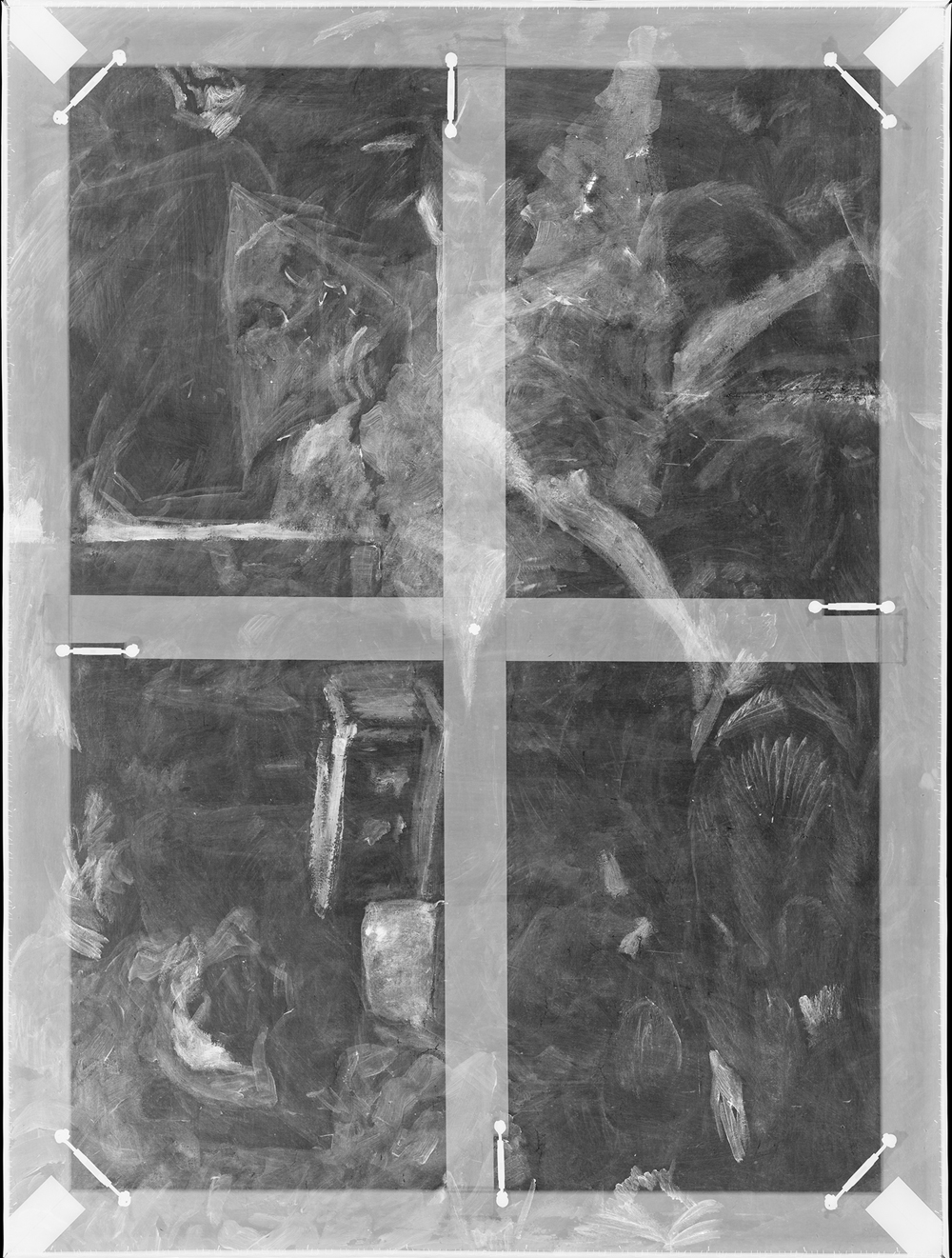
X-radiograph
The X-radiograph of a double-sided painting can quickly become challenging to decipher due to the fact that the process produces a composite image of all the X-radiosensitive layers belonging to both paintings.
In this case, the painted layers of both Circus Rider and Dancers with Castanets appear in the X-radiograph, particularly due to Kirchner’s use of lead white in most of his paint layers. The lead white strongly absorbs X-rays and appears as white—the thicker the paint, the more opaquely it appears in the image.
If the image is oriented according to Circus Rider, the tear in the canvas is visible in the upper right. The standing figures along the lower edge and the acrobat in the upper left are also visible and help to situate the viewer. The center of the composition, however, grows more muddled.
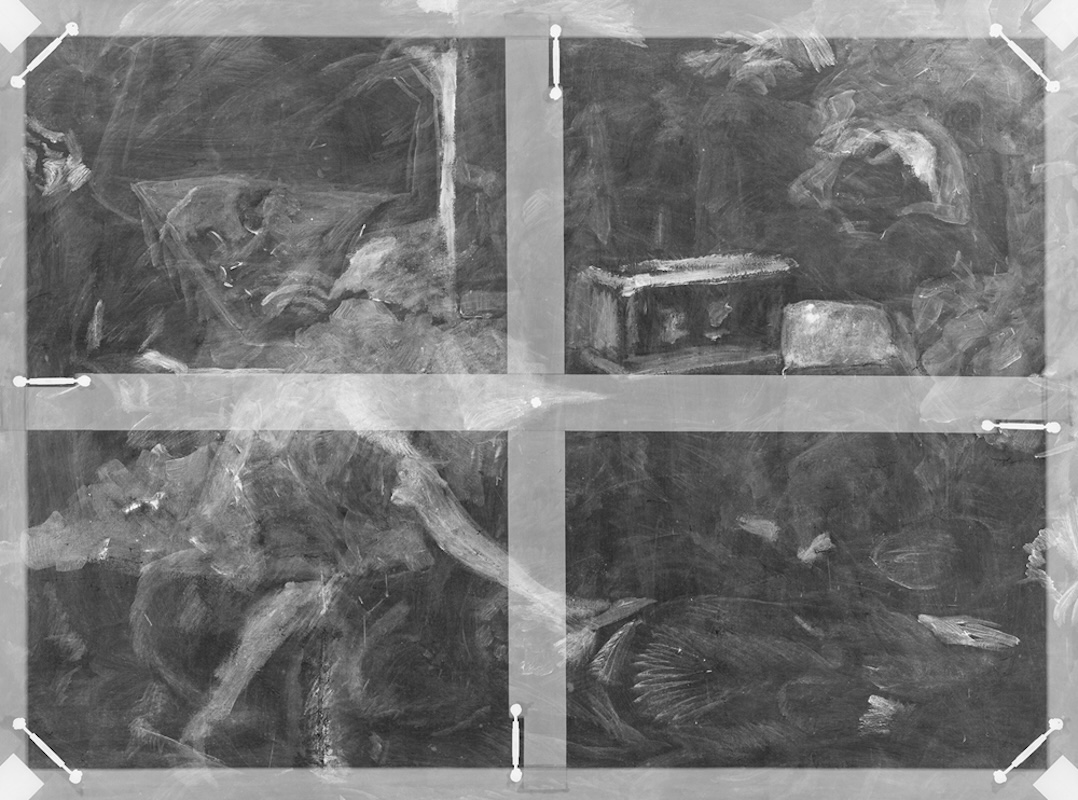
Rotating the image clockwise 90 degrees and flipping it horizontally provides the correct orientation for Dancers with Castanets. The chest-like furniture in the background and the hat plus waistband of the righthand dancer were likely painted with a large amount of lead white. The kicking legs, spinning skirt, and triangular shawl of the left dancer are also visually dominant. Without knowledge of this painting on the other side of Circus Rider’s canvas, her legs may be misunderstood as the central horse’s forelegs.
Infrared
Unlike X-radiography, infrared reflectography can target one side of the painting. This is largely due to the presence of Kirchner’s chalk-rich ground layers, which uniformly reflect infrared light.
The infrared image indicates Kirchner made very few changes to Circus Rider. Kirchner likely applied the paint layers using a mixture of commercial oil paint mixed with wax and thinned with benzene solvent so that the surface appeared translucent and matte. Drip marks following the horse’s right hindquarter show this fluid paint application. Kirchner may have mapped his design in a reddish paint—underlying red markings appearing in the infrared image denote a repositioning of the horse’s forelegs and rider’s coat.
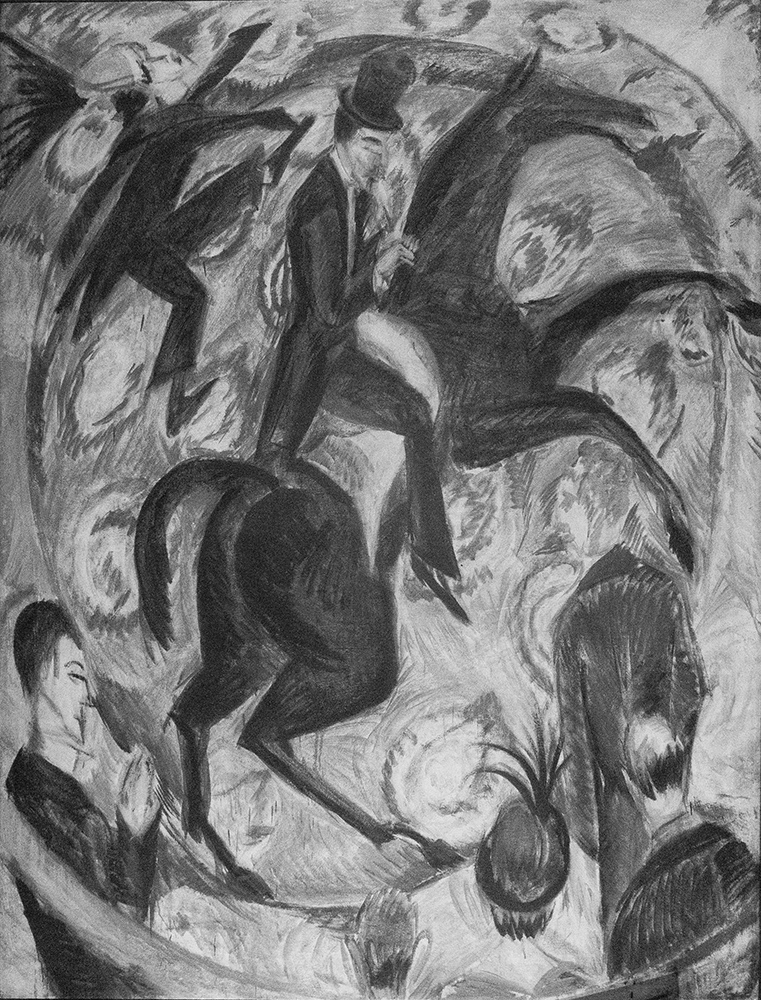
Specular light
Kirchner constructed both Circus Rider and Dancers with Castanets by first applying to the canvas an extremely absorbent ground layer—a warmed mixture of chalk, glue, and linseed oil. The high proportions of chalk in his ground thirstily sucked oil from the paint as it dried, imparting a matte quality that is heightened in specular light. Kirchner did not varnish either side in order to retain the soft sheen of the muted colors.
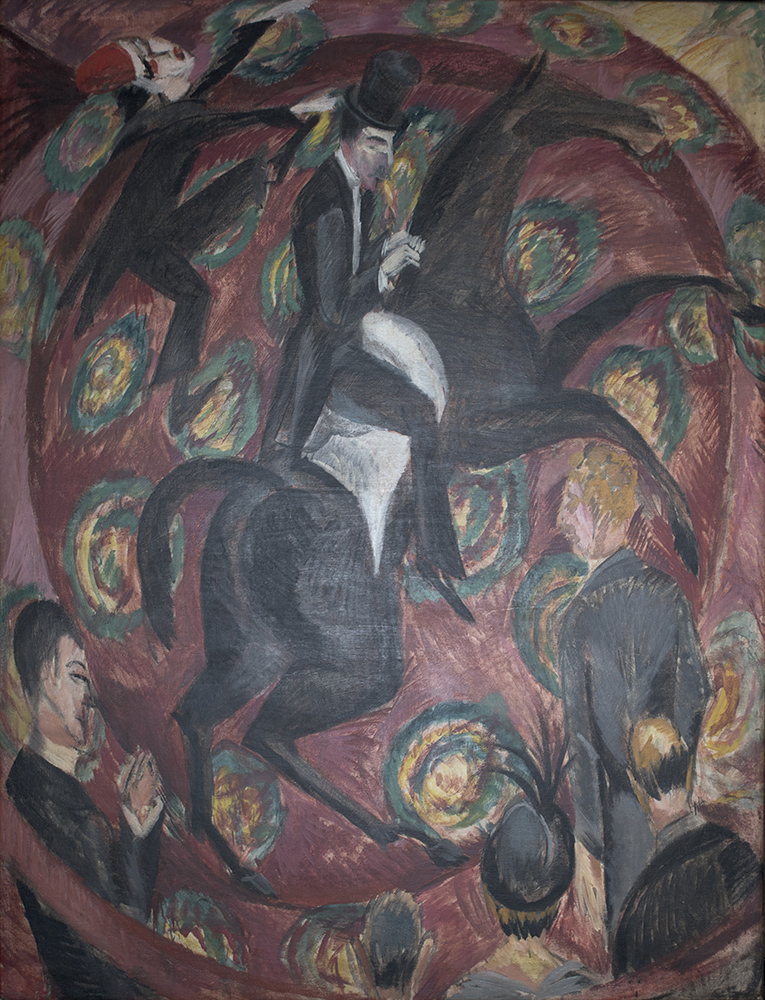
Raking light, cast from below
To create surface texture in Circus Rider, Kirchner manipulated the ground layer more than the paint layers. In raking light, gritty clusters of ground material are revealed as sharp, small bumps scattered throughout the surface. Also visible is the pattern of the ground that Kirchner applied by using broad, horizontally sweeping strokes. The infrared image confirms the absence of underlying compositions between the finished composition and the applied ground of Circus Rider. Therefore, these contrasting patterns in the paint belong to the applied ground layers.

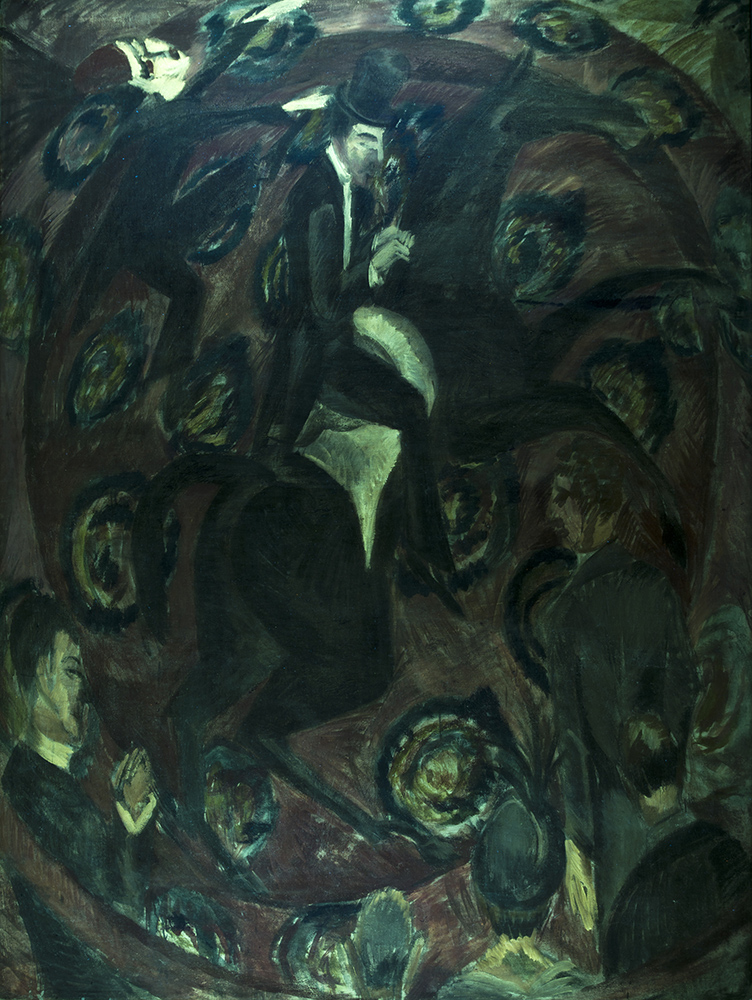
Ultraviolet-induced fluorescent (UVF)
The muted ultraviolet (UV) image of Circus Rider, painted with a limited palette of dark reds, blacks, and greens, is pierced by the green-yellow glow of zinc white. In the upper right corner, the canvas tear is noticeable by a stretch of conservation paints that appear a dark purple, revealing their lack of absorption under ultraviolet light.
Normal light, back of painting
The canvas of Circus Rider was adhered to another canvas in a 1979 conservation treatment. This secondary canvas, called a lining, is shown stretched over a replacement wooden stretcher equipped with adjustable hardware for tensioning the canvases. The original linen canvas that peeks unevenly around the stretcher bars appears dark brown, largely due to a heavy saturation of wax-resin. As part of a 1957 treatment, this adhesive once held strips of extra canvas to these edges in an attempt to salvage weakening canvas. This treatment was partially reversed and replaced with a full lining using a synthetic adhesive in 1979.

Additional Objects
View all objects in the technical imaging suite to reveal hidden details and examine underlying material layers.

-
Glossary
Back (Verso)
The back of a painting provides a wealth of information about its structure. Changes made to the canvas, such as visible repairs, reveal past damage or vulnerabilities. Markings, labels, and inscriptions often tell new stories of the painting’s past, including original titles, previous owners, and exhibition histories.
Raking Light
Raking light, directed from a side angle, casts surface textures into strong relief. This technique highlights details such as thick brushstrokes, canvas weave, or cracks in the paint layers.
Specular Light
Light cast directly onto the painting’s surface at a 90-degree angle highlights glossy or matte qualities. This technique helps determine if a varnish is present and quickly exposes variations of sheen in different paints.
Infrared Reflectography
Infrared reflectography (IRR) uses a specially adapted camera to detect infrared energy. When an image of a painting is captured using infrared light, some pigments appear transparent, which enables the viewer to see through overlying layers of paint. This technique often reveals hidden details, such as preparatory drawings by the artist or parts of the composition the artist painted over.
Ultraviolet Radiation
Ultraviolet (UV) light sources cause certain materials to absorb and re-emit colorful light, known as fluorescence. The fluorescence of some materials can identify certain pigments, such as zinc white, which produces a vibrant glow. Conservators can also detect previous treatments, which may appear dark purple.
X-radiography
X-radiography uses an X-ray source and sensitive film to produce an image of the painting’s composite layers. Materials transparent to X-rays appear dark in the images, while X-ray–absorbing materials like lead white and metal hardware appear white. Artist’s changes and, in some exciting instances, completely different, earlier compositions may be unveiled.