Normal light
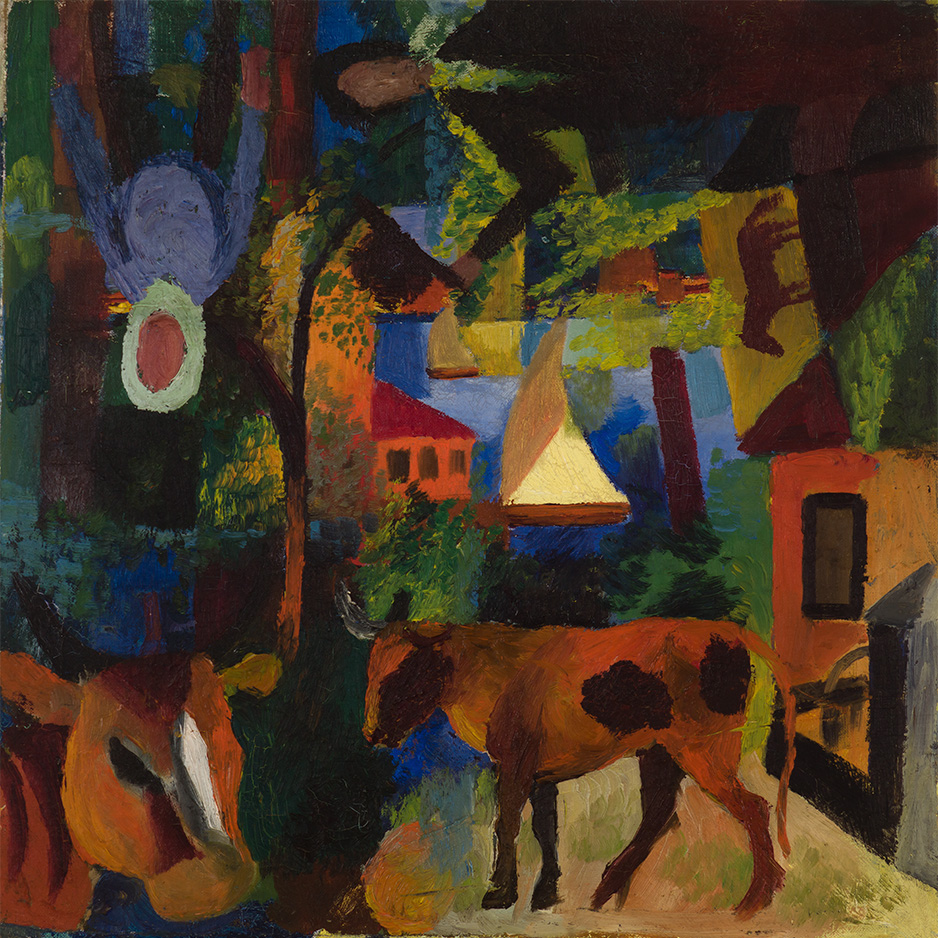
It is fair to question which orientation is right-side up or upside down with a painting like August Macke’s Landscape with Cows, Sailboat, and Painted-in Figures.
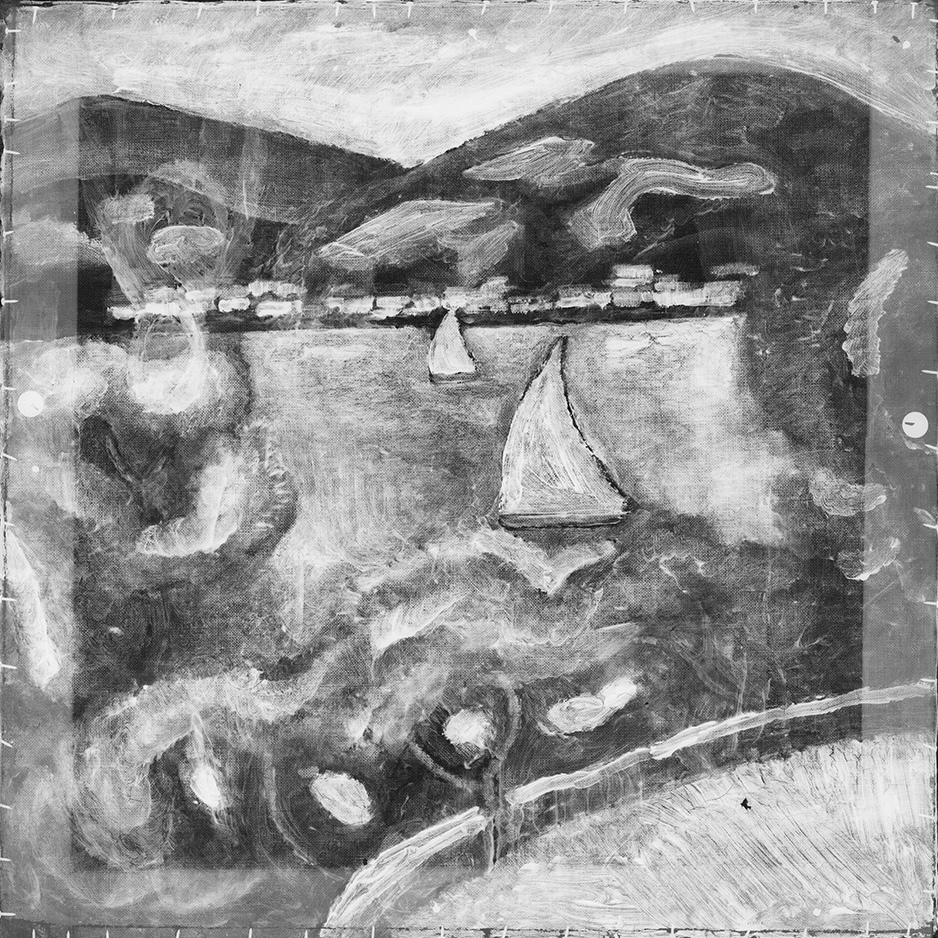
Technical analysis of the painting captured images of the turnover edges to reveal how the artist layered each scene. X-radiography revealed a more complete vision of the underlying lake scene—the base painting that still peaks through the center of the completed painting.
August Macke, German, 1887–1914; Landscape with Cows, Sailboat, and Painted-in Figures, 1914; oil on canvas; 20 1/4 x 20 1/4 inches; Saint Louis Art Museum, Bequest of Morton D. May 911:1983
Canvas Edges
The edges of the unframed Landscape with Cows, Sailboat, and Painted-in Figures provide more clues that it was constructed by layering multiple compositions.

Blue paints extending over the left edge does not include any brown from the cow’s head. The cow, therefore, was painted later, and the painting was not physically cut from a larger composition.

The top edge of the unframed painting predominantly shows Macke’s original white ground layer applied to the original linen canvas.

The right edge of Landscape with Cows, Sailboat, and Painted-in Figures contains remnants of both the sky and a yellow foreground color of an earlier, underlying composition.

When unframed, a strip of different paint colors is visible along the bottom of Landscape with Cows, Sailboat, and Painted-in Figures. The painting was likely expanded slightly during past reframing conservation campaigns, explaining why the composition now includes a portion of the bottom edge.
Raking light, cast from left
Light cast from a sharp side angle onto the surface of the painting reveals paint textures that differ from the final image. This is a primary clue that the brushwork of other compositions may be lying underneath.

X-radiograph
The X-radiograph of Landscape with Cows, Sailboat, and Painted-in Figures confirms that the sailboats in the center belong to an underlying lake scene. Underneath the later paint additions of rotated figures, buildings, and animals, is a fully rendered composition: a clear landscape with rolling mountains, a lake, a distant shoreside town, and boats sailing beyond a terrace in the foreground. Macke uniquely incorporated this underlying painting into his final composition.
Infrared
While carbon-rich pigments, such as lamp black, appear clearly in infrared reflectography, some pigments become transparent. This is the case for the browns in the upper right corner, where Macke’s application of mysterious shapes becomes more visible.

Specular light
Seen with specular light, the varied layers of opaque oil paint in Landscape with Cows, Sailboat, and Painted-in Figures appear naturally matte or glossy in different areas.

Ultraviolet-induced fluorescent (UVF)
Macke’s painting is in very good condition and that is evident under ultraviolet (UV) radiation, which often reveals added paint and materials from historic conservation work. The UV image also highlights the bright glow of zinc white mixed with yellow pigments.

Addtional Objects
View all objects in the technical imaging suite to reveal hidden details and examine underlying material layers.

-
Glossary
Back (Verso)
The back of a painting provides a wealth of information about its structure. Changes made to the canvas, such as visible repairs, reveal past damage or vulnerabilities. Markings, labels, and inscriptions often tell new stories of the painting’s past, including original titles, previous owners, and exhibition histories.
Raking Light
Raking light, directed from a side angle, casts surface textures into strong relief. This technique highlights details such as thick brushstrokes, canvas weave, or cracks in the paint layers.
Specular Light
Light cast directly onto the painting’s surface at a 90-degree angle highlights glossy or matte qualities. This technique helps determine if a varnish is present and quickly exposes variations of sheen in different paints.
Infrared Reflectography
Infrared reflectography (IRR) uses a specially adapted camera to detect infrared energy. When an image of a painting is captured using infrared light, some pigments appear transparent, which enables the viewer to see through overlying layers of paint. This technique often reveals hidden details, such as preparatory drawings by the artist or parts of the composition the artist painted over.
Ultraviolet Radiation
Ultraviolet (UV) light sources cause certain materials to absorb and re-emit colorful light, known as fluorescence. The fluorescence of some materials can identify certain pigments, such as zinc white, which produces a vibrant glow. Conservators can also detect previous treatments, which may appear dark purple.
X-radiography
X-radiography uses an X-ray source and sensitive film to produce an image of the painting’s composite layers. Materials transparent to X-rays appear dark in the images, while X-ray–absorbing materials like lead white and metal hardware appear white. Artist’s changes and, in some exciting instances, completely different, earlier compositions may be unveiled.