Normal light
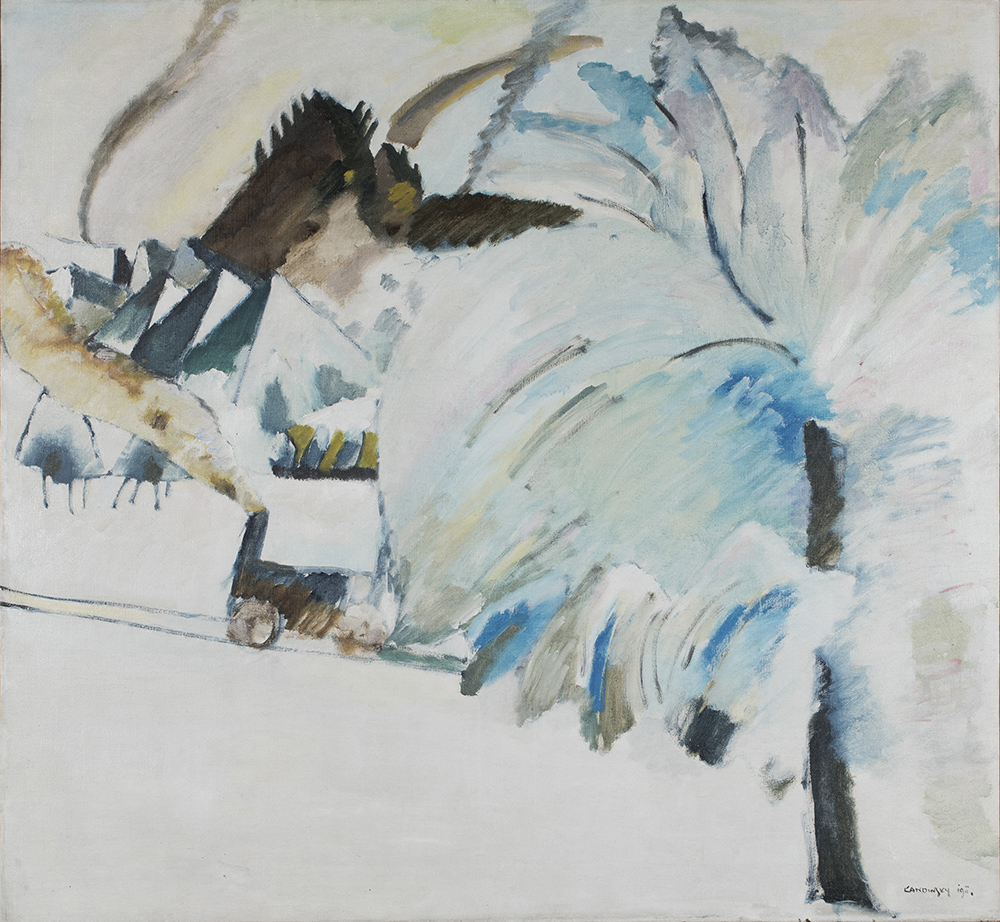
Murnau with Locomotive expresses a transitional moment when Vasily Kandinsky was developing a more abstract style—in this case, snowy white dominates a landscape with pops of translucent blues, purples, and browns.
Technical analysis of the painting shows that Kandinsky’s choice and handling of white paints, which at first impression appears simple, was deceptively complex. The same goes for his composition, which may give a false impression of spontaneity but was labored over.
Vasily Kandinsky, Russian (active Germany), 1866–1944; Murnau with Locomotive, 1911; oil on canvas; 37 3/4 x 41 1/8 inches; Saint Louis Art Museum, Bequest of Morton D. May by exchange 142:1986
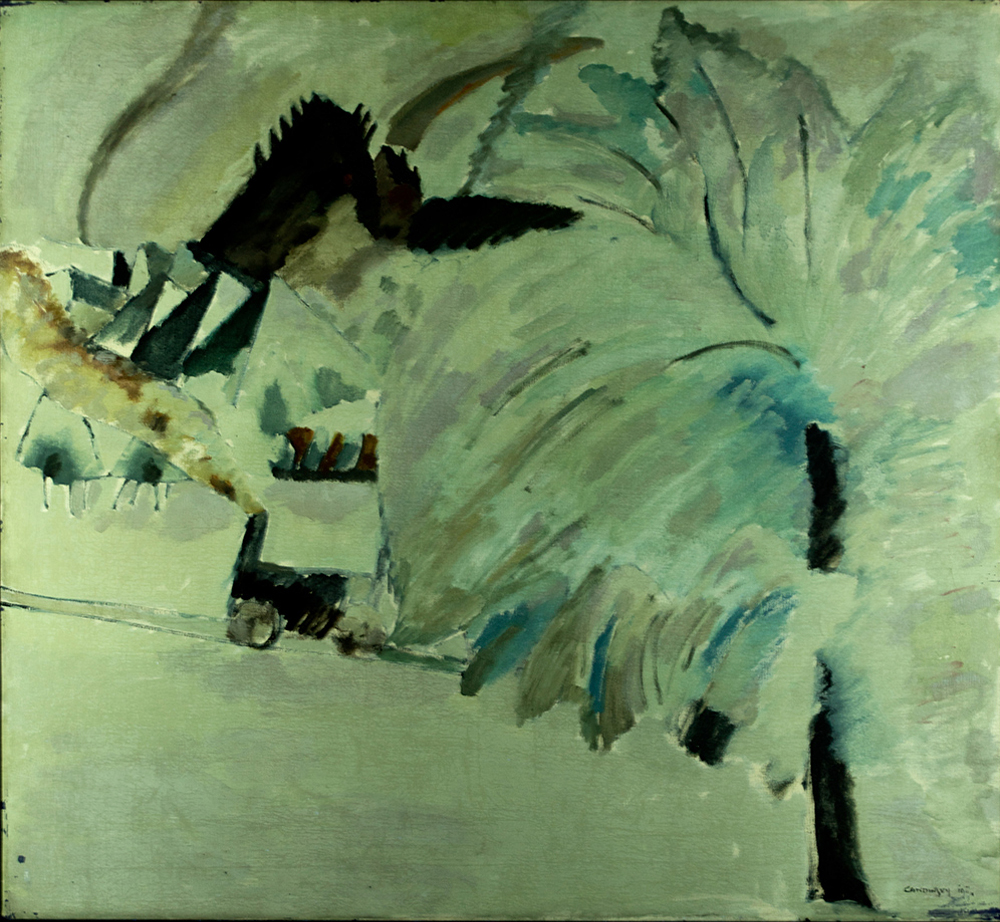
Ultraviolet-induced fluorescent (UVF)
Under ultraviolet (UV), the white paints fluoresce an incredibly diverse array of differing colors. Each variable color reveals a different mixture of lead- and zinc-white pigments plus oils or waxes—affecting the color and intensity of fluorescence visible in the UV image. Kandinsky also created his custom white paints by mixing in very small amounts of other pigments (reds, blues, yellows). The amount of added tinging pigments and oil/waxes are so small that differences between mixtures appear very subtle in visible light.
Annotated X-ray fluorescence (XRF) sample map
X-ray fluorescence (XRF) analysis revealed more about what pigments Kandinsky used in Murnau with Locomotive. The ultraviolet (UV) image provided a map identifying which areas to sample using a portable XRF device.
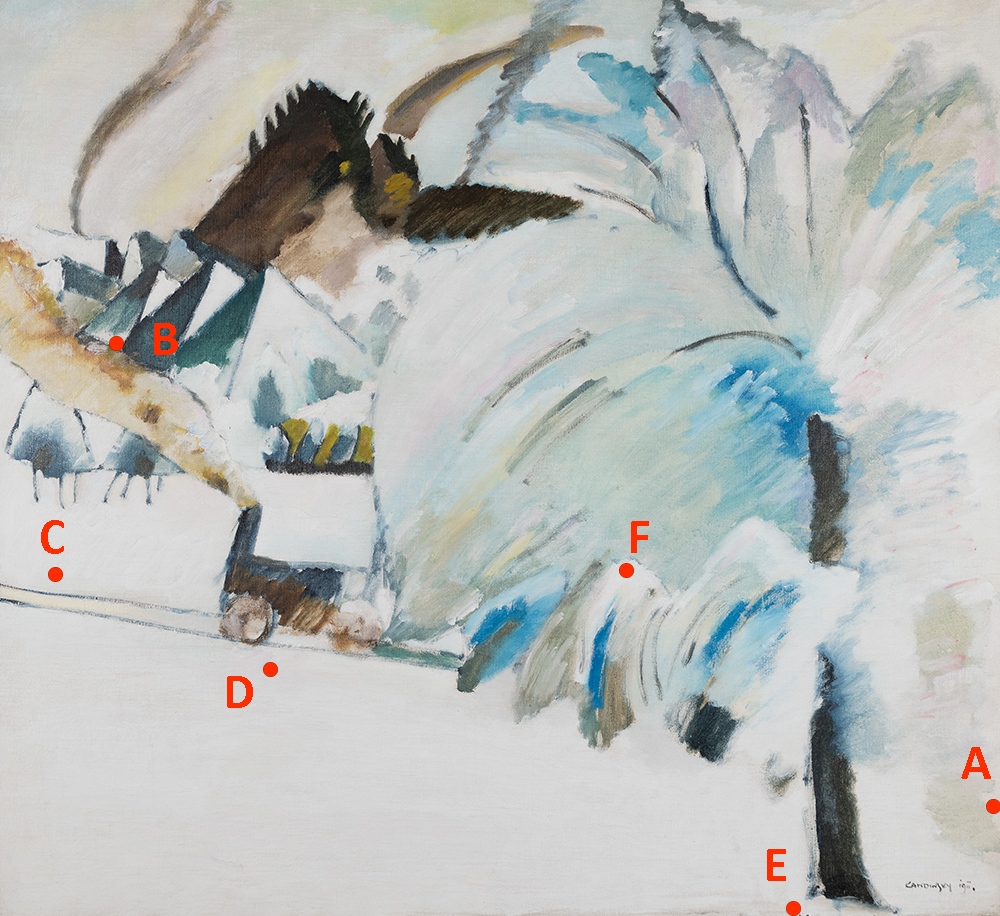
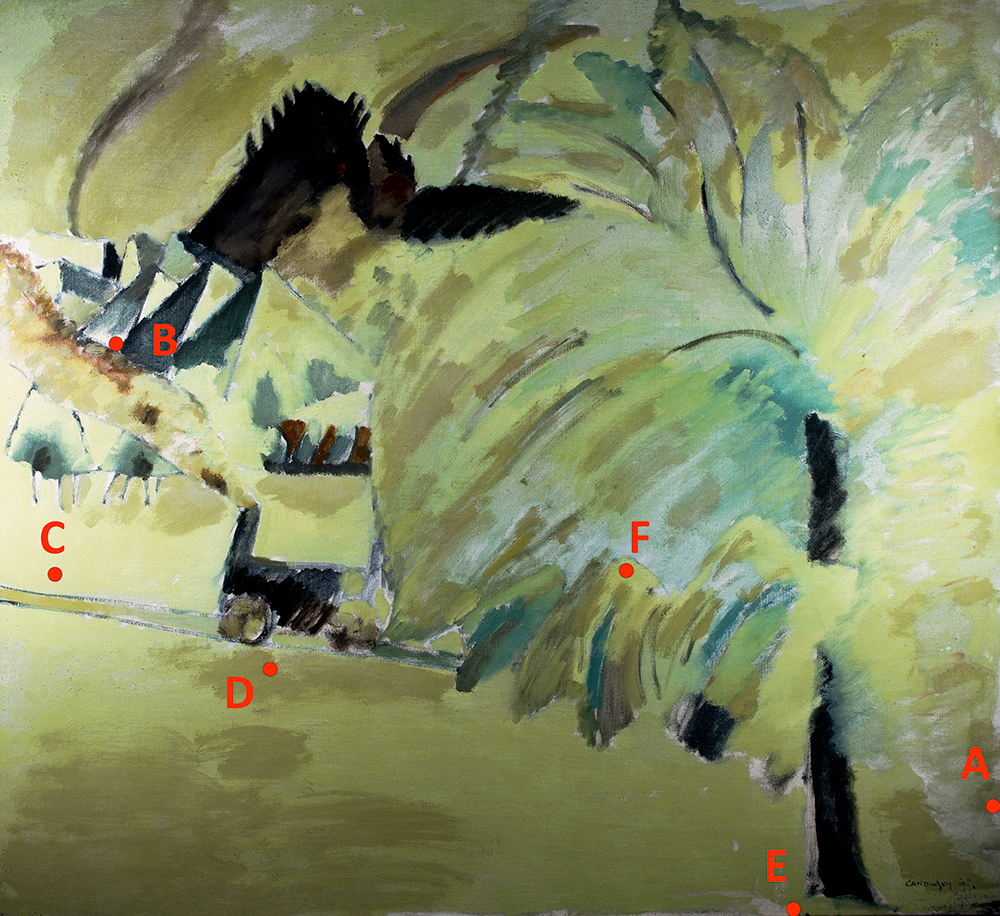
The paired techniques of UVF and XRF confirmed that the ground layer, visible throughout the composition, consists mostly of lead white.
Points A, B: These areas appear very white in visible light and present a subtle, pinkish-blue glow in the UV image.
Points C, F: Kandinsky applied his design layers and more colorful forms brushed on using browns, blacks, blues, purples, and yellows. In the uppermost paint layers, he applied the snowy whites using zinc white as a base, and pulled in different oils/waxes and pigments on his palette. Under UV, these zinc-based whites glow acidic yellow.
Points D, E: Color shifts to darker browns and greens in the UV image due to the small additions of blue, yellow, red, and black pigments.
Microscopic detail
In Murnau with Locomotive, the white ground layer and paint layers appear luminous through thin washes of color—almost as if they were painted using watercolor techniques. In certain areas, Kandinsky has thinned the paint with solvents and oils so that paint tendrils drip. The microscope captures a detail of the central sky where the smoke stack meets the top edge of the picture plane. The creamy white of the ground layer remains visible in the valleys flooded partially by a fluid gray-blue. Kandinsky then lightly swept his paintbrush over the top, capturing the crests of the canvas weave with a highlight of crisp, bright white.

Specular light
The unvarnished painting appears mostly matte, the colors muted in specular light. Looking closely, some of the white brushstrokes reflect a slightly glossier surface. Kandinsky often mixed in extra oils, for instance linseed or poppy, or waxes, such as beeswax, into his paints in order to play with the contrasts of shiny versus matte. He preferred not to varnish his paintings, allowing the juxtaposed sheen of the paints to create dynamic textures.

Raking light
Raking light reinforces how thinly Kandinsky painted Murnau with Locomotive. Apart from a few instances of thicker paint impasto articulating the locomotive’s steam and crests of tree branches, the weave of the canvas is visible through the thin paint layers.
Two distinct lines appear vertically in the center of the composition. These stress cracks in the paint mark where the painted canvas once pressed against the sharp edges of a central crossbar of the original stretcher. This subtle damage to the paint layers, likely due to slack tension in the canvas, may have inspired the replacement of the wooden stretcher in the 1950s.

Infrared
At first glance, there appears to be no visible underdrawing for Murnau with Locomotive. However, Kandinsky was known to have planned his compositions meticulously, using multiple drawings and watercolors to map out the design and coloring for a larger painting.
In negative spaces scattered throughout the composition, the white ground layer was left to peek around and through design elements. Applying this technique with a form as large and interwoven as the foreground tree would be an incredible feat without some planning.
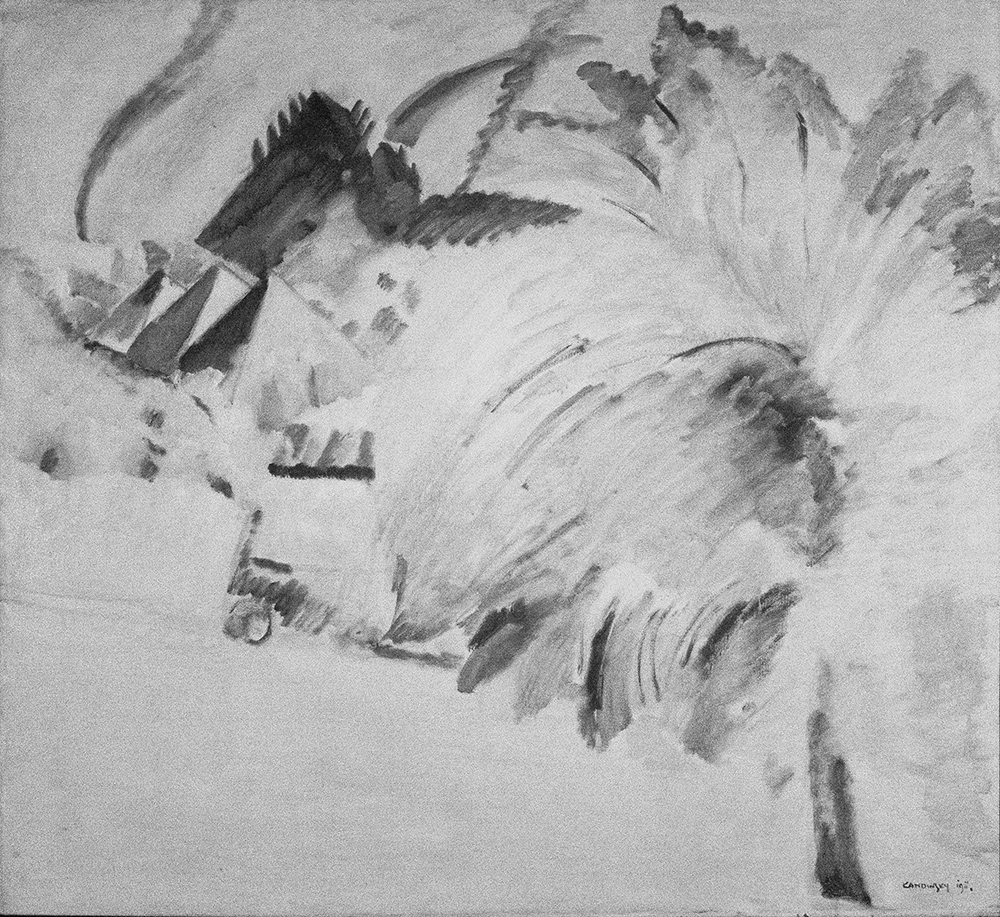
Faint lines made in a liquid medium or even with a soft-leaded pencil are sometimes hard to decipher, especially if outlines have been faithfully followed by overlapping paint. In the upper left, alternate lines mark slight adjustments made to the diagonals of the mountains. Additionally, Kandinsky defined many of the forms by using a fluid blue-black paint, likely Prussian blue with bone black. Prussian blue becomes transparent in infrared reflectography, further obscuring the underlying design.
Normal light, back of painting
The linen canvas of Murnau with Locomotive was adhered with wax-resin to another canvas in a 1957 conservation treatment. This secondary canvas, called a lining, was added to strengthen the deteriorating fibers of the original canvas and to improve planar tension. The lining is shown stretched over a replacement wooden stretcher equipped with aluminum corner plates and adjustable hardware for tensioning the canvases.

Additional Objects
View all objects in the technical imaging suite to reveal hidden details and examine underlying material layers.

-
Glossary
Back (Verso)
The back of a painting provides a wealth of information about its structure. Changes made to the canvas, such as visible repairs, reveal past damage or vulnerabilities. Markings, labels, and inscriptions often tell new stories of the painting’s past, including original titles, previous owners, and exhibition histories.
Raking Light
Raking light, directed from a side angle, casts surface textures into strong relief. This technique highlights details such as thick brushstrokes, canvas weave, or cracks in the paint layers.
Specular Light
Light cast directly onto the painting’s surface at a 90-degree angle highlights glossy or matte qualities. This technique helps determine if a varnish is present and quickly exposes variations of sheen in different paints.
Infrared Reflectography
Infrared reflectography (IRR) uses a specially adapted camera to detect infrared energy. When an image of a painting is captured using infrared light, some pigments appear transparent, which enables the viewer to see through overlying layers of paint. This technique often reveals hidden details, such as preparatory drawings by the artist or parts of the composition the artist painted over.
Ultraviolet Radiation
Ultraviolet (UV) light sources cause certain materials to absorb and re-emit colorful light, known as fluorescence. The fluorescence of some materials can identify certain pigments, such as zinc white, which produces a vibrant glow. Conservators can also detect previous treatments, which may appear dark purple.
X-radiography
X-radiography uses an X-ray source and sensitive film to produce an image of the painting’s composite layers. Materials transparent to X-rays appear dark in the images, while X-ray–absorbing materials like lead white and metal hardware appear white. Artist’s changes and, in some exciting instances, completely different, earlier compositions may be unveiled.