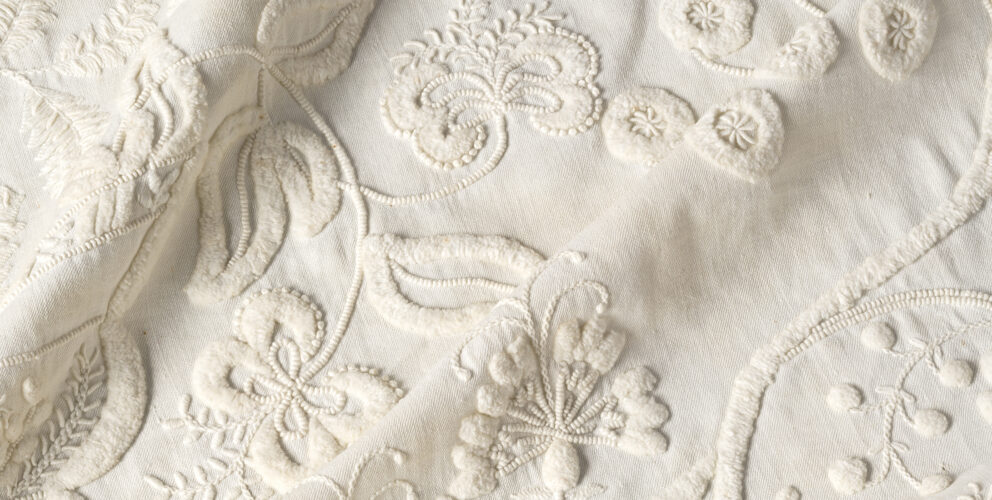
ST. LOUIS, Sept. 8, 2026—An upcoming free exhibition at the Saint Louis Art Museum presents 19th-century whitework textiles—characterized by embroidery done in white thread on white fabric—to reveal a tightly woven landscape of craft, labor and authorship.
“Quilts and Coverlets: American Needlework in White” features whitework bedcoverings from the museum’s collection, produced at the height of American neoclassicism from the early to mid-1800s, accompanied by ceramics, printed fabrics and needlework. The exhibition opens Oct. 2.
Whitework textiles find their roots in a rapidly globalizing 19th-century world. In the United States, they were produced primarily by white women who not only had ample time and superb technical skill, but who also enjoyed the means to carefully select and purchase lengths of pristine cotton cloth. At the same time, a trans-Atlantic textile trade boomed, and cotton became a lucrative crop in the Americas, driven by a swelling tide of enslaved African laborers arriving on American shores. By 1802, the United States was the most important supplier of cotton to England, which in turn produced massive quantities of finished cloth. Almost all of this fabric went back to America to be used in households, or to Africa to be used as payment for enslaved people.
“While white symbolized democracy and refinement for a young nation eager to form its identity, white objects also frequently represented racialized standards of beauty, purity and virtue,” said exhibition curator Sarah Berg, a research assistant for SLAM’s decorative arts and design department. “As such, whitework embodies a complex moment in America’s material history.”
At the center of this entanglement of exploitation and industry, whitework textiles became a canvas for the personal expression of educated American women. Their intricate needlework skills would have been learned from childhood. From rudimentary samplers to the finest stuffed-work quilts, textiles were often signed with the maker’s name, signifying pride in one’s work. Today, viewing such handmade items presents the opportunity to closely inspect each stitch and motif, and to consider what histories remain in embroidery done in white on white.
“Quilts and Coverlets” is on view through April 18, 2027, in Carolyn C. and William A. McDonnell Gallery 100.
CONTACT: Molly Morris, 314.655.5250, [email protected]

Join the press list
If you are a reporter, journalist or writer, please fill out the below form to receive updates from our press office on current and upcoming museum news.
-
Also on view in St. Louis in fall 2026
Contemporary Art Museum St. Louis
Ayana Evans: Nobody’s Gonna Love You the Way I Do, Sept. 10, 2026-Feb. 7, 2027
Great Rivers Biennial 2026: Vaughn Terrell Davis Jr., Lauren dela Roche, Vincent Stemmler, Sept. 10, 2026-Feb. 7, 20272026 Counterpublic Triennial
Coyote Time, Sept. 12-Dec. 12, 2026Laumeier Sculpture Park
Begin Again: 50 Years and Counting, through Dec. 13, 2026
Renata Cassiano Alvarez: Passage, through August 2027
Begin Again: Untitled, through Aug. 27, 2028
Begin Again: Wak’a Garden, though April 15, 2029Mildred Lane Kemper Art Museum
Buenos Aires Modern, 1935–1950, Sept. 9-Jan. 4, 2027
Carolina Caycedo: Growing Deep Roots, Sept. 9-Jan. 4, 2027Pulitzer Arts Foundation
Olga de Amaral: Weaving the Infinite, Sept. 10-Jan. 31, 2027