-
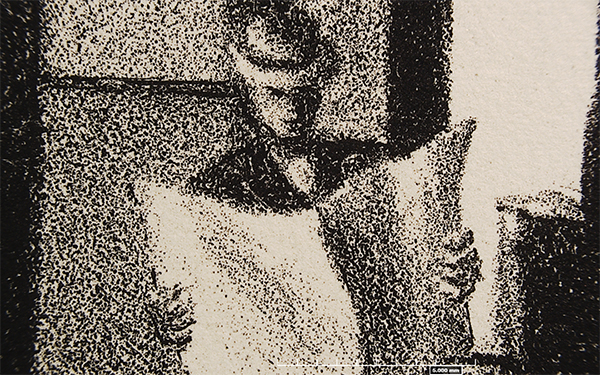
Gerardo Belfiore, American (born Italy), 1914–2002
Southbound More Information -
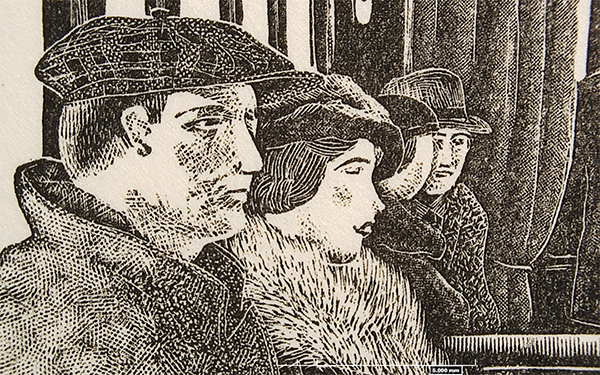
Salvatore Pinto, American (born Italy), 1905–1966
Trolley Car More Information -
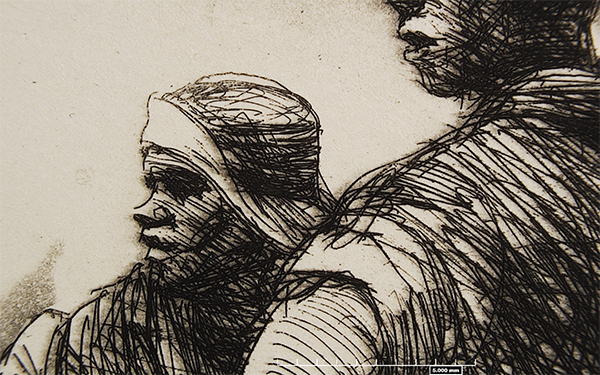
Dox Thrash, American, 1893–1965
Heave! More Information -
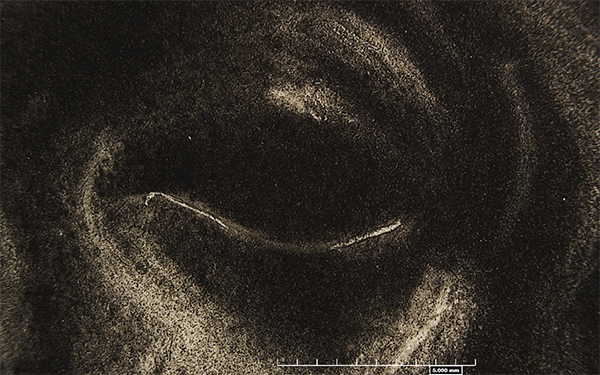
Dox Thrash, American, 1893–1965
Charlot More Information
-
Ambrotype
A unique work created from an underexposed photographic negative on glass that, when backed with an opaque coating such as black lacquer, appears as a positive image. Used in the mid-19th century, primarily for portraiture.
-
Aquatint
An etching method that produces areas of tone. Fine particles of an acid-resistant material—typically rosin or asphaltum—are distributed evenly over parts or all of a metal plate. The plate is heated to fix the particles to the plate. When the plate is submerged in acid, only the spaces between the particles are etched, thereby creating a constellation of indentations in the plate that will later hold the ink. Variations in the intensity and texture of the tone in the resulting print depend on the size and spacing of the particles. After etching the plate, the asphaltum or rosin grains are removed, and the plate is inked and printed, as in the intaglio process. In contemporary print shops, traditional aquatint is commonly used in combination with variations of the technique to achieve painterly effects or a greater range of tonal values. These techniques include spit bite, water lift, sugar lift, and soap ground.
-
Carborundum Mezzotint
An intaglio technique that uses a gritty substance called carborundum to roughen the entire surface of a metal plate, allowing it to hold ink. Areas are then burnished, or smoothed, to create lighter tones.
-
Chine Collé
A method of printing on a thin, delicate Chinese or Japanese paper backed by a layer of thicker paper. These finer papers are desirable for their smoothness and their capacity to retain more subtle details in the printed image. First, a sheet of thin paper is laid face down on an inked plate bearing the artist’s design. A water-soluble glue is then applied to the back surface of the paper. A dampened sheet of heavier paper is then laid over the adhesive surface. As all three are passed through the press, the image is printed on the thin paper, which simultaneously adheres to the thicker sheet.
-
Chromogenic Print (C-print)
A color photograph made from a color negative in which the print material has three layers of emulsion sensitized to the three primary colors. Dyes are added in the development process to form a single color image.
-
Collagraph
A process in which a textured printing surface is made by building a collage on a base—often cardboard or wood—and then sealing it with glue or varnish. The materials used for the collage may include artistic media or everyday objects. The resulting print matrix is inked, a sheet of paper is laid over it, and both are run through a press. Alternatively—as with relief processes—the image can be printed by hand-rubbing.
-
Drypoint
An intaglio process in which the artist uses a sharp stylus, called a drypoint needle, to scratch directly into a bare metal plate. As the needle scratches into the plate surface, the displaced metal residue collects along each side of the incised line. When not burnished away, this residue—the burr—holds extra ink, giving drypoint lines a rich, velvety appearance when printed. When the burr has been removed (or worn down from repeated printings), only the thin, shallow fissures remain, which print as fine lines. Drypoints are sometimes done on surfaces other than metal, with similar effects.
-
Etching
A form of intaglio printing that relies on acid to create the recessed lines in a metal plate. In the most basic form of the technique, the plate is first coated with an acid-resistant “ground” through which the artist draws lines with an etching needle, thereby exposing the bare plate beneath the ground. The plate is then submerged in a bath of acid, which “bites” or incises these lines into the plate. The ground is removed before the plate is inked and printed as in the intaglio process.
The range of visual effects that can be achieved using etching is virtually limitless. Variables include the type of ground (hard or soft); the strength of the acid and the length of time the plate is exposed to it; and the type of mark made on the plate—linear or tonal. When areas of the bare plate are exposed to acid, this is known as “open bite.” When inked, such areas will produce a light tone surrounded by a darker outline.
See also aquatint and photogravure.
-
Gelatin Silver Print
A photograph created from light sensitive silver salts suspended in a gelatin emulsion, resulting in neutral black tones and glossy surfaces. The most common black and white photographic process of the 20th century.
-
Inkjet Print
An image printed from a digital file using an inkjet printer. As the printer head moves back and forth across the paper, it deposits droplets of water-based dyes or pigments to make a pattern of dots. Most inkjet printers deposit droplets in the four subtractive primary colors: cyan, magenta, yellow, black.
-
Intaglio
From the Italian intagliare (to carve), this term applies to a range of techniques that includes etching, drypoint, aquatint, and photogravure. For all intaglio processes, printing ink is applied to a metal plate (traditionally copper), where it is held below the surface, within the parts that have been incised. Before printing, excess ink is wiped away from the plate surface, and a dampened sheet of paper is laid over it. Both are run through a high-pressure roller press, which extracts the ink from the crevices in the plate and onto the paper.
-
Lithography
A technique invented by the German actor and playwright Alois Senefelder in the 1790s that is based on the chemical principle that oily substances repel water. Using a greasy medium—such as a crayon or liquid tusche—the artist can draw directly on the surface of Bavarian limestone or, more recently, a plate made of zinc or aluminum. The drawn-on stone or plate is treated with a mixture of acid and gum arabic, which both sets the image and causes the remaining areas of the surface to attract water.
To print the image, water is sponged over the surface of the stone or plate and absorbed where the ink is not needed. Next, an oil-based ink is rolled across the entire surface. The watery areas resist the ink, which adheres only to those areas where the original drawing has been set. A sheet of paper is then placed over the stone or plate, and a scraper press applies even pressure to print the image.
-
Matrix (pl. matrices)
The surface from which an image is printed, typically a block, a plate, a stone, or a screen.
-
Monoprint
A print created from a matrix that carries an image, but in such a way that only one of its kind exists. An example might be an etched plate or carved woodblock incorporating unique hand additions or collage. The term can also refer to etchings that are inked and wiped in an expressive, not precisely repeatable manner; to prints made from a variety of printing elements that change from one impression to the next; or to prints that are painted or otherwise reworked by hand either before or after printing.
-
Monotype
A unique print created with a matrix that has not been physically or chemically altered. An image is drawn, painted, or transferred directly onto a plate, often made of metal, glass, or Plexiglas, which is then printed. Only the first printing will result in a strong impression because most of the ink will have been transferred to the paper. Further printings, called “ghosts,” may be used either as the basis for another monotype or for a work in a different medium.
-
Photogravure
An intaglio process in which the image is first photographically transferred to a metal plate and then etched with acid. The plate is coated with a layer of aquatint rosin and then covered with a light-sensitive gelatin. During exposure, the gelatin hardens in proportion to light: where the gelatin is harder, the plate will bite more slowly and thus print lighter; where the gelatin is softer, the plate will etch more deeply and print more darkly.
-
Photolithography
A variant of lithography in which the image is first photographically transferred to a light-sensitive plate or stone. Typically used in conjunction with an offset lithography press (photo offset lithography), it has been the most common commercial printing method since the 1970s.
-
Relief
A category of printmaking in which the image is printed from the raised surface of the matrix, rather than from the recessed areas. To make the print, the raised image is inked and printed, traditionally by applying vertical pressure, either with a press or by hand. Woodcut, wood engraving, and linocut are relief techniques.
-
Screenprinting
A technique that follows the basic principle of stenciling. First, a screen is made by stretching a fabric mesh over a frame. To create the image, the parts of the screen that do not print are blocked out with paper, glue, lacquer, or film; for photo-screenprinting, a light-sensitive gelatin coating may be applied and then exposed to create the stencil. To print the image, ink is forced across the screen with a rubber or vinyl blade, which presses ink through the open areas of the screen and onto the paper or other surface. Screenprinting is alternatively known as serigraphy or silkscreening, but today the mesh is more commonly made of synthetic materials rather than silk.
-
Woodcut
The oldest relief process. There are different approaches to designing, carving, and printing woodcuts. In the European tradition, a design is drawn on a block of wood and all non-printing areas are carved away using a gouge or a chisel. The image is usually printed with a press. The Japanese tradition of woodblock printing is similar in principle, but is characterized by hand-printing and the division of labor into clearly defined roles: an artist who designs the image, a carver who transfers the artist’s design and cuts the blocks—usually one for each color—and a master printer who ensures throughout that all blocks are properly aligned and registered. In contemporary printmaking, artists draw from both traditions.
-
Wood Engraving
A relief process that reached peak popularity in the 19th century. In contrast to a woodcut, which is carved on the softer side grain of a piece of wood, a wood engraving is carved into the harder and more durable end grain. Sharp, pointed engraving tools are used to cut fine lines that create very detailed compositions.