Andy Goldsworthy, English, born 1956;
Stone Sea, 2012; Missouri limestone;
courtyard: 12 feet x 73 feet x 20 feet; Saint
Louis Art Museum, Commissioned by the
Saint Louis Art Museum, Director’s
Discretionary Fund, and funds given by
Mr. and Mrs. Andrew C. Taylor, Paul M.
Arenberg Family, James G. and Catherine
B. Berges, Mr. and Mrs. F. Gilbert Bickel
III, Alison and John Ferring, Roxanne H.
Frank, Nancy and Kenneth Kranzberg, Mr.
and Mrs. John Peters MacCarthy, Pam and
Greg Trapp, Anabeth and John Weil, Mr.
and Mrs. Gary Wolff, an anonymous
donor, Mr. and Mrs. William C. Rusnack,
Mr. and Mrs. David C. Farrell, Jane S.
Shapleigh, Hope and Julian Edison,
Eleanor J. Moore, Terry Moore Shepley,
the Paul and Elissa Cahn Foundation, Mrs.
Barbara S. Eagleton, Marcia Jeanne Hart,
Bettie S. Johnson, Kodner Gallery, Jim and
Dorte Probstein, Emily Rauh Pulitzer,
Judge and Mrs. Charles A. Shaw, Susan
and David Sherman III, Mary Ann and
Andrew Srenco, the Third Wednesday
Group, Keith H. Williamson, Jerome F.
and Judith Weiss Levy, Helen Kornblum;
and gift of Paul and Elissa Cahn and
bequest of Guy A. Thompson, by
exchange 30:2012; © Andy Goldsworthy
2012, Courtesy Galerie Lelong & Co.,
Photography by Scott Smith
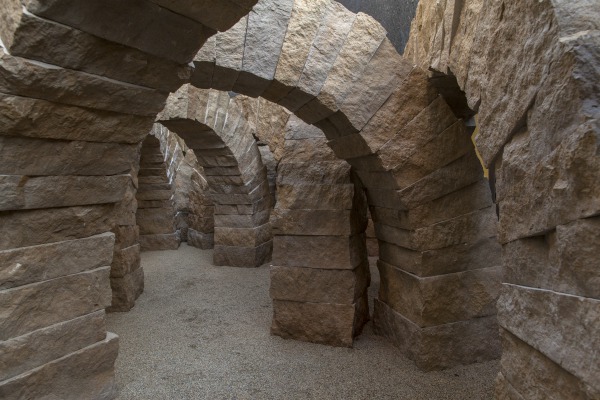
Sometimes artists use their artwork to explore the natural world, and sometimes they use nature as inspiration for innovative designs such as sculptures, installations, or other works of art. Installation art often is designed to occupy a specific room or place and referred to as site-specific. Many works of installation art surround you, like this example by Andy Goldsworthy, which the artist designed to fill an enclosed space located between the 1904 and 2013 buildings at the Saint Louis Art Museum.
Look closely at the image of this artwork.
Andy Goldsworthy, English, born 1956; Stone Sea, 2012; Missouri limestone; courtyard: 12 ft. x 73 ft. x 20 ft.; Saint Louis Art Museum, Commissioned by the Saint Louis Art Museum, Director’s Discretionary Fund, and funds given by Mr. and Mrs. Andrew C. Taylor, Paul M. Arenberg Family, James G. and Catherine B. Berges, Mr. and Mrs. F. Gilbert Bickel III, Alison and John Ferring, Roxanne H. Frank, Nancy and Kenneth Kranzberg, Mr. and Mrs. John Peters MacCarthy, Pam and Greg Trapp, Anabeth and John Weil, Mr. and Mrs. Gary Wolff, an anonymous donor, Mr. and Mrs. William C. Rusnack, Mr. and Mrs. David C. Farrell, Jane S. Shapleigh, Hope and Julian Edison, Eleanor J. Moore, Terry Moore Shepley, the Paul and Elissa Cahn Foundation, Mrs. Barbara S. Eagleton, Marcia Jeanne Hart, Bettie S. Johnson, Kodner Gallery, Jim and Dorte Probstein, Emily Rauh Pulitzer, Judge and Mrs. Charles A. Shaw, Susan and David Sherman III, Mary Ann and Andrew Srenco, the Third Wednesday Group, Keith H. Williamson, Jerome F. and Judith Weiss Levy, Helen Kornblum; and gift of Paul and Elissa Cahn and bequest of Guy A. Thompson, by exchange 30:2012; © Andy Goldsworthy 2012, Courtesy Galerie Lelong & Co., Photography by Scott Smith.
Imagine you were walking around inside this installation.
- What do you imagine it might feel like as you move around inside this space?
- What does this installation remind you of?
- What do you see that makes you say that?
Write a list of adjectives (descriptive words) that come to mind as you think about your experience.
Now use your words to build a word tower
Write the words on your page in the shape of a tower or tall building. Think about how you will use your words to build a strong tower. What words will you place at the bottom? What words will you place in the middle or at the top? What will help your tower stand strong and sturdy?
-
Did You Know?
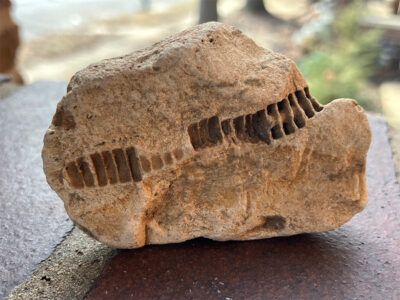
Image of a crinoid fossil in a piece of Missouri Limestone
The sculpture Stone Sea was made with limestone from Missouri. Limestone is a type of rock called sedimentary, which means that it is formed from materials such as sand, mud, pebbles, plants, and animal bones that are compressed, or squished together by the weight of other materials that pile on top of them or beside them over time. In prehistoric times, Missouri was covered in a shallow sea. The sea floor was made up of an underwater forest full of animals called crinoids. When crinoids died, their shells would fall to the bottom of the sea. Over time, the water receded, and plant, animal, and rock material piled up to create the limestone in Missouri. If you look closely, you can find imprints of shells from animals like crinoids in limestone rocks. You might also find crinoids in rocks near rivers and forests around many parts of Missouri.
Learn how Goldsworthy designed and built this sculpture
Click on each image to learn more about what is happening in the picture.
-
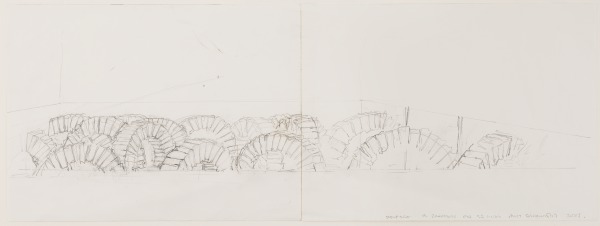
Sometimes, artists work together with other professionals, like engineers, to create their work of art. When Andy Goldsworthy created Stone Sea, he first began with a sketch. When do you like to draw or make sketches?
-
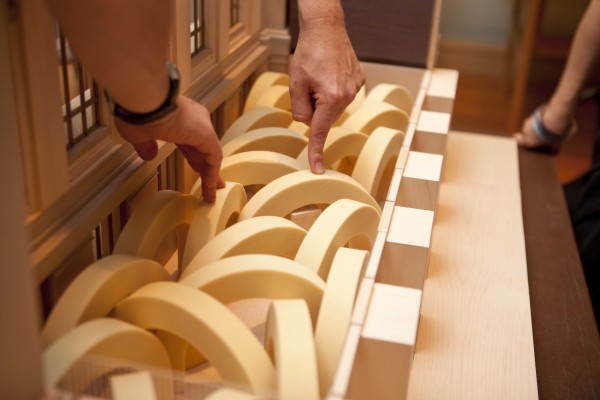
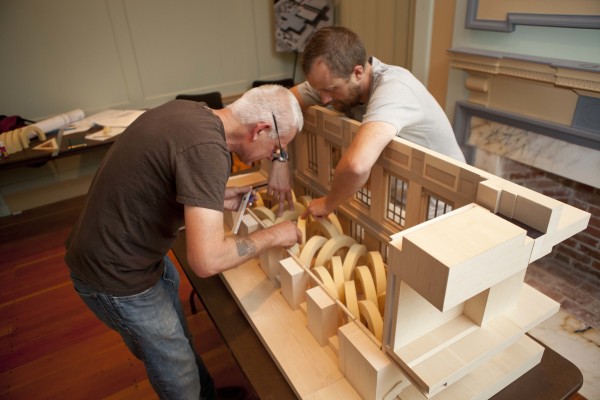
Goldsworthy then developed his idea; first by building models. In these images he is using rolls of tape, to simulate the arch design, and a wooden model of the space at the Museum where the sculpture would be installed. He then worked with a team of structural engineers to test the ability for the arch to stand up under different weather conditions or earthquakes.
-
What ideas have you tested before?
-
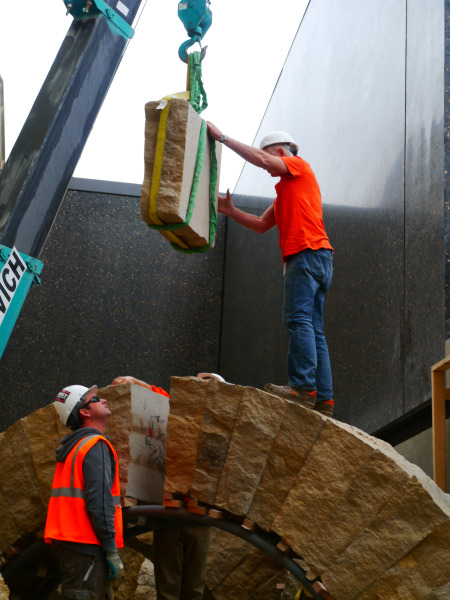
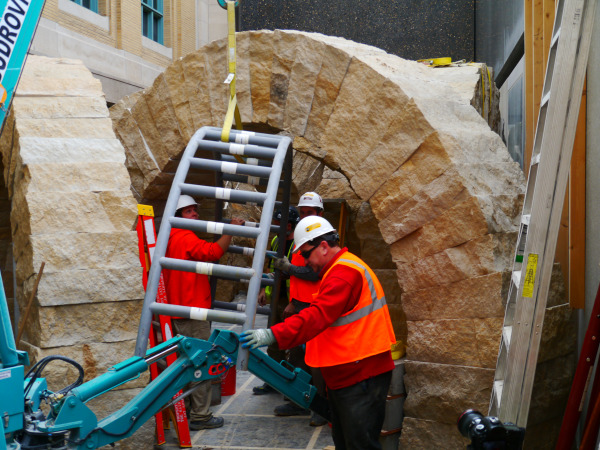
After Andy Goldsworthy and the engineers confirmed the strength of the design, he worked with curators and the art preparation and installation team at the Saint Louis Art Museum to build Stone Sea, which is a site-specific work of art—meaning that it was built specially for the space where it is located.
-
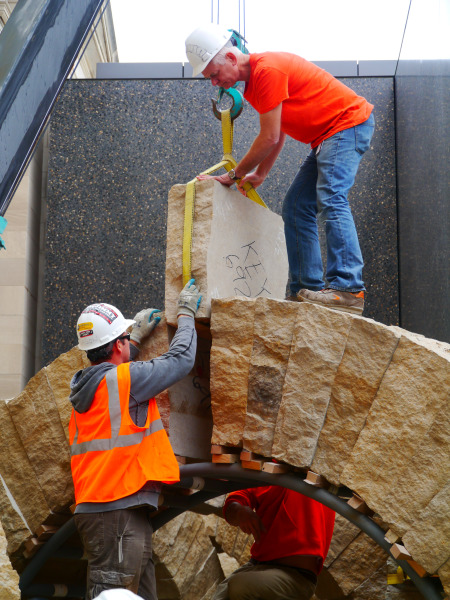
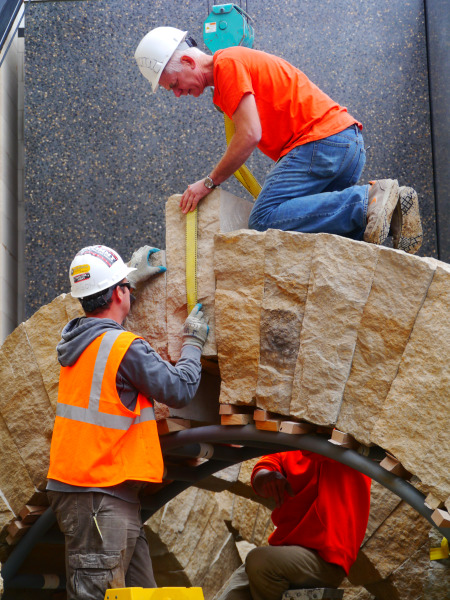
What are you curious about as you look at these images? What questions would you like to ask the artist Andy Goldsworthy? (He is the one standing on top of the arch guiding the large stone into position.)
-
Stone Sea is made up of 25 separate arches. The arches were constructed with Roman dry-stone engineering, which means the artist didn’t use any mortar, glue, or other materials to hold the stones together.
-
The stones are held together by pressure. At the top point of the arch, there is a key stone. It is the last stone builders place in the arch to lock the stones into position and enable the arch to bear its own weight.
-
View 1 more
If you were to build an arch from natural materials, what material would you use? What would you use to hold it together?
Compare Weight
Each arch in Stone Sea is 10 feet high. All of the arches together weigh 300 tons. An average female Asian elephant weighs about 3 tons.
How many elephants would you need to equal the weight of the sculpture?

Design Challenge
You have been commissioned to build a sculpture that people can walk through for a local art festival. The sculpture must meet all of the following criteria:
- Be made from materials found in nature
- Be at least 10 feet tall
- Be able to stand for at least one year through all types of weather
Draw a detailed design for your sculpture.
Consider the following questions when planning your design
- What materials will you use?
- What strategies will you use to hold it together?
- What tools or technology will you need to help you build your design?
- Whom can you collaborate with to help you build it?
- What will make it durable enough to withstand extreme weather conditions?
- What other questions can you come up with to help you develop your design?
Bring Your Idea to Life
Artists, designers, engineers, and scientists often make models of their designs before building them to full scale, to test out ideas. Build a small model of your design using materials you have available. (Andy Goldsworthy used rolls of tape for his model, a simple material that is readily available.)

Artist Andy Goldsworthy at Saint Louis Art Museum Tuesday, June 21, 2011. (Photo © Whitney Curtis)
Alternate Activity
Build a fort that you can get inside using materials that you have around you. Consider both design and function. Where will it be (indoors or outdoors)? How will your fort stand? What will support it? What will it look like? What will make people want to hang out in your fort? How long will it last?

-
Image Captions
Andy Goldsworthy, English, born 1956; Stone Sea, 2012; Missouri limestone; courtyard: 12 feet x 73 feet x 20 feet; Saint Louis Art Museum, Commissioned by the Saint Louis Art Museum, Director’s Discretionary Fund, and funds given by Mr. and Mrs. Andrew C. Taylor, Paul M. Arenberg Family, James G. and Catherine B. Berges, Mr. and Mrs. F. Gilbert Bickel III, Alison and John Ferring, Roxanne H. Frank, Nancy and Kenneth Kranzberg, Mr. and Mrs. John Peters MacCarthy, Pam and Greg Trapp, Anabeth and John Weil, Mr. and Mrs. Gary Wolff, an anonymous donor, Mr. and Mrs. William C. Rusnack, Mr. and Mrs. David C. Farrell, Jane S. Shapleigh, Hope and Julian Edison, Eleanor J. Moore, Terry Moore Shepley, the Paul and Elissa Cahn Foundation, Mrs. Barbara S. Eagleton, Marcia Jeanne Hart, Bettie S. Johnson, Kodner Gallery, Jim and Dorte Probstein, Emily Rauh Pulitzer, Judge and Mrs. Charles A. Shaw, Susan and David Sherman III, Mary Ann and Andrew Srenco, the Third Wednesday Group, Keith H. Williamson, Jerome F. and Judith Weiss Levy, Helen Kornblum; and gift of Paul and Elissa Cahn and bequest of Guy A. Thompson, by exchange 30:2012; © Andy Goldsworthy 2012, Courtesy Galerie Lelong & Co., Photography by Scott Smith.
Andy Goldsworthy, English, born 1956; Stone Sea: A Project for St. Louis, 2008; pencil on paper; sheet: 8 1/4 x 22 1/2 inches; Saint Louis Art Museum, Commissioned by the Saint Louis Art Museum 38:2013; © Andy Goldsworthy 2012, Courtesy Galerie Lelong & Co.
Goldsworthy with Model of his Sculpture
Artist Andy Goldsworthy at Saint Louis Art Museum Tuesday, June 21, 2011.
Installation of Stone Sea: Part V. Placing the Keystone
Andy Goldsworthy, English, born 1956; Stone Sea, 2012; Missouri limestone; courtyard: 12 feet x 73 feet x 20 feet; Saint Louis Art Museum, Commissioned by the Saint Louis Art Museum, Director’s Discretionary Fund, and funds given by Mr. and Mrs. Andrew C. Taylor, Paul M. Arenberg Family, James G. and Catherine B. Berges, Mr. and Mrs. F. Gilbert Bickel III, Alison and John Ferring, Roxanne H. Frank, Nancy and Kenneth Kranzberg, Mr. and Mrs. John Peters MacCarthy, Pam and Greg Trapp, Anabeth and John Weil, Mr. and Mrs. Gary Wolff, an anonymous donor, Mr. and Mrs. William C. Rusnack, Mr. and Mrs. David C. Farrell, Jane S. Shapleigh, Hope and Julian Edison, Eleanor J. Moore, Terry Moore Shepley, the Paul and Elissa Cahn Foundation, Mrs. Barbara S. Eagleton, Marcia Jeanne Hart, Bettie S. Johnson, Kodner Gallery, Jim and Dorte Probstein, Emily Rauh Pulitzer, Judge and Mrs. Charles A. Shaw, Susan and David Sherman III, Mary Ann and Andrew Srenco, the Third Wednesday Group, Keith H. Williamson, Jerome F. and Judith Weiss Levy, Helen Kornblum; and gift of Paul and Elissa Cahn and bequest of Guy A. Thompson, by exchange 30:2012; © Andy Goldsworthy 2012, Courtesy Galerie Lelong & Co., Photography by Scott Smith