Thousands of young Black students took free art classes at the LeMoyne Federal Art Center in Memphis, Tennessee, from 1938 to 1941. The center opened as the result of a cooperative effort among the Federal Art Project (FAP), what is now LeMoyne-Owen College, and Memphis’s African American communities. Between 1936 and 1943, the FAP opened 107 community arts centers across the United States, with the goal of placing art into the lives of everyday people. Some centers were integrated; the FAP supported others specifically to extend its outreach into African American communities.
In 1943, the FAP gave 39 paintings from the LeMoyne Federal Art Center to the Saint Louis Art Museum. They were intended to be used as examples for instruction at the People’s Art Center, an FAP-supported community art center in St. Louis. Fifteen of these paintings are included in the exhibition The Work of Art: The Federal Art Project, 1935–1943. This web page shares details of the artists’ biographies.
Joseph Percy Atkins Jr.
The sun bursts onto a valley, its golden light spilling onto houses, fields, and roads. Joseph Percy Atkins Jr. was 11 years old when he painted this exuberant landscape in 1938. During Joseph’s early childhood, the Atkins family lived in a house that they owned in a newly developed Memphis neighborhood. But his father—a World War I veteran and postal worker—was not in good health. In 1937, the family decided to rent out their own home to make money and move into a shotgun house in a less prosperous neighborhood. This new house, which perhaps appears in Joseph’s second painting, was located just a few blocks from the LeMoyne Federal Art Center.
Joseph proceeded to lead a life of purpose and service. At age 18, he enlisted in the Army Air Forces, where he rose to the rank of sergeant. He earned a bachelor’s degree from Wilberforce University and, later, a doctorate in education from the University of Tennessee. From 1952 to 1970, he taught in Memphis public schools. For the next two decades, he led the Louisville, Kentucky, public school system as assistant superintendent. A former colleague remembered that “his strongest attribute was that he put kids first,” especially as he oversaw plans for desegregating the school district.

Joseph Percy Atkins Jr., American, 1927–1999; Landscape, 1938; poster paint on brown paper; 13 1/2 x 18 inches; Saint Louis Art Museum, Gift of the Federal Works Agency, Work Projects Administration 365:1943
Jack Bell Jr.
Jack Bell Jr. painted a view of a house and a yard covered by a blanket of snow when he was 12 years old. He created surface textures with jagged, dashing lines suggesting the grain of a wooden fence or the feathery branches of foliage. This structure could have been his own home or perhaps one he encountered on the 1.5-mile walk to the LeMoyne Federal Art Center during the particularly cold and snowy winter of 1938. At this time, he lived with his sister and mother, who worked as a domestic servant for a private family. Jack registered for the draft at age 18 in 1944. By then, he worked for Mahaffey Brothers, a Memphis company that made hospital tents and ammunition bags during World War II. He had moved to St. Louis by 1950, when he was recorded on the census as living with his sister and brother-in-law, Kathryn and William Paschal, on Olive Street on the north edge of the Mill Creek Valley neighborhood. Jack worked as a busboy at a steakhouse. On November 26, 1989, he died in Fayetteville, North Carolina.

Jack Bell Jr., American, 1926–1989; Houses, 1938; poster paint on brown paper; 14 3/4 x 18 inches; Saint Louis Art Museum, Gift of the Federal Works Agency, Work Projects Administration 371:1943
Scott Bell Jr.
Scott Bell Jr. painted two scenes related to his lived experiences. In the first, a young man, accompanied by a black-and-white dog, proudly displays fish that he has caught. Scott excelled at the specific and sensitive depiction of facial features in what could be a self-portrait. In the second painting, a mule-drawn wagon loaded with cotton has backed up to a building labeled “Miss. Cotton Gin.” Pipes snake around the building, transporting unprocessed cotton inside, while the finished bales of cotton are stacked nearby. Scott undoubtedly drew this scene from his memories. Three generations of his father’s family had lived in Lexington and Yazoo County, Mississippi, where they worked in the cotton industry, first as enslaved laborers and then as sharecroppers.
Scott’s father had started to move north in the 1920s, settling first in Tunica, Mississippi, before moving to Memphis by at least 1935. His family’s home was located about three miles away from the LeMoyne Federal Art Center. By 1942, when Scott registered for the draft, he had moved to Chicago with his younger sister. He served in the US Army from 1943 until November 1945. Following his discharge, he returned to Chicago and worked as a laborer at an automobile manufacturer. He passed away in Los Angeles in 1984.

Scott Bell Jr., American, 1924–1984; Bin Fishin, 1938; poster paint on brown paper; 14 1/4 x 18 inches; Saint Louis Art Museum, Gift of the Federal Works Agency, Work Projects Administration 367:1943
Vivian Crowder
A pink dress, a yellow dress, and a pair of orange socks hang on a clothesline beneath an apple tree. It is wash day in Vivian Crowder’s home. In 1938, when she was 12, she lived with her mother, grandmother, aunt, and younger sister and brother in a house located about a mile from the LeMoyne Federal Art Center. Her mother worked as a “presser” at a clothing store, and her aunt worked as a domestic servant in a private home. Vivian was born in Chicago, though both of her parents were from Tennessee. They returned home shortly after her birth. Her father began working as a porter at the Methodist University Hospital, and by 1930, the family owned their own home on Marigold Street. Sadly, this stability did not survive the Great Depression. Her father passed away sometime between 1931 and 1938, and Vivian, along with her mother and younger siblings, moved into a succession of rented apartments. Sometime between 1950 and 1954, Vivian married Perry Clayton Jr. (1926–1973). He served in the US Navy during the Korean War before working as a driver for Herrin Transportation. They had eight children, who inscribed her tombstone with the phrase “You will be truly missed.”

Vivian Crowder, American, 1926–2019; Wash Day, 1938; poster paint on brown paper; 15 1/8 x 18 1/8 inches; Saint Louis Art Museum, Gift of the Federal Works Agency, Work Projects Administration 372:1943
Iona Ruby Farley
Brilliantly colored clouds float in a line above a row of buildings. They join together into a single, solid mass, linked by the repetition of their salmon-hued roofs. Some are large structures that lean into one another, while others are smaller and more discrete units, standing on their own. It’s tempting to speculate that Iona Farley, the artist of this scene, lived in one of these buildings or, at the least, that they were familiar sights in her Memphis neighborhood. In 1938, she lived on Louisa Street with her parents and siblings. But no such structures from the 1930s on her block, or streets nearby, have survived. In the early 1920s, her mother, Molly J. Williams, married her father, James Arthur Farley. They probably met in Memphis; she came from a smaller town to the north, and he came from Sardis, Mississippi, an hour to the south. He worked as a porter at William R. Moore Dry Goods, a prominent Memphis wholesale business, a job which he would hold for the next 30 years. By 1950, Iona had married Joe Taylor and moved to Detroit, Michigan, where she lived for the rest of her life.

Iona Ruby Farley, American, 1927–2013; Landscape, 1938; poster paint on brown paper; 12 7/8 x 18 3/8 inches; Saint Louis Art Museum, Gift of the Federal Works Agency, Work Projects Administration 373:1943
Robert Louis Franklin Jr.
Robert Louis Franklin Jr. created this dynamic scene of daily life in the Creative Children’s Class at the LeMoyne Federal Art Center. Seven students play and fight on their way home from school. Robert drew figures with confidence and assurance and used energetic lines and gestures to construct complex compositions. In 1939, he lived with his father, a US Post Office employee, and his stepmother in a house that they owned, less than a mile from the art center and just around the corner from classmates. By age 18, when he registered for the World War II draft, Robert lived in Atlanta, where he attended Morehouse College. He enlisted in the Army from 1951–1953 and attained the rank of sergeant while serving in Korea. Though his parents continue to live in Memphis until their deaths in the 1970s, Robert spent at least part of his life in Chicago and Elmwood, Illinois.

Robert Louis Franklin Jr., American, 1928–2005; After School, 1938; poster paint on brown paper; 18 x 23 5/8 inches; Saint Louis Art Museum, Gift of the Federal Works Agency, Work Projects Administration 400:1943
Mary Frances Gathings
In 1938, seven-year-old Mary Frances Gathings joined her older brother Richard in classes at the LeMoyne Federal Art Center. The two paintings she created there have possible autobiographical connections. In one, she painted a woman wearing a pink and orange dress, gold earrings, a blue-gray head wrap, and pink nail polish. She sits at a table, shelling peas or snapping beans, in front a vibrant purple background. Could this be Mary and Richard’s mother, Frances Shields Gathings (1902–1942)? Around this time, she worked as a domestic servant; very sadly, she passed away just a few years later from tuberculosis.
In the second painting, two children play in the yard of a substantial house. If the little girl on the left is Stella, Mary’s sister, younger by five years and the youngest child in their family, then the girl dressed in yellow at the right is probably a self-portrait. The two sisters remained close for their entire lives. When Stella was around age 20, she married Fred Usher and moved to Cleveland, Ohio. Mary lived in Memphis for the next 50 years, but she moved to Ohio to join her sister near the end of her life.

Mary Frances Gathings, American, 1931–1995; Woman Preparing Supper, 1938; poster paint on brown paper; 12 1/4 x 15 7/8 inches; Saint Louis Art Museum, Gift of the Federal Works Agency, Work Projects Administration 375:1943
Emmett Erskine Jones
In 2018, family members shared memories of Emmett Jones. They wrote: “Emmett was truly a Renaissance Man who loved to work with his hands as well as his intellect. There was seemingly nothing he couldn’t do and do well . . . He touched many lives with his kindness, generosity, public service, dignified charm, and good humor.” He had worked for 40 years for the California Department of Health as a research chemist and as the Assistant City Manager for Health and Human Services for the City of Berkeley. In the 1950s, he earned bachelor’s and master’s degrees in biochemistry and public health from UC Berkeley, following two years of service in the army, during which he worked in the Counter Intelligence Corps.
Emmett had attended LeMoyne Federal Art Center classes, where he created three paintings that offer a glimpse into his 10-year-old thoughts. He painted views of the art center itself, as well as a factory and a yard with felled trees. These early artistic experiences stuck with him throughout his life. As his family remembered: “He loved to build and re-finish furniture, tinker with cars, . . . cook gourmet meals, and serve fine wine. A lover of jazz music, Emmett was also an avid dancer who was always willing to display his moves! He was an outstandingly versatile and well-rounded person.”
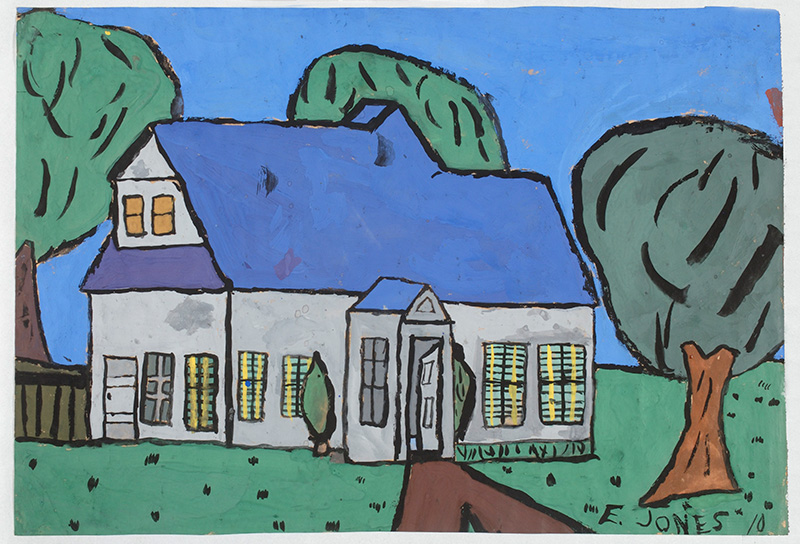
Emmett Erskine Jones, American, 1928–2018; The Art Center, 1938; poster paint on brown paper; 12 1/2 x 18 1/4 inches; Saint Louis Art Museum, Gift of the Federal Works Agency, Work Projects Administration 382:1943
Cornelia Massey
A child and dog look up in surprise as an airplane roars overhead. Aircraft were increasingly present in Cornelia Massey’s life in late summer 1938. Earlier that year, the Memphis Airport had built its first modern terminal to meet the demands for increased commercial passenger service, and Cornelia’s home lay along its flight path. Perhaps that home, located on Louisa Street, was one of the buildings that appear in Cornelia’s three paintings. She lived there with her six siblings, mother, and father, who worked as a laborer for the City WPA project in 1940 and for the Army Depot at the time of his death in 1957. In a wonderful bit of recordkeeping, Cornelia noted her age as 11 on the first two drawings and 12 on the third, suggesting that she might have painted them before and after her birthday on September 8.
In 1961, Cornelia married Joe Bland in Galveston, Texas. Originally from Mississippi, Joe had served in the US Army from 1943 to 1945 and worked as a carpenter. The rest of their lives were spent in Memphis. Cornelia (also known as Sue) passed away recently, at age 91, survived by a daughter, son-in-law, and granddaughter.

Cornelia Massey, American, 1926–2018; Boy Showing Dog Airplane, 1938; poster paint on brown paper; 12 x 18 inches; Saint Louis Art Museum, Gift of the Federal Works Agency, Work Projects Administration 386:1943
Mattie Lou Mitchell
Mattie Lou Mitchell is the most prolific artist among the group. She is represented by four paintings: ducks on a pond, a street scene, an expansive landscape, and a pared-down view of a field. In some of her works, she focused on specifics, such as drawing in close to examine the ducks. But Mattie gravitated more frequently toward generalities, using flat, solid blocks of color and simplified outlines to suggest the essential shape of foliage, water, and sky.
It’s possible that these views could have been inspired by memories of visiting her grandparents, who all were farmers in the Mississippi delta, three hours south of Memphis. Mattie’s parents had met and married in Coahoma, Mississippi, but had moved to Memphis by the time she was born. In 1938, she lived in a house close to the LeMoyne Federal Art Center with her parents and seven siblings. Her father worked as a truck driver for an ice delivery company. In 1942, at age 17, she married William J. Scott. They had a son the following year while living in Indiana. By 1950, she had divorced and moved back to Memphis, where she worked as a maid at the City Hospital Nurses Home. Sometime in the next two decades, she married John Thomas Cox. She sadly passed away at the young age of 48.

Mattie Lou Mitchell, American, 1925–1973; Two Ducks on a Pond, 1938; poster paint on brown paper; 12 5/8 x 18 1/4 inches; Saint Louis Art Museum, Gift of the Federal Works Agency, Work Projects Administration 390:1943
Harold Lloyd Neal
In an interview with the Detroit Free Press at age 65, Harold Neal connected his lifelong artistic practice to his experiences making art as a young boy: “When I drew as a small child, I received compliments which were reinforced by adults. You keep doing what gets you compliments from adults.” One can imagine the praise that the 13-year-old artist received for his sensitive depiction of a woman washing clothes or his bold, experimental color study of trees. Harold pursued a career as a professional artist in Detroit, where he had moved in 1947 following his US Army service. After studying painting and art education at the College for Creative Studies and Wayne State University, he took a job with the Michigan Bell Telephone Company. But he continued to paint, exhibit, and participate in the city’s art scene. In 1958, he cofounded the Contemporary Studio, one of the first Black-owned galleries in the Midwest. By the 1970s, Harold had become a professor of fine arts at the Wayne County Community College. Throughout his career, he painted works that spoke directly to African American experiences. In 1994, he explained to a reporter: “My work is a journal, an ongoing process, evolving as my experiences dictate. My struggle is black history.”

Harold Lloyd Neal, American, 1924–1996; Wash Day, 1938; poster paint on brown paper; 12 x 18 inches; Saint Louis Art Museum, Gift of the Federal Works Agency, Work Projects Administration 393:1943
Byron Gilbert Ragsdale
Byron Gilbert Ragsdale painted portraits of a small house and a neighborhood. Both appear to have been painted in autumn, with trees losing their leaves and smoke pouring out of a chimney. The single house may very well have been the home on Dunnavant Street, Memphis, where Byron lived with his parents and siblings through his childhood.
Following his graduation from Morehouse College in 1946, Byron attended Howard University Divinity School and became a pastor in the Baptist Church, like his father. He served first at churches in Humboldt, Tennessee, and Bristol, Virginia, before being called to become pastor at the Rogers Memorial Baptist Church in Knoxville, Tennessee. Byron was a prominent civic and religious leader during his years in this position, from 1961 until his retirement 30 years later. In 1968, he delivered hopeful words at a memorial service for Dr. Martin Luther King Jr.: “Today, let us affirm our faith and strengthen our hopes. His death has left a dark shadow over the minds of many. But the dawn of a new day has come of peace, equality, and dignity of man everywhere.”

Byron Gilbert Ragsdale, American, 1925–1996; Landscape with Trees, 1938; poster paint on brown paper; 12 x 18 inches; Saint Louis Art Museum, Gift of the Federal Works Agency, Work Projects Administration 399:1943
Walter Ellis Ragsdale Jr.
Walter Ellis Ragsdale Jr. was the older brother of Byron Ragsdale. The siblings took art classes together at LeMoyne, where they both painted views of a neighborhood dotted with compact buildings, large trees, a tidy fence, and a wide expanse of lawn bisected by a path or road. The strong similarities between their paintings suggest that this piece of land was an actual location rather than an imagined arrangement. But the buildings don’t resemble the Ragsdales’ home in a Memphis neighborhood, and the brown building at the end of the road looks like a barn, with large double doors. The brothers’ grandfathers and great-grandfathers had worked as farmers in Mississippi and Louisiana before moving to Memphis in the 1910s. Did they travel back to these locations to visit relatives? Or might this place be closer to Memphis and connected in some way to Walter’s painting of a truck piled high with melons, set off against a gray-blue road and flaming orange sky?
In 1942, when Walter registered for the World War II draft, he was unemployed. Nearly 10 years later, when he married Lillie Williams, he was working as a porter for First National Bank. Alongside their three children, eight grandchildren, and eight great-grandchildren, Walter and Lillie celebrated their 60th wedding anniversary shortly before his death in 2011.

Walter Ellis Ragsdale Jr., American, 1924–2011; Watermelon Truck, 1939; poster paint on brown paper; 12 1/4 x 18 1/4 inches; Saint Louis Art Museum, Gift of the Federal Works Agency, Work Projects Administration 398:1943
Weldon Sugarmon
Weldon Sugarmon was born in Gunnison, Mississippi, where her father, Russell Bertram Sugarmon, worked as a plantation store bookkeeper. At age three, her family moved to Memphis, where her father worked first as an insurance salesman and then as a real estate agent. She first attended Talladega College in Alabama before transferring to Boston University and majoring in public health administration. She studied guidance counseling at Northwestern University, before moving to St. Louis, where she taught at Washington Technical High School for two semesters. In 1946, she married Dr. Sidney Smith, who served the director of the dermatology clinic at Homer G. Phillips Hospital and also practiced at St. Mary’s Medical Center in Richmond Heights and Bethesda General Hospital in south St. Louis. Called “Sugar” by family and friends, Weldon fought for social equality and legal justice through civic volunteerism and served on the boards of Stowe Teachers College, the Urban League of St. Louis, and the Metropolitan YWCA, while raising three sons.
Before Weldon’s recent passing, the Museum was fortunate to welcome her and her son Barry Smith to view her painting on display in 2021. HEC-TV was on hand to record their visit and produced a feature about the rediscovery of Aquarium.

Weldon Sugarmon, American, 1924–2023; Aquarium, 1938; poster paint on brown paper; 11 3/4 x 19 1/4 inches; Saint Louis Art Museum, Gift of the Federal Works Agency, Work Projects Administration 401:1943
Earnest Yarbrough
Earnest Yarbrough’s childhood had been marked by frequent moves. His parents were originally from Arkansas but had lived in Tunica, Mississippi in the 1910s, where his father worked as a farmer. By the time of Earnest’s birth in 1923, they had settled in Buffalo, New York, where his father worked as a building laborer. By 1930, the family had moved to Gary, Indiana, perhaps in order for his father to take a job as a laborer at a steel mill. By 1937, Earnest’s family had moved to Memphis and by 1940, his father had passed away.
Between 1937 and 1942, Earnest and his mother lived near the LeMoyne Federal Art Center. Around this same time, he also participated in another New Deal program sponsored by the WPA, working as a porter for the National Youth Administration—an agency designed to provide work and education for Americans between the ages of 16 and 25. In February 1942, Earnest followed his family’s tradition of military service by enlisting in the US Navy. His father had served in the 816th Pioneer Infantry of the US Army, which was posted to France from October 1918 to August 1919. Earnest first served from 1942 to 1945 and then re-enlisted from 1948 to 1964. In 1980, he passed away in Pineland, South Carolina.

Earnest Yarbrough, American, 1923–1980; White Horse, 1938; poster paint on brown paper; 12 1/8 x 18 1/2 inches; Saint Louis Art Museum, Gift of the Federal Works Agency, Work Projects Administration 403:1943
Feedback
We would be grateful to hear from you if you have any additional information to share about the artists or would like to propose any corrections.