Installation view of Storm of Progress: German Art After 1800 from the Saint Louis Art Museum
This audio guide includes a general introduction and 16 commentaries on the Saint Louis Art Museum’s collection of German art. For the first time, eight narrators from the Museum examine a full range of modern and contemporary art from 1800 to the early 2000s.
-
Access and Assistance
Free Public Wi-Fi
The Saint Louis Art Museum offers free Wi-Fi to visitors. From your device, access the SLAM_GUEST network.
Large Print Labels
Large-print labels are available on your own device and upon request at the Taylor Hall Welcome Desk.
AUDIO GUIDE TRANSCRIPT
The audio guide transcript is available to view on your own device.
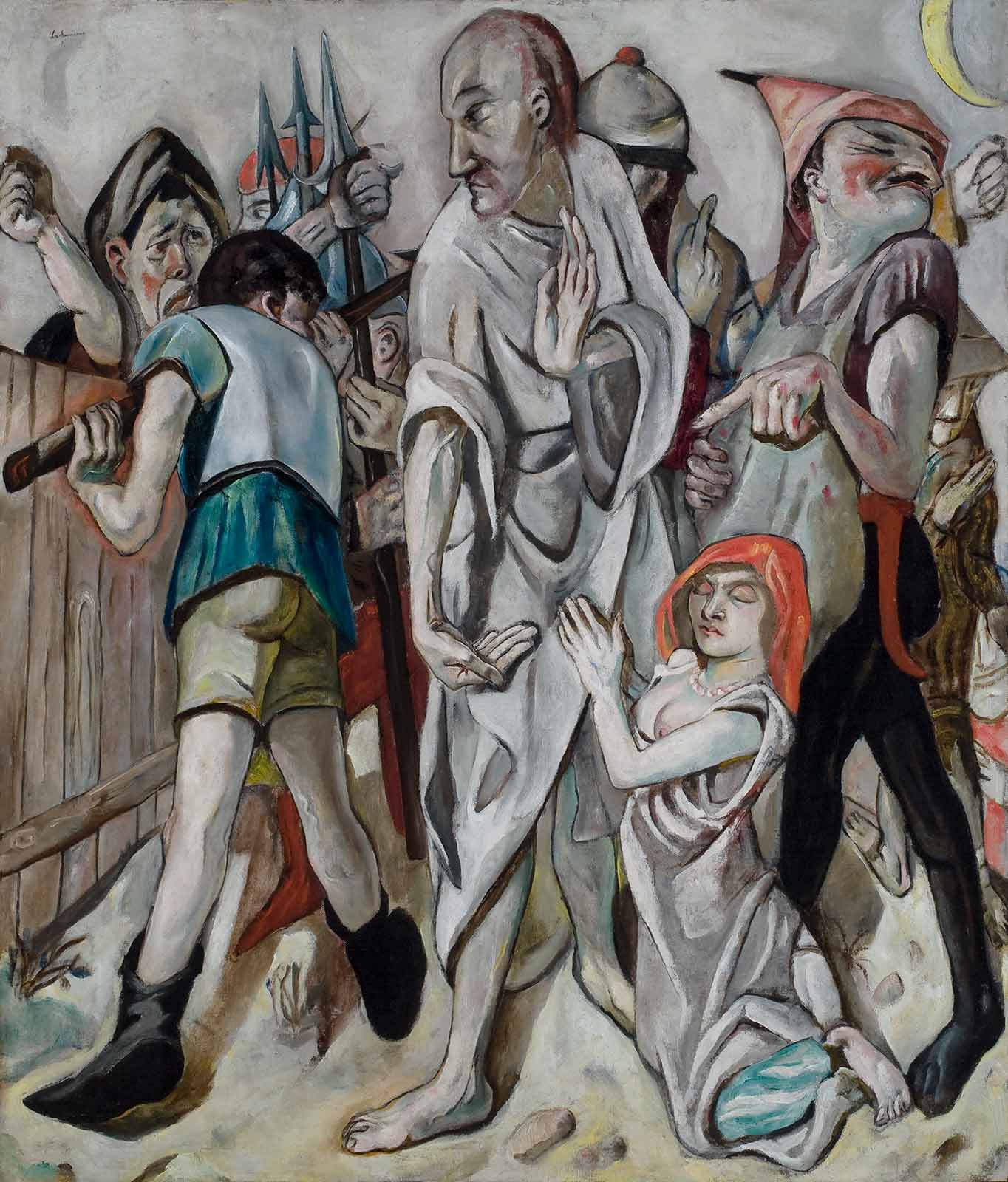
Christ and the Sinner, 1917
Max Beckmann
- Transcript
Speaker: Melissa Venator
Andrew W. Mellon Foundation Fellow for Modern Art
Saint Louis Art MuseumThis is a painting titled Christ and the Sinner, made in 1917 by Max Beckmann. It shows a passage from the Gospel of John from the New Testament of the Christian Bible. In the passage Jesus is asked to determine the fate of a woman accused of adultery. The law called for her to be stoned to death, but Jesus responded, “He that is without sin among you, let him first cast a stone at her,” the source of the familiar expression, “let him who is without sin cast the first stone.” It’s interpreted as a lesson in the virtue of forgiveness and a warning against hypocrisy. After all, are any of us so good that we can judge the action of others?
Beckmann often depicted scenes from the Bible, but he wasn’t a particularly religious man. For him, biblical stories represented universal themes, like the idea of forgiveness, easily understood by the average German. And that’s an important point to remember. In the German census of 1910, over 98 percent of Germans identified as Christian, either Protestant or Catholic. They would be familiar enough with Bible stories to identify the subject of this painting from the figures alone, and they would also know its moral lesson.
But while Beckmann refers to the biblical account, he also departs from it. Jesus stands at the center in a white robe, but Beckmann shows him beardless and bald, looking, in fact, very much like Beckmann himself. The woman at his feet is the woman accused of adultery, kneeling in prayer and thanking Jesus for his intercession. The other figures are harder to identify. One may be a soldier, another in tights and a red pointed hat and apron is a complete mystery. And they all make bizarre hand gestures. These are puzzles with no clear answers, which leave us with unresolved curiosity, a response I regularly have to Beckmann’s art.
As we try to understand Christ and the Sinner, its date helps a lot: 1917, the middle of World War I. By then Beckmann’s war was already over. He volunteered as a medical orderly in early 1915 and spent a year in occupied Belgium caring for wounded soldiers. In a letter home, he described how the wounded men reminded him of the sufferings of Jesus, likely the only example of a heavily wounded man he had ever encountered in his life before the war.
Beckmann’s constant exposure to pain and death led to a breakdown and discharge on medical grounds. While recuperating he began to paint large biblical scenes in a new angular and more abstract style, paintings including Christ and the Sinner. For Germans in the midst of war, not just Beckmann, the Bible’s apocalyptic narrative seemed a wholly appropriate metaphor for the large-scale human loss and environmental devastation.
- Gallery Text
Max Beckmann
German, 1884–1950Christ and the Sinner, 1917
oil on canvasIn this unconventional depiction, Jesus stops an angry mob from stoning a woman to death. The biblical story’s message of non-violence expresses Max Beckmann’s pacifism after his wartime service. Beckmann volunteered as a medical orderly during the war, but constant exposure to dead and dying soldiers traumatized him. This is one of the first paintings he made after his discharge in 1917.
Twenty years later, Christ and the Sinner appeared in the infamous Entartete Kunst (Degenerate Art) show, a propaganda exhibition organized by the Nazi government to indoctrinate Germans against Expressionist and abstract art.
Bequest of Curt Valentin 185:1955
Industry as Art
Industrialization in Germany advanced with breathtaking speed after 1900. Germany produced more steel than any other European nation, and its high-quality manufactured goods flooded markets. A major factor in Germany’s transformation was its trade schools, where students learned to approach industry with scientific precision.As German engineers elevated industry to an art form, artists explored industrial subjects and materials. Students at the Bauhaus school of art, architecture, and design used glass and tubular steel to make furniture and household goods that imitated the streamlined style of machine-made products. Photography was celebrated as the epitome of mechanical art, and photographers turned to factories and machines as fitting subjects.
Industry drove Germany’s economic recovery after World War I (1914–1918), but it soon showed a dark side. Leading companies supported the rise of the Nazi (National Socialist) party and, in return, profited from Nazi government contracts and protections.
Credits
Max Beckmann, German, 1884–1950; Christ and the Sinner, 1917; oil on canvas; 58 3/4 x 49 7/8 inches; Saint Louis Art Museum, Bequest of Curt Valentin 185:1955; © 2020 Artists Rights Society (ARS), New York, NY / VG Bild-Kunst, Bonn