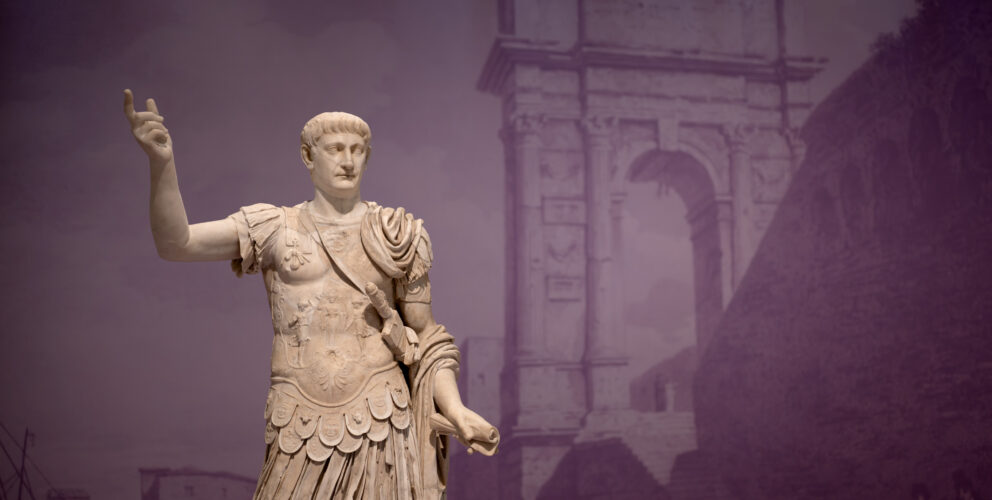
Visitors can use all their senses to explore the latest ticketed exhibition, Ancient Splendor: Roman Art in the Time of Trajan.

In ancient Rome, pleasure that was derived from sensory experiences wasn’t just an indulgence; it was tied to power, identity, and purpose. The Roman Empire was at its height under the emperor Trajan, and sensory experience was woven into the fabric of society, from elite banquets to ornate public spaces. Experiencing life fully through sight, sound, taste, touch, and smell was part of what it meant to live well and fully.
The current ticketed exhibition at the Saint Louis Art Museum, Ancient Splendor: Roman Art in the Time of Trajan, offers an experience for all the senses, reflecting this theme from antiquity. Through August 16, visitors can see majestic marble sculptures, vivid frescoes, and other works chronicling life during Trajan’s reign, but they can also smell, touch, and hear elements reminiscent of this moment in history. We’ve rounded up some locations throughout the exhibition where you can engage all your senses to experience ancient Rome.
Smell
Visit scent boxes throughout the exhibition to experience the smells of ancient Rome, developed by Alexy Karenowska, director of technology at the Institute for Digital Archaeology in Oxford, England. Under one lid, you can smell how the Apollo statue might have been perfumed in ancient times. Rose petals were mixed with oils and pressed by a perfumer with honey on their hands to create a thick balm that could be applied to the surface of sculptures.
Under another lid, catch a whiff of garum, a fermented fish sauce made from salting fish intestines. Garum was once dubbed an “exquisite liquid . . . so pleasant it can be drunk!” by ancient Roman author Pliny the Elder. Two other boxes include a scent emulating air from the Roman seaside with a distinct mix of salty air, warm sand, and sweat; and a box evoking the type of perfume that elite Roman women preferred, with luxury ingredients including frankincense and musk.

A scent box in the Ancient Splendor: Roman Art in the Time of Trajan exhibition.
Touch
While visitors can’t touch the ancient artworks on display, there is an opportunity to interact with different parts of the exhibition. Stop by a life-size, 3D-printed scene from Trajan’s Column, and use your hands to explore the narrative spiral frieze of figures.

3D-printed scene from Trajan’s Column as seen in Ancient Splendor: Roman Art in the Time of Trajan.
In another part of the exhibition, you can scroll through an interactive screen with information about coins from the Roman Empire, many of which are from SLAM’s collection. The silver and gold coins represent different family members of Trajan including Plotina, Trajan’s wife and adoptive mother of his successor, Hadrian.

Visitors can explore an interactive showing ancient coins in the Ancient Splendor: Roman Art in the Time of Trajan exhibition.
Hearing
Don’t forget to listen to the soundscape in Ancient Splendor, created by musician Chris Cundy. Ancient Roman baths are brought to life through field recordings made at the Roman Baths, part of the UNESCO World Heritage Site in Bath, England. The work uses a combination of hydrophones and ambient microphones to follow a subterranean journey from the source of a geothermal hot spring, dedicated to ancient-Roman times.
“Increasingly, I’ve been incorporating field recordings into my work, and particularly I’m interested in observations of the world which contain vibrations and frequencies of place, of landscape, and time,” Cundy said in a recent lecture at SLAM. “And I’m using them to reflect on collective experiences . . . especially when it comes to engaging with objects from antiquity and how these things are interpreted or represented in the museum context.”
The complex sounds in Cundy’s soundscape blend meteorological activity, contemporary infrastructure, and spectral frequencies from around the source site. As you listen to the quiet, contemplative sounds, you might even feel like you’re enjoying a moment of otium, or leisure, in baths of ancient times.

Visit a soundscape with sounds reminiscent of ancient Roman baths.
Sight
Among the many works you can see in the exhibition—all of which are a feast for the eyes—make sure not to miss the frescoes, including Seascape with a Boat and Marine Animals. This painted work on plaster dating from 123–150 CE features a detailed maritime scene with two caudicariae boats, which were used in ancient times to transport merchandise. The boats and sea life pictured symbolized wealth, connection, and thriving trade in ancient times.

Seascape with a Boat and Marine Animals, 123–150 CE; Roman, Imperial period; painted plasterwork; 44 1/8 x 91 5/16 x 9 13/16 inches; The National Roman Museum, 121460A da pietra papa 2026.149
Elsewhere in the exhibition, check out the reliefs, or sculptures where figures are carved into a flat surface rather than standing on their own like statues. Reliefs were one of the Romans’ favorite ways to tell stories and celebrate victories. One marble relief in the exhibition, Funerary Relief with the Circus Maximus, dates from the beginning of the 2nd century CE and depicts a quadriga, or four-horse chariot. Quadriga charioteers in ancient times were like modern-day race car drivers, famous for competing in dangerous, high-speed races with multiple laps.

Funerary Relief with the Circus Maximus, beginning of the 2nd century CE; Roman, Imperial period; marble; 22 1/2 x 41 1/4 x 6 1/2 inches; Vatican Museums, Gregoriano Profano Museum, Vatican City, 9556 2026.11