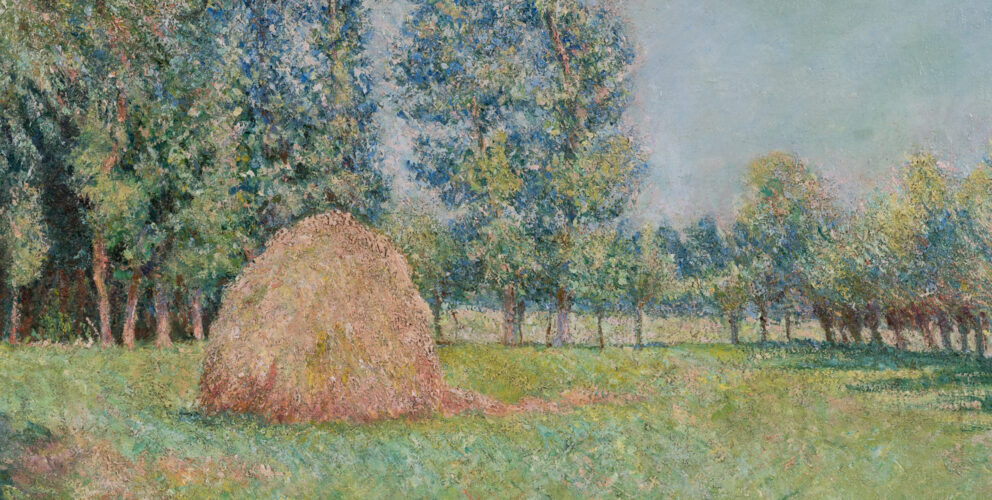
Berthe Morisot, French, 1841–1895; The Lilacs of Maurecourt(detail), 1874, oil on canvas; 19 11/16 × 24 inches; Private Collection, Paris 2026.201
Family relationships played an integral role in many women Impressionists’ careers, as visitors can see in the SLAM exhibition Women Impressionists and the Land. This exhibition, which runs through January 10, 2027, features work by several late-19th-century artists, including Blanche Hoschedé-Monet, Marie Bracquemond, and Berthe Morisot, whose family members influenced their paintings. The artists both drew on these bonds and developed an identity outside them, a process that led to the creation of some of their most notable works.

Thérèse Bonney, French, 1894—1978; Claude Monet and Blanche Hoschedé-Monet, 1926; © The Bancroft Library, University of California, Berkeley / Thérèse Bonney / BHVP / Roger-Viollet, Image: Bibliothèque Historique de la Ville de Paris
Stepfather, father-in-law, and mentor: The lifelong bond between Blanche Hoschedé-Monet and Claude Monet
Blanche Hoschedé-Monet and her stepfather and eventual father-in-law, Claude Monet, shared more than a famous last name. Blanche’s mother, Alice Hoschedé, and Claude became close after Ernest Hoschedé—Alice’s husband and Blanche’s father, who was also a major supporter of Impressionist painters—faced a financial collapse. The Hoschedé and Monet families lived together for years, and Alice even cared for Claude’s first wife, Camille. Camille suffered from a prolonged illness, from which she died in 1879. After Ernest’s death in 1891, Alice married Claude in 1892, making Blanche his stepdaughter.
This union deepened the artistic relationship between Claude and his stepdaughter, who started painting as a child. Blanche became Claude’s only pupil and assistant. The pair often painted together en plein air (outdoors) at the family estate in Giverny in northern France. Claude was so invested in his stepdaughter’s budding career that he monitored her progress from afar: “I hear that you’ve done wonders. I wish I were there to guide you and to help you decide about the exhibition,” Claude wrote to Blanche from Antibes in 1888, while traveling through the South of France before that year’s Salon in Paris.
Claude’s mentorship of Blanche continued into the late 1890s. Blanche used what she learned from her stepfather to create her own works. Her paintings from this time, including The Weeping Willows on the Lily Pond at Giverny and Haystack at Giverny, reflect Claude’s motifs and his techniques. Over the years, the pair’s landscape practice became more collaborative and mutually influential, as Blanche explored her own compositional techniques. For example, in Haystack at Giverny, Blanche decentered the haystack, achieving harmony in the painting by balancing it against the open blue sky and trees in the background. This commitment to compositional balance continued to define her work in years to come.

Blanche Hoschedé-Monet, French, 1865–1947; The Weeping Willows on the Lily Pond at Giverny, 1893–97; oil on canvas; 23 3/4 × 32 inches; Columbus Museum of Art, Museum Purchase, through exchange 2026.189

Blanche Hoschedé-Monet, French, 1865–1947; Haystack at Giverny, c.1893; oil on canvas; 19 7/8 × 32 1/2 inches; Alice and Rick Johnson 2026.07
Claude and Blanche’s relationship changed significantly in 1897, when she married Claude’s son Jean, the oldest of his two children with his first wife, Camille. The couple moved from Giverny to Rouen. For the first time, Claude and Blanche began working apart. They wouldn’t regularly paint side-by-side again until after Jean and Alice both died. Blanche returned to Giverny in 1914 to care for Claude and assist him with his projects.
Blanche continued to paint and exhibit her work after Claude’s death in 1926, but perhaps unsurprisingly, her reception was colored by her relationship with her late stepfather and father-in-law. Still, art critics recognized her singular talent. As critic Arsène Alexandre wrote in the French newspaper Le Figaro at the 1929 Salon des indépendants, a popular independent art exhibition: “Blanche Hoschedé is, as we know, the daughter-in-law of Monet, and she did great honor to her teacher without copying him; delicate and sensitive talent.” Blanche continued to paint well into her final years, producing more than three hundred paintings before her death in 1947.

Unknown photographer; Marie Bracquemond, c.1886; Imagine: Wikimedia Commons
Model and confidante: The sisterly bond between Marie Bracquemond and Louise Quivoron
Blanche Hoschedé-Monet was not the only woman Impressionist whose work was influenced by a family member. Marie Bracquemond’s bond with her younger half sister, Louise Quivoron, is often cited as one of the most stable, supportive relationships in her life, positively impacting her artistic career. Notably, Quivoron was Bracquemond’s favorite model at a time when it was difficult for women to find subjects.
During the era in which Bracquemond painted, women artists often had limited access to professional models. Given these constraints, Bracquemond repeatedly turned to her sister as a willing subject, having Quivoron pose in the garden at Bracquemond’s home in Sèvres. Quivoron appears in many of Bracquemond’s paintings, including Woman in White, On the Terrace at Sèvres, and Three Women with Parasols. The paintings reflect Bracquemond’s experimentations with light and color, which became central to her style.
Often regarded as one of Bracquemond’s finest works, Woman in White shows her reliance on Quivoron as a model and her developing technique. The pale dress worn by Quivoron in the portrait allowed Bracquemond to explore how sunlight transforms white through reflections of surrounding colors. SLAM visitors can view this painting in the Women Impressionists and the Land exhibition.

Marie Bracquemond, French, 1840–1916; Woman in White, c.1880; oil on canvas; 71 1/16 × 41 5/16 inches; Paris, Musée d'Orsay 2026.212; © RMN-Grand Palais / Art Resource, NY>
Behind the scenes, Quivoron supported Bracquemond as she faced personal issues affecting her career. Quivoron lived with Bracquemond and her husband, Félix, who did not support his wife’s shift towards Impressionism, as art historian Elizabeth Childs writes in her essay, “From la Terrasse to la Terre: Marie Bracquemond’s Encounters with the Land,” in the Women Impressionists and the Land exhibition catalogue (2026). Amid domestic tension, Quivoron offered Bracquemond encouragement and support, which helped her continue her studies of light, color, and landscape.

Unknown photographer; Edma Morisot-Pontillon, c.1865, Private Collection, Paris

Unknown photographer; Berthe Morisot, c.1870, Private Collection
Diverging paths: Sisterhood and its influence on Berthe Morisot and Edma Morisot-Pontillon
Another influential sibling bond appears in the Women Impressionists and the Land exhibition. Berthe Morisot and her older sister Edma developed a close relationship during their childhood in a cultured, middle-class family in France. As young women, the sisters studied under landscape painter Camille Corot. They painted outdoors together and encouraged each other’s artistic ambitions.
However, their lives diverged after Edma married naval officer Adolphe Pontillon in 1869 and moved away from Paris. Although Edma continued to sketch occasionally, she couldn’t devote herself fully to painting, which effectively ended her artistic career. In contrast, Berthe remained unmarried for several years and continued pursuing art. She eventually became one of the founding figures of the Impressionist movement.
These changes deeply affected Berthe and Edma, as one can see in their letters to one another from this time. Berthe wrote how she missed having her sister as a companion and artistic partner. Edma talked about how little time she had for painting after marriage. She also expressed how she felt cut off from the artistic life they once shared. “I am often with you, my dear Berthe. In my thoughts I follow you about in your studio, and wish that I could escape, were it only for a quarter of an hour, to breathe that air in which we lived for many long years.” Edma wrote in a letter to Berthe.
Watching Edma give up her artistic practice not only saddened Berthe; it sharpened her resolve to continue her career. Berthe saw firsthand how a woman’s ambitions could fall prey to societal expectations, including marriage. Perhaps she realized her independence was key toward preserving her own career. “I will only achieve [my independence] if I persevere and declare my intention to emancipate myself,” Berthe wrote about her ambitions in 1871, two years after her sister’s marriage.
Despite their diverging paths, the sisters’ affection for one another never waned. Their close relationship greatly influenced Berthe’s work, as one can see in several notable paintings featuring Edma as a model. These works include Reading, where Edma posed for painting of a woman seated on her shawl in a field, her eyes on the pages of a book. The painting is currently on view in the Women Impressionists and the Land exhibition.

Berthe Morisot, French, 1841–1895; Reading, 1873; oil on canvas; 18 1/8 × 28 1/4 inches; The Cleveland Museum of Art, Gift of the Hannah Fund, 1950.89 2026.186
Berthe also featured Edma in several paintings in domestic settings. For example, The Mother and Sister of the Artist shows Edma and the sisters’ mother, Marie-Joséphine, sitting together at home. Berthe began the painting when Edma stayed with family in the winter of 1869–70 to await the birth of her first child. Another notable example is The Cradle, a work from 1872 that shows Edma watching over her sleeping infant daughter. Additionally, The Lilacs of Maurecourt, which is currently on view in Women Impressionists in the Land, depicts Edma with her children in 1874.

Berthe Morisot, French, 1841–1895; The Mother and Sister of the Artist, 1869–70; oil on canvas; 39 3/4 × 32 3/16 inches; National Gallery of Art, Washington, D.C., Chester Dale Collection 1963.10.186

Berthe Morisot, French, 1841–1895; The Cradle, 1872; oil on canvas; 22 × 18 5/16 inches; Paris, Musée d'Orsay RF 2849; © Musée d’Orsay, Dist. RMN-Grand Palais / Patrice Schmidt

Berthe Morisot, French, 1841–1895; The Lilacs of Maurecourt(detail), 1874, oil on canvas; 19 11/16 × 24 inches; Private Collection, Paris 2026.201
As visitors can see in the Women Impressionists and the Land exhibition, Hoschedé-Monet, Bracquemond, and Morisot drew on family relationships to develop their artistic careers. Women artists in the 19th century faced many obstacles, including restrictions in locations where they could paint—mostly confined to private, domestic settings. Models were also often limited to family members or close friends, so in a sense, relying on family members was a limitation, not a boon to their painting. Still, family provided ongoing support and motivation, while also helping these artists achieve more independence. They continued to develop their careers both alongside and separately from family members, building from a strong foundation to make names for themselves as women artists in a restrictive, male-dominated field.