Madonna and Child Enthroned with Sts. Peter, John the Baptist, Dominic, and Nicholas of Bari
- Material
- Tempera and oil on panel

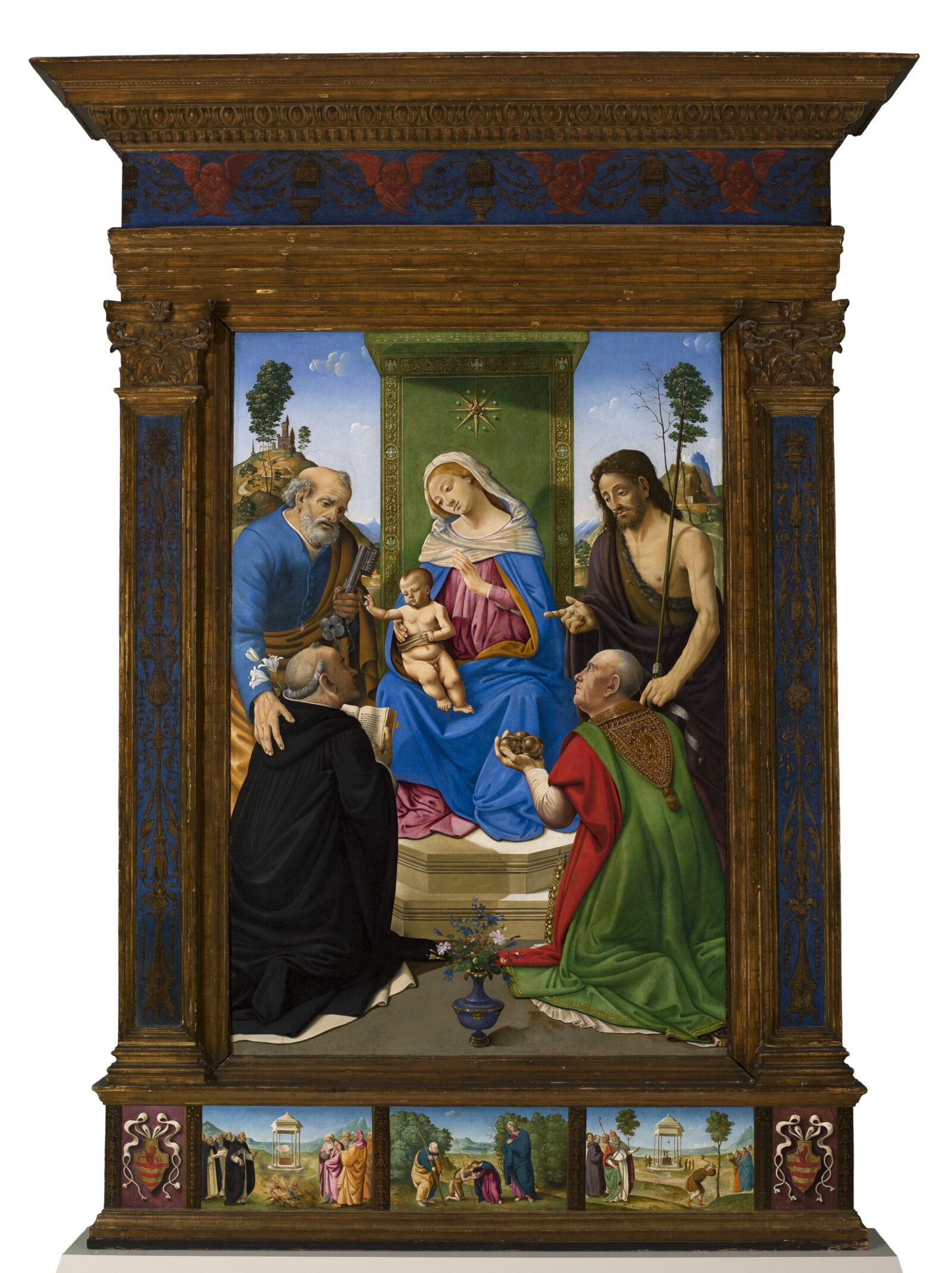
Piero di Cosimo, Italian, 1462–1522; Madonna and Child Enthroned with Sts. Peter, John the Baptist, Dominic, and Nicholas of Bari (detail), c.1481–85; tempera and oil on panel; panel: 69 3/4 in. x 47 in. x 5 inches framed: 105 1/4 x 63 3/8 inches; Saint Louis Art Museum, Museum Purchase 1:1940

In the Madonna and Child Enthroned with Sts. Peter, John the Baptist, Dominic, and Nicholas of Bari in the Saint Louis Art Museum’s collection, artist Piero di Cosimo depicts four Catholic saints—one of whom is painted in the guise of Florentine politician Piero del Pugliese (1430–1498).
Piero di Cosimo, Italian, 1462–1522; Madonna and Child Enthroned with Sts. Peter, John the Baptist, Dominic, and Nicholas of Bari, c.1481–85; tempera and oil on panel; panel: 69 3/4 in. x 47 in. x 5 inches framed: 105 1/4 x 63 3/8 inches; Saint Louis Art Museum, Museum Purchase 1:1940
This work is often referred to as the Pala Pugliese. Pala is the Italian term for “altarpiece,” and Pugliese refers to the family who commissioned the work. It was made for the Pugliese private chapel within the Church of St. Maria a Lecceto near Florence, which has since been renamed Church of Sts. Jacopo e Filippo a Lecceto. Each saint in this altarpiece was included for his significance to the Pugliese family. St. Peter, dressed in blue and holding his attributional keys, is the saint for whom Piero del Pugliese, a wealthy politician and avid collector of Renaissance art, was named. St. John the Baptist, gesturing to the infant Christ with a pointed finger, is the patron saint of Florence. The kneeling St. Dominic, with three white lilies over his shoulder, was the founder of the Dominican Order. Offering three golden spheres is St. Nicholas. He is a symbol of charity, and in this case, he is modeled after Piero del Pugliese.
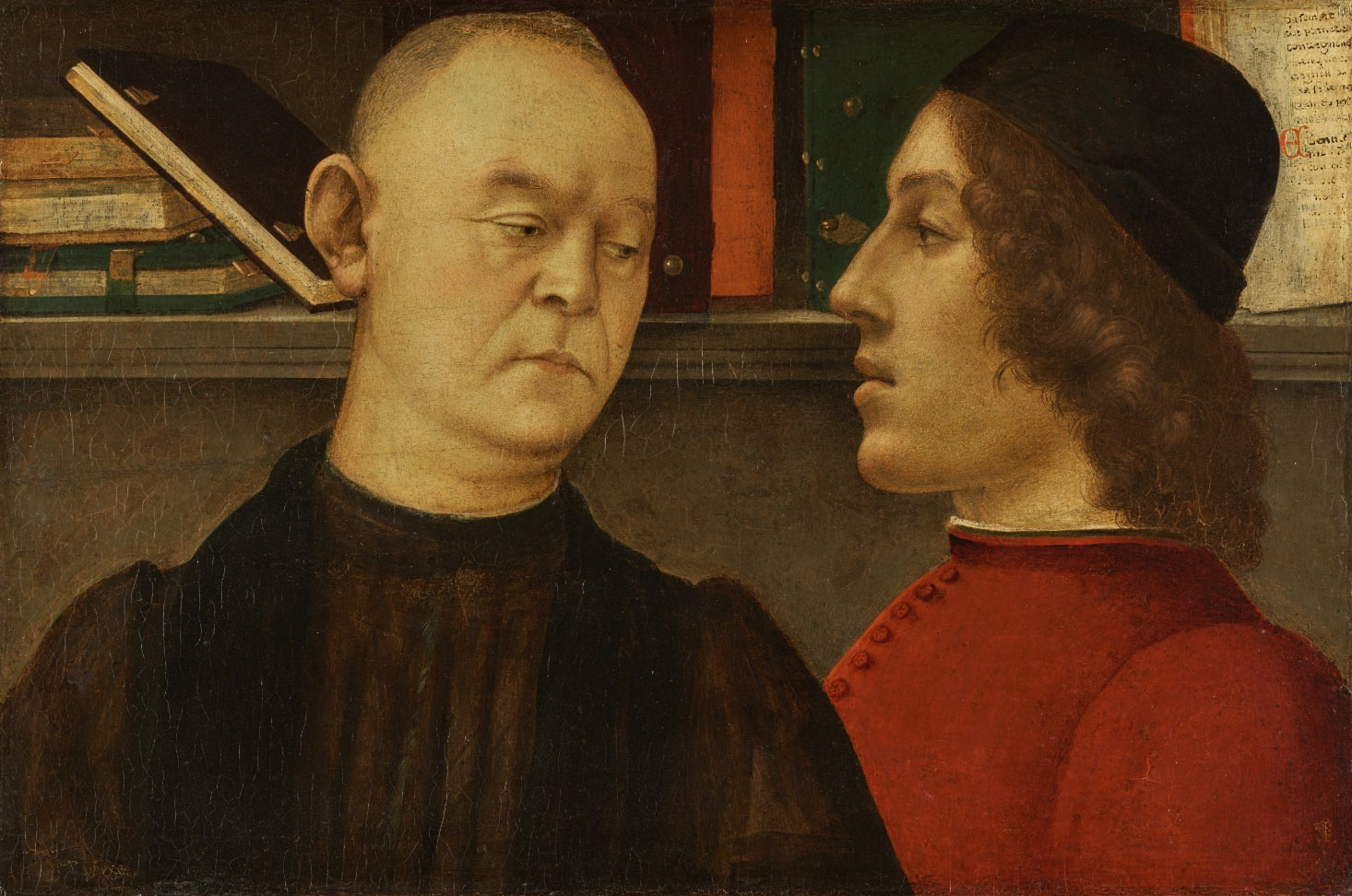
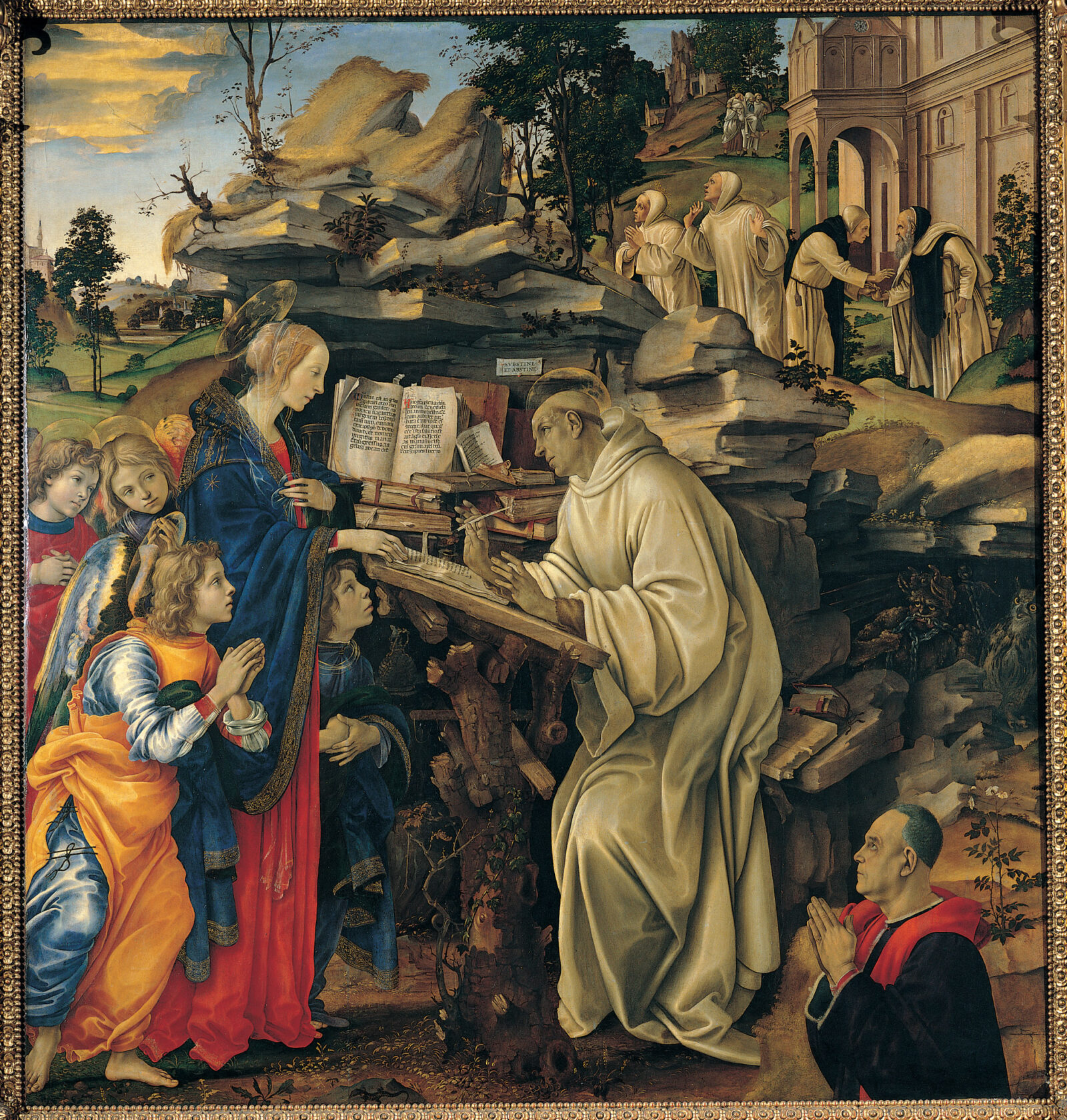
Piero del Pugliese’s physical appearance is known through two paintings by artist Filippino Lippi: Double Portrait of Piero del Pugliese and Filippino Lippi (c.1486), and Apparition of the Virgin to St. Bernard (c.1485–1487). The double portrait presents Pugliese in a three-quarter profile, brows furrowed as he looks in Lippi’s direction. In the latter painting, Pugliese is confined to the lower right corner, kneeling piously before the Virgin and saint. Compare the image of Pugliese in these two portraits to the depiction of St. Nicholas, with his strikingly similar profile, enlarged ears, and cropped hair.
Filippino Lippi, Italian, 1457-1504; Double Portrait of Piero del Pugliese and Filippino Lippi, c.1486; oil and tempera on panel; framed: 22 x 29 1.2 inches; Denver Art Museum, The Simon Guggenheim Memorial Collection 1955.88
Filippino Lippi, Italian, 1457-1504; Apparition of the Virgin to St Bernard, 1486; Badia Fiorentina, Florence
Italian Renaissance painters often attributed certain physical characteristics to saints, allowing onlookers to easily identify them. In addition to his attribution of three golden spheres, St. Nicholas was often painted as an elderly man with a short, white beard. Piero del Pugliese was around 50 years old when the Pala Pugliese was painted, and it seems Piero di Cosimo aged him a bit to better conform to the image of St. Nicholas. Aside from some embellished crow’s feet, however, Pugliese’s distinct facial features stray far from the customary appearance of the saint.
The inclusion of this portrait was almost certainly at the request of Piero del Pugliese himself, and his desire to be represented as St. Nicholas shows the identity he wished to embody. St. Nicholas is associated with generosity, and the gold in his hand references the tale of three impoverished daughters. The story tells of three sisters of marrying age who were unable to pay their dowries and would soon become destitute. St. Nicholas tossed three golden balls through their window during the night, providing each woman with the dowry she needed to marry. Pugliese was a very wealthy man and seems to have identified with St. Nicholas in regard to his generosity; this is especially fitting in the case of Pala Pugliese, as Piero del Pugliese was the first major patron of St. Maria a Lecceto, where this altarpiece originally hung. Fueled by the desire to exhibit his pious gifts to the church, Piero del Pugliese assumed the role of St. Nicholas within the very church he patronized.
It is often difficult to identify when a sacred painting has been modeled after a secular individual, and the true extent of this practice is unknown. This practice most likely developed early in the 15th century, and early known examples during this period incorporated members of the Strozzi and Medici family within religious scenes. These powerful families made their fortunes as bankers, and members of both families chose to be depicted as the three wise men in their respective paintings. In her book Changing Patrons, art historian Jill Burke has argued that depicting donors as sacred figures is presumed to have been both rare and frowned upon by some church members.
Artist Piero di Cosimo provides no indication beyond the portrait itself that Piero del Pugliese is depicted in this work. In the years since it was made, the face of Piero del Pugliese would grow exceedingly unfamiliar to the viewers of this altarpiece, allowing his image to be further conflated with that of St. Nicholas. In his rendering of the Pala Pugliese, Piero di Cosimo allowed Pugliese to embody the saint he admired most, sanctifying the patron for centuries to come.
Madonna and Child Enthroned with Sts. Peter, John the Baptist, Dominic, and Nicholas of Bari is on view in the Arthur B. and Helen K. Baer Gallery 222.
Marjorie Kennedy was a 2024 summer curatorial intern at the Saint Louis Art Museum. She is a master’s student of art history at Tulane University.