untitled (to Ileana and Michael Sonnabend)
- Material
- Fluorescent lights

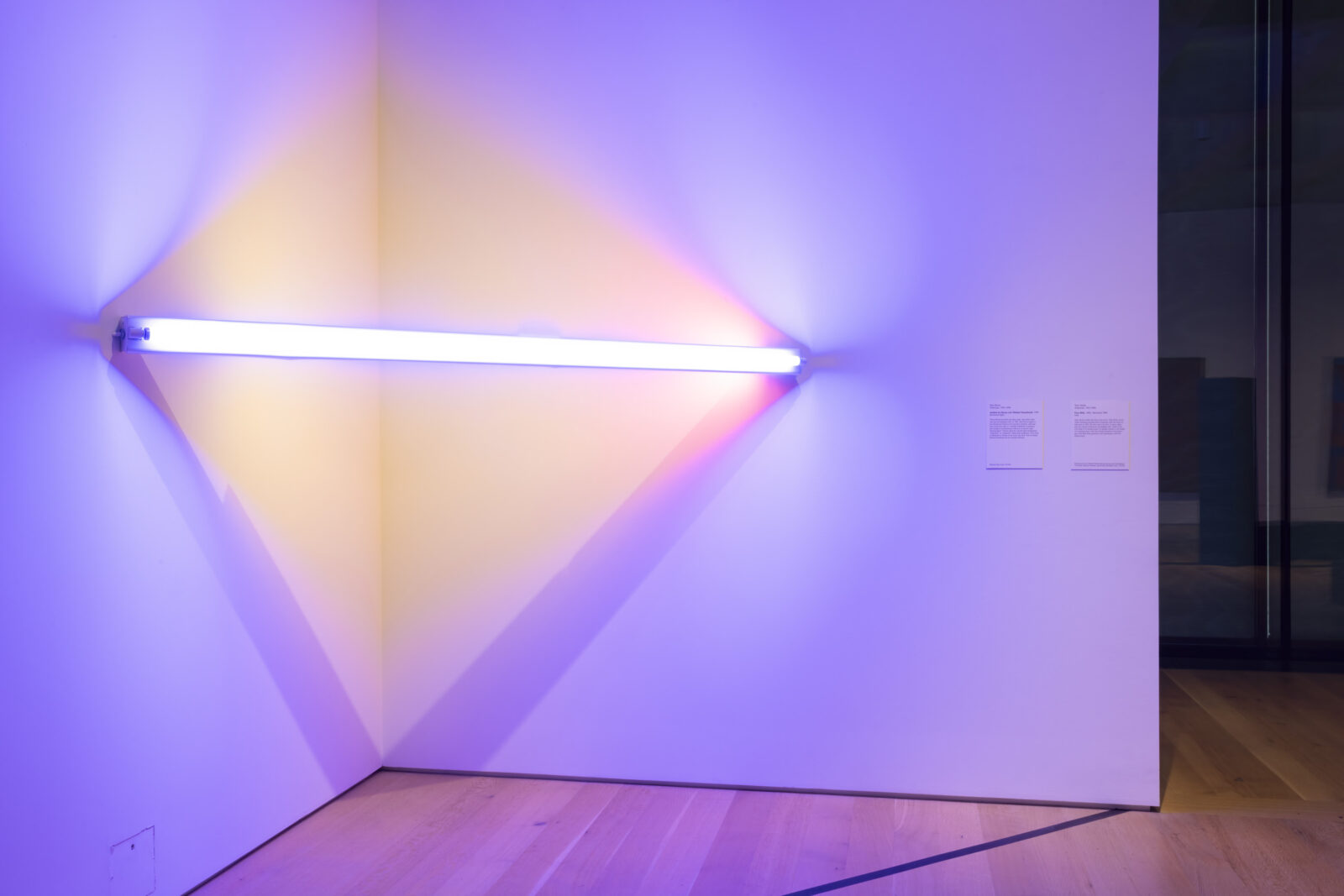
Installation image from Modern & Contemporary - 1960s. Dan Flavin, American, 1933–1996; untitled (to Ileana and Michael Sonnabend), 1970; fluorescent lights ; length: 96 inches; Saint Louis Art Museum, Museum Shop Fund 35:2006; © 2024 Stephen Flavin / Artists Rights Society (ARS), New York.
Tony Smith, American, 1912–1980; Free Ride, 1962, fabricated 1968; steel; 80 x 80 x 80 inches; Saint Louis Art Museum, Funds given by the National Endowment for the Arts, the Contemporary Art Society, Museum Purchase, and the Eliza McMillan Trust 115:1976; © Estate of Tony Smith
Art of the 1960s was defined by a wide range of artistic expression. With bold colors and geometric patterns, artists of the period subversively challenged the conventional function and form of art.
A new installation in the Museum’s contemporary galleries highlights the innovative art movements in the 1960s, with a particular focus on Minimalism and Op Art.
Minimalism is characterized by geometric shapes, industrial materials, and simple designs. The style emerged in the late 1950s when artists began to turn away from the gestural art of the previous generation, according to tate.org. Among the movement’s foremost innovators was American artist Dan Flavin, who is featured in this installation.
Dan Flavin, American, 1933–1996; untitled (to Ileana and Michael Sonnabend), 1970; fluorescent lights ; length: 96 inches; Saint Louis Art Museum, Museum Shop Fund 35:2006; © 2024 Stephen Flavin / Artists Rights Society (ARS), New York
Flavin’s untitled (to Ileana and Michael Sonnabend) is made of three fluorescent bulbs that cast blue, pink, and yellow light onto the surrounding walls. In 1961, the artist began to use fluorescent fixtures as his primary medium, allowing him, as he once said, to “combine traditions of painting and sculpture in architecture with acts of electric light defining space.” He referred to his colored light installations as “proposals” or “situations” rather than sculptures.
Minimalist artists, such as Flavin, emphasized the physical presence of the art object and its interaction with the viewer instead of representational or narrative content. This resulted in impressive sculptural installations, such as the work shown above.
Op Art, popularized in the mid-1960s, is characterized by artworks that create optical illusions. Works in this style can range from subtle to extremely disorienting as the eye struggles to comprehend the art.
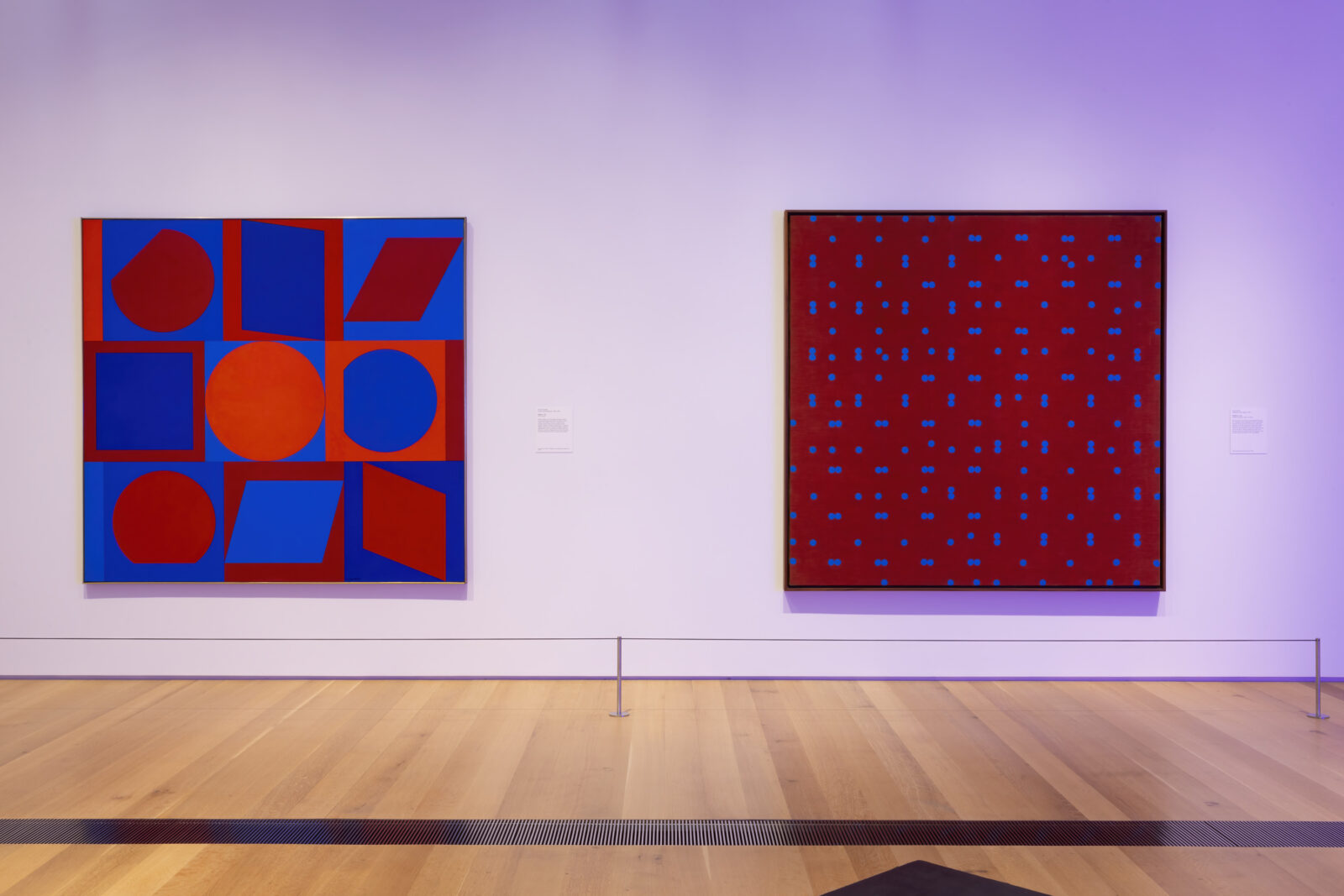
Victor Vasarely, French (born Hungary), 1906–1997; Kalota, 1963; oil on canvas; 82 5/8 x 78 3/4 inches; Saint Louis Art Museum, Funds given by Henry B. Pflager and the Shoenberg Foundation, Inc. 5:1965; © 2024 Artists Rights Society (ARS), New York / ADAGP, Paris.
Larry Poons, American (born Japan), born 1937; Enforcer, 1962; Liquitex and fabric spray on canvas; 80 1/4 x 80 1/4 inches; Saint Louis Art Museum, Museum Purchase and Friends Endowment Fund 2:1976; © 2024 Larry Poons / Licensed by Artists Rights Society (ARS), New York
French artist Victor Vasarely is a pioneer of Op Art. His 1963 oil painting Kalota, on view in the installation, is part of the series Planetary Folklore, in which he repeated what he called “plastic units” of standardized shapes in different combinations. Kalota is the name of a Transylvanian town famous as a center for Hungarian folk art, whose distinctive red and blue decorations may have inspired this painting.
A milestone of the Op Art movement was the Museum of Modern Art’s 1965 exhibition The Responsive Eye, which travelled to SLAM and prompted the first purchases of Op Art, including Kalota, for the collection.
In common with Minimalism, Op Art centers on the viewer’s experience; in the case of this installation, on the physiology of human sight and color perception.
