

Rising Moon
- Material
- Oil on canvas

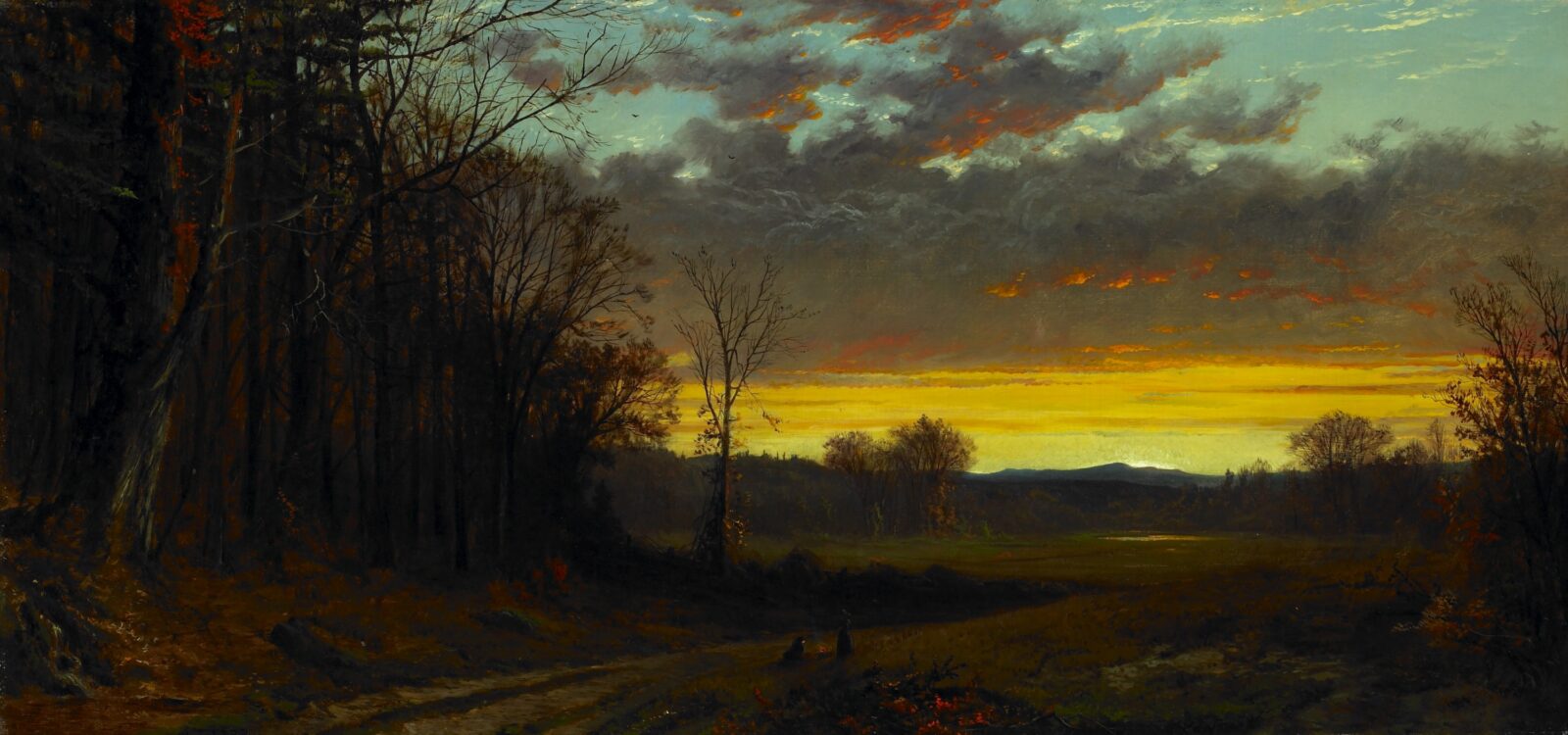
Alfred Thompson Bricher, American, 1837–1908; Twilight in the Wilderness, 1865; oil on canvas; 20 1/8 x 42 inches; Saint Louis Art Museum, Friends Fund, funds given by Jeanne and Rex Sinquefield and Eleanor Moore; bequest of Friederike Gottfried, gift of Nellie Ballard White, Whitaker Charitable Foundation, Mrs. Willard Bartlett, Howard Russell Butler Jr., and James F. Ballard, by exchange 22:2007
As renowned novelist and poet George Eliot once wrote, “Is not this a true autumn day?”
The leaves are beginning to turn, and the crisp smell of autumn is in the air. To mark the change of the season, we invite you to view a selection of works in Saint Louis Art Museum’s collection that imitate life and showcase autumn in all its glory. As of October 1, 2023, all of the below works are on view in the Museum’s galleries.
Alfred Thompson Bricher, American, 1837–1908; Twilight in the Wilderness, 1865; oil on canvas; 20 1/8 x 42 inches; Saint Louis Art Museum, Friends Fund, funds given by Jeanne and Rex Sinquefield and Eleanor Moore; bequest of Friederike Gottfried, gift of Nellie Ballard White, Whitaker Charitable Foundation, Mrs. Willard Bartlett, Howard Russell Butler Jr., and James F. Ballard, by exchange 22:2007
A stand of trees and an open field are dramatically silhouetted against a vibrant autumn sunset of orange, yellow, and purple. Most likely painted along the front range of the White Mountains in New Hampshire, this scene communicated poetic and symbolic meaning to audiences at the time rather than landscape details. Painted at the close of the Civil War, such a vivid representation of the end of day provided visual affirmation of the profound trauma Americans had endured. Simultaneously, the grandeur of the scene spoke to American democratic fervor that would carry the country through its distress.
On view in Gallery 336
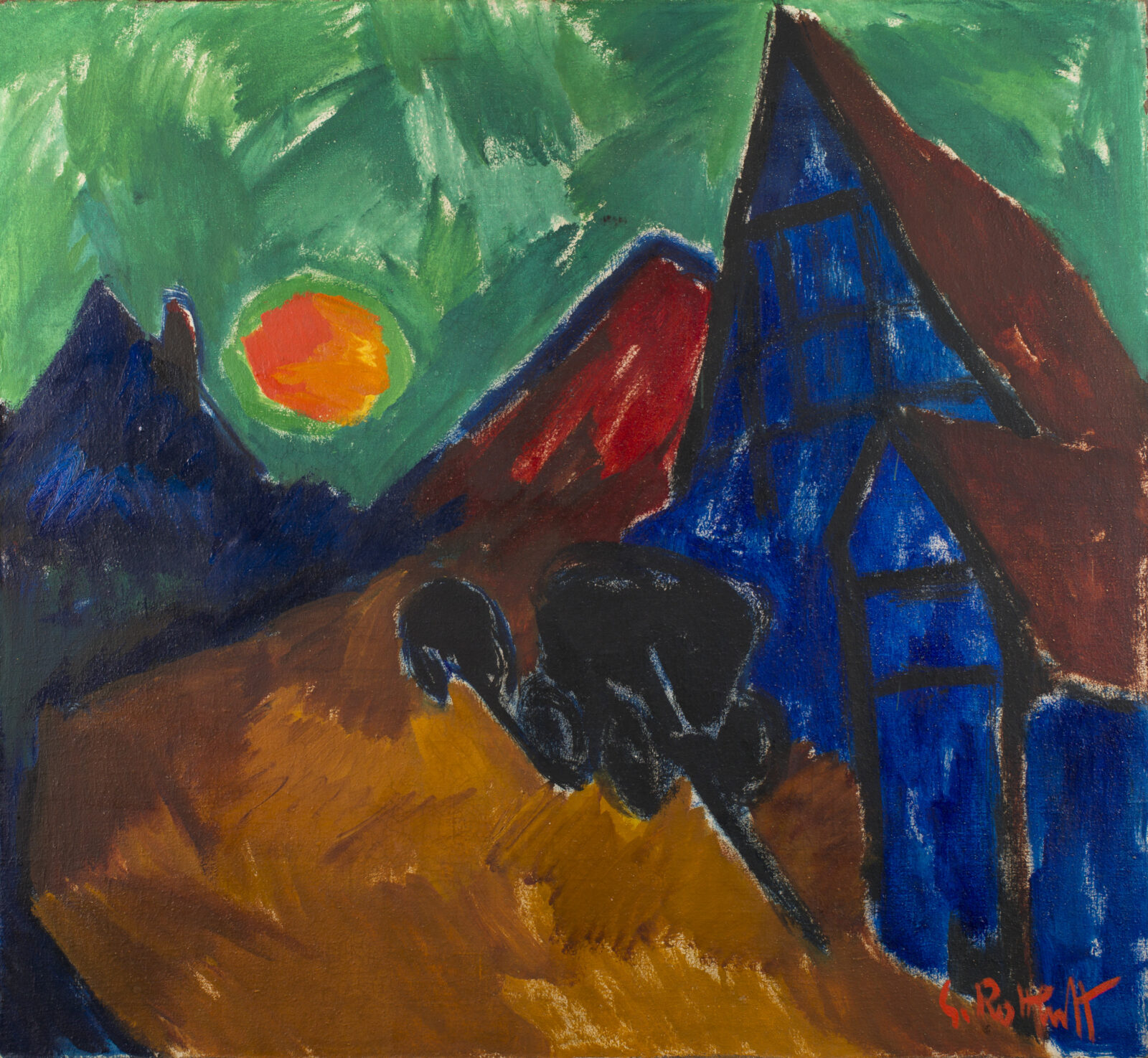
Karl Schmidt-Rottluff, German, 1884–1976; Rising Moon, 1911–12; oil on canvas; 34 7/8 x 37 7/8 inches; Saint Louis Art Museum, Bequest of Morton D. May 938:1983
A solitary cart waits on an empty path receding between gabled cottages; in the distance are a steep mountain and glowing harvest moon. Karl Schmidt-Rottluff’s mysterious work was inspired by the landscape around the Baltic coast of Germany. The artist represents his scene with vibrant, nonnaturalistic colors: the mountain is rendered in intense red and magenta, and the houses in ultramarine blue. Schmidt-Rottluff was the youngest member of Die Brücke (The Bridge) and focused largely on landscapes.
On view in Gallery 214
Flowers and Plants of the Four Seasons, 18th century; Japanese, Edo period; pair of six-panel folding screens: ink, color, and gold leaf on paper; each screen, open flat: 69 1/16 inches x 12 feet 2 1/2 inches x 3/4 inches; Saint Louis Art Museum, Edwin and Betty Greenfield Grossman Endowment 3:2010.1,.2
Read from right to left, this pair of screens feature a variety of plant and flower species from spring and summer (on the right screen) to fall and winter (on the left screen). Included on the right are yellow rose, Japanese dandelion, tree peony, dianthus, cymbidium, Oriental poppy, cow lily, rabbit-ear iris, hydrangea, morning glory, and arrow bamboo. On the left are amaranthus, begonia, chrysanthemum, the “seven grasses of autumn” (bush clover, eulalia, Japanese arrowroot, dianthus, Patrinia, thoroughwort, and mistflower), Chinese bellflower, rose mallow, Japanese aster, arrow bamboo, Japanese narcissus, and grape.
On view in Gallery 225
Marsden Hartley, American, 1877–1943; Smelt Brook Falls, 1937; oil on board; 28 x 22 7/8 inches; Saint Louis Art Museum, Eliza McMillan Trust 9:1939
A jagged, rushing waterfall fills this canvas. Its stark white forms, heavy black outlines, and bold rust surroundings evoke the severity and ruggedness of the Maine landscape. Marsden Hartley lived with the Mason family in Nova Scotia in 1936, when two of their grown sons and their cousin were drowned in a boating accident. Hartley channeled his grief into a series of brooding landscapes and seascapes, one of which is this painting. The work symbolizes characteristics he associated with the family: “Every one of ‘em like rocks from which fresh springs flow without hindrance.”
On view in Gallery 334


