Photograph of the Martine students’ living quarters. Their own designs are used in the decoration; note that the bedding is made in the same pattern as the above curtain panel.
Thérèse Bonney, American, 1894-1978; Bedroom of the girls of the Atelier Martine, Paris, c.1925; Smithsonian Libraries and Archives SIL-SIL-Bonney-IBE027-A
French designer Paul Poiret (1879–1944) is remembered for the vibrant womenswear produced by his eponymous fashion house (1903–1929), such as the acid-green coat on display in the SLAM exhibition Roaring: Art, Fashion, and the Automobile in France, 1918–1939. At the same time as the rise of his fashion empire, Poiret launched an ambitious franchise that included fragrance and interior design as well as clothing. A peek into the history of his interiors branch, founded in 1911 and named after his daughter, Martine, reveals a unique group of young, working-class artisans who flourished under the tutelage of the so-called King of Fashion.

Designed by Paul Poiret, French, 1879–1944; Woman's Green Evening Coat, 1924; silk; Courtesy of the Missouri Historical Society 2025.08
In Roaring, a richly colored floral curtain panel illustrates the work of the “Martines”—girls and young women employed by this branch. It incorporated a school (École Martine), design studio (Atelier Martine), and retail business (La Maison Martine). For this endeavor, Poiret was inspired by visits to the Wiener Werkstätte (Vienna Workshop) in Austria, an artisans organization that produced modern decorative arts. He was intrigued by their visions of fine artistry and cohesion across all fields of design, and he loved their hand-painted silks and graphic patterns. However, he found their strict teaching methods incongruent with their free, expressive aesthetic. Driven by the popularity of primitivism and notions of childish naïveté, he sought out young, untrained pupils to start his own school, hoping to tap into their unbounded imaginations.

Made by Atelier Martine, Paris, France, active 1911–1929; Curtain Panel, possibly Les Giroflées, c.1923; printed cotton with metal hardware; 105 x 46 inches; Saint Louis Art Museum, Richard Brumbaugh Trust in memory of Richard Irving Brumbaugh and Grace Lischer Brumbaugh 26:2016
“I scoured the working-class districts around Paris for little girls of about twelve, who had just finished their schooling,” Poiret wrote in his autobiography. “I put them to work copying nature, without any teacher. . . . Free to do as they liked, I discovered all the freshness and spontaneity of their natures.”
Although at least one boy did attend the school, Martine student Alice Rutty said girls were favored due to their perceived affinities for color and the natural world.

Photograph of the Martine students’ living quarters. Their own designs are used in the decoration; note that the bedding is made in the same pattern as the above curtain panel.
Thérèse Bonney, American, 1894-1978; Bedroom of the girls of the Atelier Martine, Paris, c.1925; Smithsonian Libraries and Archives SIL-SIL-Bonney-IBE027-A
Embraced for their youthfulness and their penchant for splashy florals, the Martines flourished creatively with little formal instruction. Originally, the artist Marguerite Gabriel-Claude Sérusier was employed as their teacher—having recommended many of the students to Poiret—but she soon left and was not replaced.
Poiret also made sure the students were taught to make carpets themselves so that their designs were not at risk of being misinterpreted by “nonunderstanding workers” who otherwise produced their textiles, wallpapers, lighting, furnishings, and ceramics. He writes in his autobiography, “They came to weave with their own hands, straight away without any previous design, carpets whence flowered marvelous blossoms, fresh and living as if they had sprung straight from the earth itself.” These rugs—and their young designers—enjoyed immense popularity, propelled by showings at the Salon d’Automne, an annual Parisian art exhibition, and in Poiret’s own art gallery, the Galerie Barbazanges.
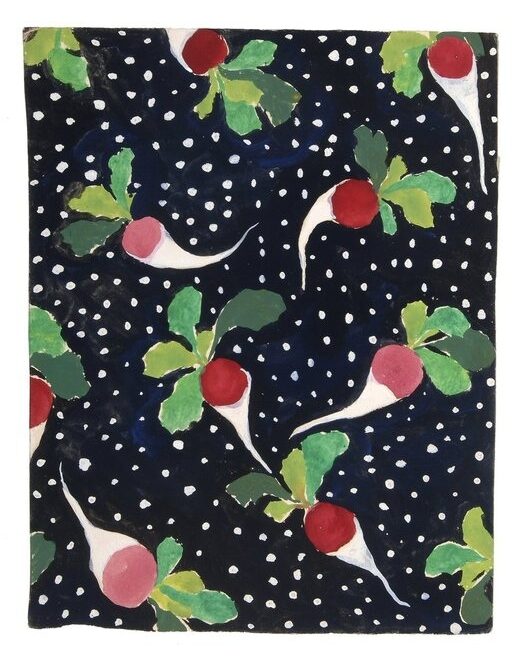
Gabrielle Rousselin, French; for Atelier Martine, Paris, active 1911–1929; Les radis (The Radishes), 1913; gouache on paper; 12 3/8 x 9 3/4 inches; Musée des Arts décoratifs, Paris, Purchase thanks to the heritage fund, with the support of the patronage of Michel and Hélène David-Weill, 2005
Among the Martines, a few names stand out in records of the Poiret empire. One student, Madeleine Panizon, became a successful milliner, or hat maker; she later oversaw all hats by Poiret from 1920 to 1928 and ran her own shop, according to scholar Colin McDowell in Hats: Status, Style, and Glamour. Gabrielle Rousselin (later Gabrielle Drapier) designed the branch’s playful Radish textile pattern seen above. Agnès Jallat (later Agnès Charlemagne) is remembered as a talented draftsperson and painter—second only to Alice Rutty (later Alice Natter), who was Poiret’s best student, or premiére.
The designer would frequently address Alice as a de facto leader, especially when he was away during World War I (he served in the military, while the Martines went to Normandy to teach soldiers how to sew). In one letter, he instructed her, “Try to imagine what sort of carpets the soldiers will want in their rooms when they come home: nothing that will remind them of the war, but something very cheerful with a tricolor effect . . . please tell the others this and get them to do some designs.” In another, he is a stern disciplinarian, writing, “My dear Alice, I am writing to you so that you can speak for the girls for me . . . I am told: 1. That you are going around with young men. 2. That you let people buy you drinks or spirits, according to the custom of Normandy. These . . . I am bringing to the attention of your parents immediately.” Despite the occasional admonishment, Alice would recall that the students considered Poiret a harmless friend, according to an article by Sylvie Gayan: “When we had done too many stupid things, he tried to be authoritarian but could not help laughing under his breath.”
Coming of age in the École Martine, Alice Rutty would become a star designer in her own right. In 1917, her work was featured in the avant-garde magazine SIC. In 1921, she married and left the school but continued to design hats with Madeleine Panizon and textiles with artist-decorator Raoul Dufy. According to Dufy, he worked closely with Poiret and the Martines. The 1930s saw her make and exhibit wallpapers, some with the manufacturer Paul Dumas. She continued creating even past 80 years of age, producing colorful velvet cushions with quilting and embroidery.

Color print of a design by Alice Rutty featured in SIC magazine, no. 18, June 1917 (Pierre Albert-Birot: Paris); Ville de Paris / Bibliothèque historique, BHVP, 2013-304408; Source gallica.bnf.fr / Bibliothèque nationale de France.
Paul Poiret would remember Alice Rutty as a lifelong friend and inspiration. She recalled that they would meet every year to discuss the heyday of the Martine school, which was sold in 1925 due to severe financial difficulties. In 1944, he wrote to her, “I very much want you to come back to work for me, but this time as a teacher rather than as a student . . . draw up a list of those girls you think would be interested and come to see me and talk about it . . . there is a great future in it for you all . . . Martine is holding my pen and it is to your advantage.” Poiret would die in April of that year, unable, in the end, to revive the Martine project.