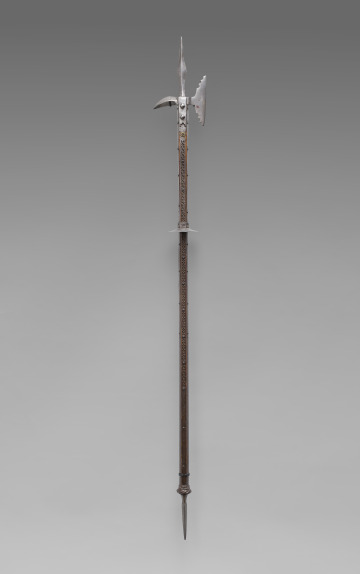
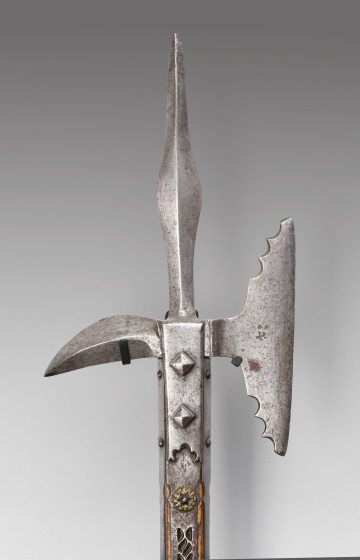
Pollaxe for Foot Combat
- Culture
- European
- Date
- c.1500
- Material
- Steel, iron, and wood
- made in
- Europe
- Classification
- Arms & armor, metalwork
- Collection
- Decorative Arts and Design
- Current Location
- On View, Gallery 138
- Dimensions
- 67 1/4 x 7 1/2 x 4 7/8 in. (170.8 x 19.1 x 12.4 cm)
weight: 6 lb. 14 oz. (3.1 kg) - Credit Line
- Museum Purchase
- Rights
- Public Domain
- Object Number
- 43:1919
NOTES
Staff weapons, popularly called polearms, were the most typical infantry weapons until well into the 16th century. Most staff weapons evolved from agricultural or everyday tools modified for military use and simply fastened to long wooden staves. All polearms require the use of both hands and were used exclusively on foot, except for the long spear called a lance, which was used from horseback. Staff weapons were used by commoners and professional soldiers in battle, by knights in armored sporting combats, and by bodyguards of royalty. Like many other arms, staff weapons assumed a primarily ceremonial role by the mid-17th century.
Provenance
Chabrières-Arlès Collection, France
- 1919
Duveen Brothers, New York, NY, USA [1]
1919 -
Saint Louis Art Museum, purchased from Duveen Brothers [2]
Notes:
[1] The Duveen Brothers invoice, dated March 21, 1919, states that 43:1919 was formerly in the Chabrières-Arlès Collection. This provenance is further supported by a page removed from a catalogue, which confirms 43:1919 as previously belonging to the Chabrières-Arlès Collection. It is not clear from which publication this single sheet has been removed; the only printed notation on the page reads "Héliog R. Varin." The object on the page is annotated in hand "214 N", "46 B", and "43:19" [SLAM document files].
[2] The Duveen Brothers invoice refers to 43:1919 as No. C.A. 110-B. Minutes of the Administrative Board of Control of the City Art Museum, April 18, 1919.
- 1919
Duveen Brothers, New York, NY, USA [1]
1919 -
Saint Louis Art Museum, purchased from Duveen Brothers [2]
Notes:
[1] The Duveen Brothers invoice, dated March 21, 1919, states that 43:1919 was formerly in the Chabrières-Arlès Collection. This provenance is further supported by a page removed from a catalogue, which confirms 43:1919 as previously belonging to the Chabrières-Arlès Collection. It is not clear from which publication this single sheet has been removed; the only printed notation on the page reads "Héliog R. Varin." The object on the page is annotated in hand "214 N", "46 B", and "43:19" [SLAM document files].
[2] The Duveen Brothers invoice refers to 43:1919 as No. C.A. 110-B. Minutes of the Administrative Board of Control of the City Art Museum, April 18, 1919.
We regularly update records, which may be incomplete. If you have additional information, please contact us at provenance@slam.org.