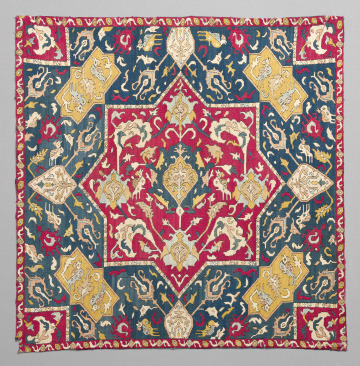
Cushion Cover with Design of Flowers and Mounted Figures in Eight-pointed Star with Birds in Cartouches
- Culture
- Azerbaijani
- Date
- late 17th century
- made in
- Azerbaijan, Asia
- Classification
- Coverings & hangings, textiles
- Collection
- Islamic Art
- Current Location
- Not on view
- Dimensions
- 28 15/16 x 28 3/4 in.
- Credit Line
- Bequest of Mrs. Frank H. Cook
- Rights
- Public Domain
- Object Number
- 56:1955
NOTES
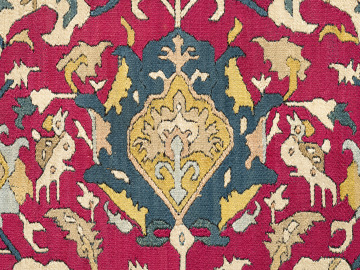
This cushion cover has an eight-pointed star at the center containing a large palmette, or palm decoration, surrounded by leaves and smaller palmettes. Figures riding a four-legged animal may be seen to the immediate left and right of the central palmette. Squares define this cushion cover’s corners, while rectangles with small triangles projecting from each side are situated between the squares and the central star. These elements and the rest of the textile are adorned with conventionalized flowers, animals, or birds.
The design of palmettes in a central, eight-pointed star originated in Persian (present-day Iran) carpets. Other Persian characteristics include birds enclosed in hexagons, but here there are also birds across the background. Additionally, the angularity of the designs is more characteristic of textile work from the Caucasus region (which includes present-day Azerbaijan) than from the main centers of Persian culture.
The design of palmettes in a central, eight-pointed star originated in Persian (present-day Iran) carpets. Other Persian characteristics include birds enclosed in hexagons, but here there are also birds across the background. Additionally, the angularity of the designs is more characteristic of textile work from the Caucasus region (which includes present-day Azerbaijan) than from the main centers of Persian culture.
Provenance
1880s or later - 1931
F. H. Cook [Frank Henry Cook (1862–1931)], Wonersh, Waverley, Surrey, England [1]
1931 - 1932
Estate of F. H. Cook [2]
1932 - 1953
Mrs. F. H. Cook [Beatrice Elliott Lindell Cook (1875–1953)], Wonersh, Waverley, Surrey, England, by inheritance from her husband, F. H. Cook [3]
1953 - 1955
Estate of Mrs. F. H. Cook [4]
1955 -
Saint Louis Art Museum, bequest of Mrs. F. H. Cook [5]
Notes:
[1] Frank Henry Cook was born in Leicester, Leicestershire, England. On June 21, 1894 in Jackson, Missouri, he married Beatrice Elliott Lindell, who was born in Illinois but grew up in St. Louis, Missouri. He died on December 25, 1931 in Wonersh, Waverley, Surrey, England, where he had lived with his wife. Mrs. Cook subsequently commissioned Alan John Bayard Wace (1879–1957), who had been the director of the British School at Athens (1914–1923), Deputy Keeper of the Department of Textiles, Victoria and Albert Museum, London (1924–1934), and the second Laurence Professor of Classical Archaeology, University of Cambridge (1934–1944), and later to be professor at the Farouk I University in Egypt (1943–1952), to write a two-volume catalogue of the Cook collection that she had inherited. According to the catalogue's foreword (in vol. 1, Text, p. v) written by Beatrice Cook in February 1935, the collection was begun by her late husband Frank Henry Cook in the late 1880s during his travels around the eastern Mediterranean region. This object is among those published in the catalogue [A. J. B. Wace, Mediterranean and Near Eastern Embroideries from the Collection of Mrs. F. H. Cook, 2 vols. (London: Halton & Company Ltd., 1935), vol. 1, Text, p. 77, cat. no. 112 (catalogue entry), and vol. 2, Plates, pl. CXXVII (color illustration)].
[2] After the death of Frank Henry Cook on died on December 25, 1931, his estate was probated on February 5, 1932 in London, England to his wife Beatrice Elliott Cook, his younger brother Ernest Edward Cook (1865–1955), and Evan Cadogan Eric Smith (1894–1950), Ashfold, Sussex, chairman of the National Provincial Bank [Ancestry England & Wales, National Probate Calendar (Index of Wills and Administrations), 1858–1966, 1973–1995].
[3] Per SLAM Accession Record [SLAM document files]. See also notes [1] and [2].
[4] After the death of Beatrice Elliott Lindell Cook on August 2, 1953, her estate was probated on October 22, 1953 in London, England to her daughter, Frances Beatrice Cook Steward (1897–1991), her friend Alice Frederica Girardot (1889–1972), and Malcolm John Henderson (1876–1954), a solicitor from the law firm of Shaen, Roscoe, Massey, and Co., London, England [Ancestry England & Wales, National Probate Calendar (Index of Wills and Administrations), 1858–1966, 1973–1995].
[5] Minutes of the Administrative Board of Control of the City Art Museum, January 6, 1955.
F. H. Cook [Frank Henry Cook (1862–1931)], Wonersh, Waverley, Surrey, England [1]
1931 - 1932
Estate of F. H. Cook [2]
1932 - 1953
Mrs. F. H. Cook [Beatrice Elliott Lindell Cook (1875–1953)], Wonersh, Waverley, Surrey, England, by inheritance from her husband, F. H. Cook [3]
1953 - 1955
Estate of Mrs. F. H. Cook [4]
1955 -
Saint Louis Art Museum, bequest of Mrs. F. H. Cook [5]
Notes:
[1] Frank Henry Cook was born in Leicester, Leicestershire, England. On June 21, 1894 in Jackson, Missouri, he married Beatrice Elliott Lindell, who was born in Illinois but grew up in St. Louis, Missouri. He died on December 25, 1931 in Wonersh, Waverley, Surrey, England, where he had lived with his wife. Mrs. Cook subsequently commissioned Alan John Bayard Wace (1879–1957), who had been the director of the British School at Athens (1914–1923), Deputy Keeper of the Department of Textiles, Victoria and Albert Museum, London (1924–1934), and the second Laurence Professor of Classical Archaeology, University of Cambridge (1934–1944), and later to be professor at the Farouk I University in Egypt (1943–1952), to write a two-volume catalogue of the Cook collection that she had inherited. According to the catalogue's foreword (in vol. 1, Text, p. v) written by Beatrice Cook in February 1935, the collection was begun by her late husband Frank Henry Cook in the late 1880s during his travels around the eastern Mediterranean region. This object is among those published in the catalogue [A. J. B. Wace, Mediterranean and Near Eastern Embroideries from the Collection of Mrs. F. H. Cook, 2 vols. (London: Halton & Company Ltd., 1935), vol. 1, Text, p. 77, cat. no. 112 (catalogue entry), and vol. 2, Plates, pl. CXXVII (color illustration)].
[2] After the death of Frank Henry Cook on died on December 25, 1931, his estate was probated on February 5, 1932 in London, England to his wife Beatrice Elliott Cook, his younger brother Ernest Edward Cook (1865–1955), and Evan Cadogan Eric Smith (1894–1950), Ashfold, Sussex, chairman of the National Provincial Bank [Ancestry England & Wales, National Probate Calendar (Index of Wills and Administrations), 1858–1966, 1973–1995].
[3] Per SLAM Accession Record [SLAM document files]. See also notes [1] and [2].
[4] After the death of Beatrice Elliott Lindell Cook on August 2, 1953, her estate was probated on October 22, 1953 in London, England to her daughter, Frances Beatrice Cook Steward (1897–1991), her friend Alice Frederica Girardot (1889–1972), and Malcolm John Henderson (1876–1954), a solicitor from the law firm of Shaen, Roscoe, Massey, and Co., London, England [Ancestry England & Wales, National Probate Calendar (Index of Wills and Administrations), 1858–1966, 1973–1995].
[5] Minutes of the Administrative Board of Control of the City Art Museum, January 6, 1955.
We regularly update records, which may be incomplete. If you have additional information, please contact us at provenance@slam.org.