NOTES
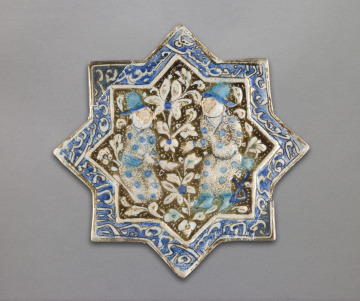
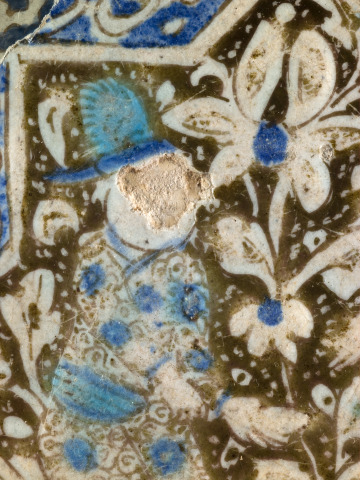
Mongol rulers constructed many shrines throughout Iran in the late 13th century, and adorned them with luster tiles, such as this one. It depicts two men in Mongol clothing whose faces have been removed. Although figural decoration is frequently seen on secular art from the Islamic world, it is rare in a religious context. Someone in the succeeding centuries must have felt offended by the presence of the figures in a shrine, and defaced the tile.
Ilkhanid, or Mongol-era luster tile panels were delightfully eclectic. Tiles with figural and non-figural decoration were often combined in a single panel. The star-shaped tiles were connected by cross-shaped tiles in between, which may or may not have had a similar luster glaze. Inscriptions usually consisted of Persian poetry or Qur’anic verses, which could be placed side-by-side, and rarely seem to bear any thematic relation to the central decoration.