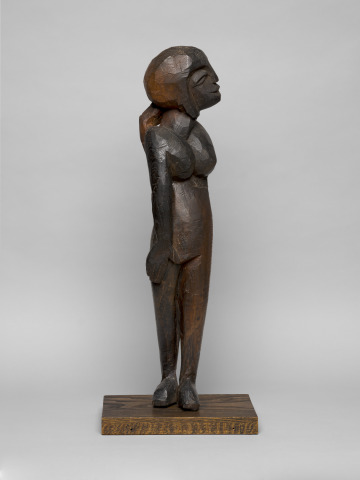
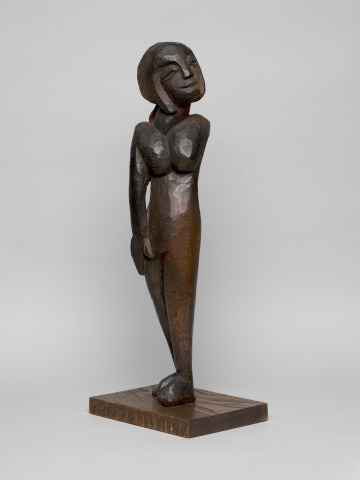
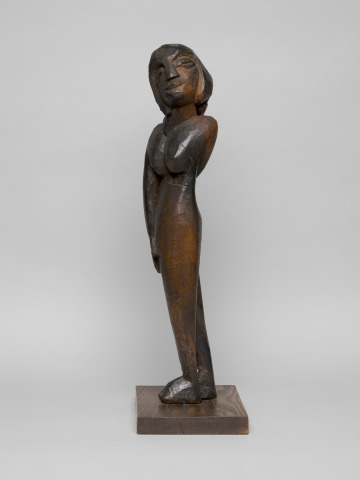
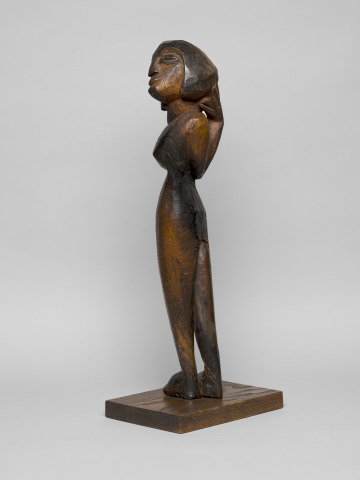
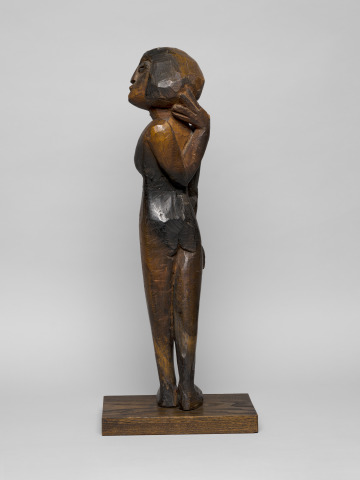
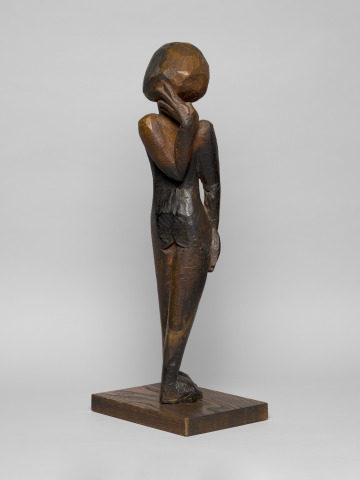
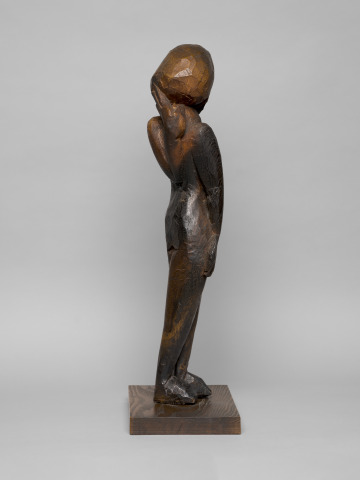
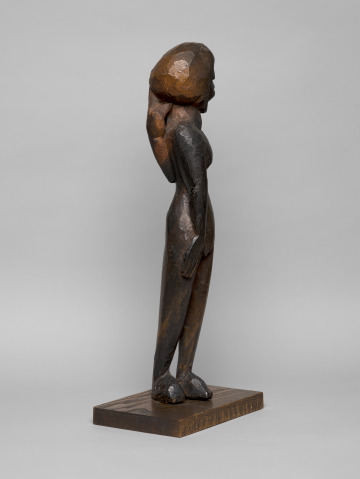
Standing Nude Turning
- Date
- 1913
- Material
- Wood
- possibly made in
- Fehmarn, Schleswig-Holstein state, Germany, Europe
- Classification
- Sculpture
- Collection
- Modern and Contemporary Art
- Current Location
- Not on view
- Dimensions
- 27 1/4 x 11 x 7 3/4 in. (69.2 x 27.9 x 19.7 cm)
- Credit Line
- Gift of Mr. and Mrs. Morton D. May
- Rights
- Public Domain
- Object Number
- 402:1955
NOTES
Ernst Ludwig Kirchner carved this figure from a piece of oak, most likely driftwood that he gathered during a summer visit to the island of Fehmarn in the Baltic Sea. For Kirchner, a newly discovered piece of wood presented a welcome challenge: "There is a figure in every trunk," he said, "one must only peel it out." This boyish female figure with slender silhouette has been depicted in one sweeping motion. While her lower body appears in a straightforward position, her upper torso is forcibly twisted to the side, and her left arm is pulled unnaturally behind her back. Her striking masklike features, defined by almond eyes and bobbed haircut, are forcefully assertive. During this period, Kirchner regularly visited the ethnographic museums in Dresden and Berlin, where the forms of African, Indian, and Oceanic sculpture helped him bypass the European tradition of figural representation and create a more direct expression of the female nude.
Provenance
- still in 1919
Kunstsalon Ludwig Schames, Frankfurt am Main, Germany [1]
by 1923 -
Ludwig Fischer (1860-1922) and Rosy Fischer (1869-s1926), Frankfurt am Main, Germany [2]
c.1932 -
Galerie Ferdinand Möller, Berlin, Germany [3]
- 1945
Kurt Feldhäusser (1905-1945), Berlin, Germany, purchased from Ferdinand Möller [4]
1945 -
Marie Luise Feldhäusser (1876-1967), Berlin, Germany, by inheritance [5]
- 1954
Feigl Gallery (Hugo Feigl), New York, NY, USA
1954/01/11 - 1955
Morton D. May (1914-1983) and Margie Wolcott May (d.2001), St. Louis, MO, purchased from Feigl Gallery [6]
1955 -
Saint Louis Art Museum, given by Mr. and Mrs. Morton D. May [7]
Notes:
[1] This sculpture was exhibited in 1919 at the Galerie Ludwig Schames in Frankfurt; ["Ausstellung von Germälden von E.L. Kirchner," Frankfurt: Ludwig Schames, 1919, cat. 54].
[2] This sculpture is visible in a 1923 photograph of the dining room of Ludwig and Rosy Fischer, taken the year after Ludwig Fischer's death [Heuberger, Georg, ed. "Expressionismus und Exil: Die Sammlung Ludwig and Rosy Fischer, Frankfurt am Main." München: Prestel, 1990, p. 18].
Ludwig and Rosy Fischer were art collectors who, by the time of Ludwig's death, had amassed a collection of about 500 works. Finding that the rate of inflation made it impossible to maintain the collection, Rosy Fischer founded an art gallery in her home in November of 1923 called the Fischer Gallery. The Gallery was not successful, however, and Rosy closed it in 1925. She died in 1926 while traveling in Egypt [Heuberger, Georg, ed. "Expressionismus und Exil: Die Sammlung Ludwig and Rosy Fischer, Frankfurt am Main." München: Prestel, 1990, p.170].
Author Georg Heuberger, in his 1990 exhibition catalogue on the Fischer collection, stated that Ludwig and Rosy Fischer’s son, Max Fischer, inherited the sculpture after Rosy’s death [Heuberger, p.170, 116, 118]. Independent evidence to confirm Max Fischer’s possession, or how the sculpture left Rosy Fischer’s collection, has not been found.
[3] Wolfgang Henze, author of the Kirchner catalogue raisonné, lists the sculpture in Ferdinand Möller's possession c.1932 [ Henze, Wolfgang. "Die Plastik Ernst Ludwig Kirchners, Monographie mit Werkverzeichnis." Wichtrach/Bern: Verlag Galerie Henze & Ketterer, 2002, p. 342]. A copy of an information card from Galerie Ferdinand Möller with images of the sculpture was provided in a letter to the Museum from Wolfgang Henze dated July 15, 2003. The original card was sent by Möller to Carl Hagemann, with whom Möller corresponded between 1929 and 1933. The address on the card is one used by the Galerie Ferdinand Möller between 1932 and 1935 [SLAM document files].
[4] See note [3]. Kurt Feldhäusser acquired a great deal of his collection from Ferdinand Möller and collected works by Kirchner quite heavily. Feldhäusser died in a bombing raid in Nürnberg in January 1945. His mother, Marie Luise Feldhäusser, inherited his collection and subsequently sold much of it through E. Weyhe Gallery in New York [Heuberger, p. 120, note 52; letter to the Museum from Wolfgang Schöddert, Ferdinand-Möller-Stiftung, dated November 20, 2002, SLAM document files].
According to Andrew Robison, Marie Luise Feldhäusser moved to Brooklyn, NY in May 1948 to join her other son Erwin and his family. She brought nearly all of Kurt's collection with her, with the exception of five paintings and three sculptures - which included two wood sculptures of female nudes by Kirchner, one of which is "Standing Nude." She left these few pieces in the care of Fritz Kolb, an artist and friend of Kurt Feldhäusser in Stuttgart, Germany [Robison, Andrew. "Kirchner Collector Kurt Feldhäusser" in "Festschrift für Eberhard W. Kornfeld zum 80. Geburtstag." Bern: Galerie Kornfeld, 2003].
[5] See note [4].
[6] The invoice dated January 11, 1954 from Feigl Gallery to Morton D. May indicates that this work is from the Feldhäusser collection [May Archives, Saint Louis Art Museum; Robison, p. 260]. A letter to Morton D. May from Hugo Feigl of Feigl Gallery refers to some artwork he purchased "from the famous Feldthaeusser [sic] collection, where I bought them directly" [letter dated October 24, 1960, SLAM document files], though he doesn’t mention this work specifically.
[7] Minutes of the Administrative Board of Control of the City Art Museum, December 8, 1955.
Kunstsalon Ludwig Schames, Frankfurt am Main, Germany [1]
by 1923 -
Ludwig Fischer (1860-1922) and Rosy Fischer (1869-s1926), Frankfurt am Main, Germany [2]
c.1932 -
Galerie Ferdinand Möller, Berlin, Germany [3]
- 1945
Kurt Feldhäusser (1905-1945), Berlin, Germany, purchased from Ferdinand Möller [4]
1945 -
Marie Luise Feldhäusser (1876-1967), Berlin, Germany, by inheritance [5]
- 1954
Feigl Gallery (Hugo Feigl), New York, NY, USA
1954/01/11 - 1955
Morton D. May (1914-1983) and Margie Wolcott May (d.2001), St. Louis, MO, purchased from Feigl Gallery [6]
1955 -
Saint Louis Art Museum, given by Mr. and Mrs. Morton D. May [7]
Notes:
[1] This sculpture was exhibited in 1919 at the Galerie Ludwig Schames in Frankfurt; ["Ausstellung von Germälden von E.L. Kirchner," Frankfurt: Ludwig Schames, 1919, cat. 54].
[2] This sculpture is visible in a 1923 photograph of the dining room of Ludwig and Rosy Fischer, taken the year after Ludwig Fischer's death [Heuberger, Georg, ed. "Expressionismus und Exil: Die Sammlung Ludwig and Rosy Fischer, Frankfurt am Main." München: Prestel, 1990, p. 18].
Ludwig and Rosy Fischer were art collectors who, by the time of Ludwig's death, had amassed a collection of about 500 works. Finding that the rate of inflation made it impossible to maintain the collection, Rosy Fischer founded an art gallery in her home in November of 1923 called the Fischer Gallery. The Gallery was not successful, however, and Rosy closed it in 1925. She died in 1926 while traveling in Egypt [Heuberger, Georg, ed. "Expressionismus und Exil: Die Sammlung Ludwig and Rosy Fischer, Frankfurt am Main." München: Prestel, 1990, p.170].
Author Georg Heuberger, in his 1990 exhibition catalogue on the Fischer collection, stated that Ludwig and Rosy Fischer’s son, Max Fischer, inherited the sculpture after Rosy’s death [Heuberger, p.170, 116, 118]. Independent evidence to confirm Max Fischer’s possession, or how the sculpture left Rosy Fischer’s collection, has not been found.
[3] Wolfgang Henze, author of the Kirchner catalogue raisonné, lists the sculpture in Ferdinand Möller's possession c.1932 [ Henze, Wolfgang. "Die Plastik Ernst Ludwig Kirchners, Monographie mit Werkverzeichnis." Wichtrach/Bern: Verlag Galerie Henze & Ketterer, 2002, p. 342]. A copy of an information card from Galerie Ferdinand Möller with images of the sculpture was provided in a letter to the Museum from Wolfgang Henze dated July 15, 2003. The original card was sent by Möller to Carl Hagemann, with whom Möller corresponded between 1929 and 1933. The address on the card is one used by the Galerie Ferdinand Möller between 1932 and 1935 [SLAM document files].
[4] See note [3]. Kurt Feldhäusser acquired a great deal of his collection from Ferdinand Möller and collected works by Kirchner quite heavily. Feldhäusser died in a bombing raid in Nürnberg in January 1945. His mother, Marie Luise Feldhäusser, inherited his collection and subsequently sold much of it through E. Weyhe Gallery in New York [Heuberger, p. 120, note 52; letter to the Museum from Wolfgang Schöddert, Ferdinand-Möller-Stiftung, dated November 20, 2002, SLAM document files].
According to Andrew Robison, Marie Luise Feldhäusser moved to Brooklyn, NY in May 1948 to join her other son Erwin and his family. She brought nearly all of Kurt's collection with her, with the exception of five paintings and three sculptures - which included two wood sculptures of female nudes by Kirchner, one of which is "Standing Nude." She left these few pieces in the care of Fritz Kolb, an artist and friend of Kurt Feldhäusser in Stuttgart, Germany [Robison, Andrew. "Kirchner Collector Kurt Feldhäusser" in "Festschrift für Eberhard W. Kornfeld zum 80. Geburtstag." Bern: Galerie Kornfeld, 2003].
[5] See note [4].
[6] The invoice dated January 11, 1954 from Feigl Gallery to Morton D. May indicates that this work is from the Feldhäusser collection [May Archives, Saint Louis Art Museum; Robison, p. 260]. A letter to Morton D. May from Hugo Feigl of Feigl Gallery refers to some artwork he purchased "from the famous Feldthaeusser [sic] collection, where I bought them directly" [letter dated October 24, 1960, SLAM document files], though he doesn’t mention this work specifically.
[7] Minutes of the Administrative Board of Control of the City Art Museum, December 8, 1955.
We regularly update records, which may be incomplete. If you have additional information, please contact us at provenance@slam.org.