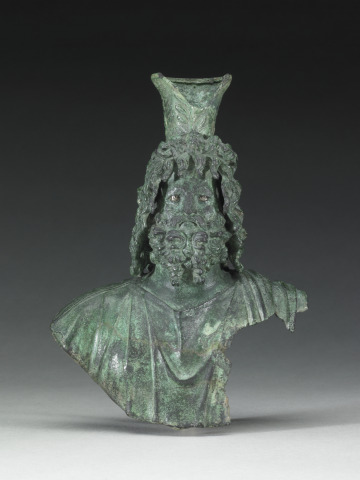
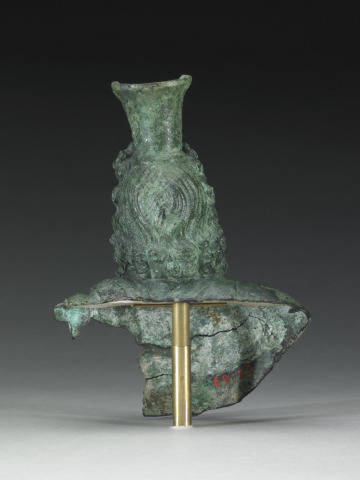
Bust of Zeus Serapis
- Culture
- Roman, 753 BCE–395 CE
- Date
- mid-2nd–mid-3rd century CE
- Material
- Bronze with silver inlay
- associated with
- Europe
- associated with
- Asia
- Classification
- Sculpture
- Collection
- Ancient Art
- Current Location
- On View, Gallery 259
- Dimensions
- 6 3/4 x 5 1/8 x 1 7/8 in. (17.1 x 13 x 4.8 cm)
- Credit Line
- Museum Purchase
- Rights
- Public Domain
- Object Number
- 69:1923
NOTES
As today, individuals in antiquity found ways to express their devotion to the gods. Whether maintaining a small altar at home for the worship of a particular deity, or presenting gifts called votives, at sanctuaries or graves, many of the objects that survive from antiquity served a ritual function.
This bronze bust represents Zeus Serapis—a hybrid deity. The pharaohs of Egypt introduced Zeus Serapis in the 3rd century BCE to unify competing Greek and Egyptian pantheons.
This bronze bust represents Zeus Serapis—a hybrid deity. The pharaohs of Egypt introduced Zeus Serapis in the 3rd century BCE to unify competing Greek and Egyptian pantheons.
Provenance
- 1923
Vladimir G. Simkhovitch, New York, NY, USA
1923 -
Saint Louis Art Museum, purchased from Vladimir G. Simkhovitch
Notes:
Invoice from Vladimir G. Simkhovitch dated January 27, 1923 [SLAM document files]. Minutes of the Administrative Board of Control of the City Art Museum, February 9, 1923.
Vladimir G. Simkhovitch, New York, NY, USA
1923 -
Saint Louis Art Museum, purchased from Vladimir G. Simkhovitch
Notes:
Invoice from Vladimir G. Simkhovitch dated January 27, 1923 [SLAM document files]. Minutes of the Administrative Board of Control of the City Art Museum, February 9, 1923.
We regularly update records, which may be incomplete. If you have additional information, please contact us at provenance@slam.org.