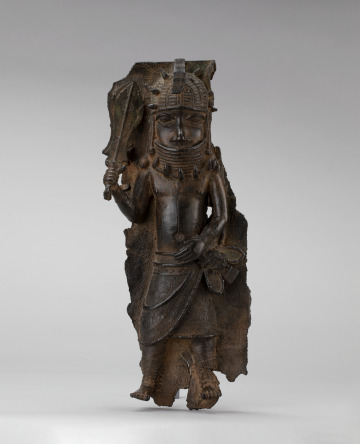
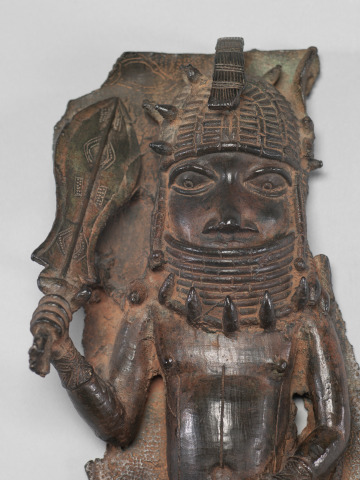


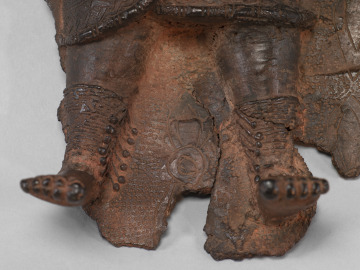
Plaque Portraying a Ceremonial Attendant
- Culture
- Edo artist
- Date
- 16th–17th century
- Material
- Copper alloy
- associated with
- Benin City, Edo state, Nigeria, Africa
- Classification
- Metalwork, sculpture
- Collection
- Arts of Africa, Oceania, and the Americas
- Current Location
- Not on view
- Dimensions
- 16 1/2 x 6 x 3 1/4 in. (41.9 x 15.2 x 8.3 cm)
- Credit Line
- Museum Shop Fund and gift of Sharon McDonald Hollander and Stuart Hollander
- Rights
- Public Domain
- Object Number
- 10:1996
NOTES
This plaque portrays the regalia of a member of the Benin court in remarkable detail. A crested and coral-beaded helmet and collar, necklace of leopard teeth, a sculptural waist pendant in the form of an animal, patterned cloth wrapper, and wrist and ankle cuffs identify this individual as one of high rank. The figure is a chieftancy-titleholder from the Benin court whose role was to hold a ceremonial sword (eben) beside the king during public festivals.
Benin bronzes were cast using the “lost wax” method, an important artistic innovation requiring great skill. The sculpture was first formed in wax over a clay core, and then encased in clay to create a mold. Next, molten bronze was poured into the mold, melting out the wax and filling the mold with metal after which the hardened clay was chipped away.
Benin Kingdom Arts in Global Context
The copper alloy material comprising this sculpture originated from manillas, currency pieces Portuguese traders imported to the area after 1489.
The Benin Kingdom’s engagement with Europeans intensified over 300 years from the late 15th to 19th centuries. The kingdom received foreign products like manillas, guns, and cloth in exchange for ivory, palm oil, and pepper. During the 15th and 18th to 19th centuries, this commerce included captive people destined for trade as enslaved Africans.
Benin Kingdom art in European and American museum collections largely originates from a raid on Benin City in 1897. The British military burned the palace, confiscated the royal arts, and exiled the king (oba), Oba Ovonramwen. Much of this art then entered the market. The Benin Kingdom was reinstated in 1914 under British colonial rule until Nigeria’s independence in 1960. The current oba is Ewuare II.
Benin bronzes were cast using the “lost wax” method, an important artistic innovation requiring great skill. The sculpture was first formed in wax over a clay core, and then encased in clay to create a mold. Next, molten bronze was poured into the mold, melting out the wax and filling the mold with metal after which the hardened clay was chipped away.
Benin Kingdom Arts in Global Context
The copper alloy material comprising this sculpture originated from manillas, currency pieces Portuguese traders imported to the area after 1489.
The Benin Kingdom’s engagement with Europeans intensified over 300 years from the late 15th to 19th centuries. The kingdom received foreign products like manillas, guns, and cloth in exchange for ivory, palm oil, and pepper. During the 15th and 18th to 19th centuries, this commerce included captive people destined for trade as enslaved Africans.
Benin Kingdom art in European and American museum collections largely originates from a raid on Benin City in 1897. The British military burned the palace, confiscated the royal arts, and exiled the king (oba), Oba Ovonramwen. Much of this art then entered the market. The Benin Kingdom was reinstated in 1914 under British colonial rule until Nigeria’s independence in 1960. The current oba is Ewuare II.
Provenance
by February 9, 1897 -
Oba Ovonramwen Nogbaisi (c.1857–c.1914), Benin Kingdom
- 1969
Norman Pretty, Esq.[1]
1969/07/08 -
Charles Ratton (1895–1986), Paris, France, purchased at auction, "African, Oceanic, American Indian and Pre-Columbian Art," Sotheby's, London, July 8, 1969, lot no. 235 [2]
1976
Merton D. Simpson (1928–2013) [Merton D. Simpson Gallery], New York, NY, USA
1976 - 1996
Stuart (1929–2013) and Sharon Hollander, Lake Forest, MO, purchased from Merton D. Simpson Gallery [3]
1996 -
Saint Louis Art Museum, purchased from and given by Stuart and Sharon Hollander through agent Tom Alexander [of Alexander Gallery, Inc.] [4]
Notes:
[1] This plaque was included in the July 8, 1969 Sotheby's auction, listed as "The Property of Norman Pretty, Esq." See the auction catalog ["African, Oceanic, American Indian and Pre-Columbian Art," Sotheby's, London, July 8, 1969, lot no. 235].
[2] See Note 1. Sale results from the auction identify the buyer of the plaque, listed as "Ratton." A photograph of this object is embossed with a “Charles Ratton, Paris, France” stamp. A description of the object is typed on the back of the photograph, signed by Ratton on September 2, 1976 [SLAM document files].
[3] A note dated March 18, 1996 from Jim Burke to Sid Goldstein and John Nunley, all of the Saint Louis Art Museum, describes how “Mr. Hollander purchased this object from Merton Simpson, a dealer in NYC, in 1976.” A note on IRS form 8283 indicates this object was purchased in 1976 [note and IRS form 8283 in SLAM document files].
[4] An invoice dated February 6, 1996 from Alexander Gallery, Inc. to the Saint Louis Art Museum documents the role of Tom Alexander as agent and the Museum’s purchase of 80% of this object from Stuart and Sharon Hollander, listed as “Benin Bronze Plaque, Nigeria Warrior Chief.” A Deed of Gift signed by Stuart and Sharon Hollander on December 29, 1997 documents the gift of the remaining 20% of this object to the Saint Louis Art Museum [invoice and Deed of Gift in SLAM document files]. Minutes of the Collections Committee of the Board of Trustees, Saint Louis Art Museum, February 15, 1996 and March 18, 1998.
Oba Ovonramwen Nogbaisi (c.1857–c.1914), Benin Kingdom
- 1969
Norman Pretty, Esq.[1]
1969/07/08 -
Charles Ratton (1895–1986), Paris, France, purchased at auction, "African, Oceanic, American Indian and Pre-Columbian Art," Sotheby's, London, July 8, 1969, lot no. 235 [2]
1976
Merton D. Simpson (1928–2013) [Merton D. Simpson Gallery], New York, NY, USA
1976 - 1996
Stuart (1929–2013) and Sharon Hollander, Lake Forest, MO, purchased from Merton D. Simpson Gallery [3]
1996 -
Saint Louis Art Museum, purchased from and given by Stuart and Sharon Hollander through agent Tom Alexander [of Alexander Gallery, Inc.] [4]
Notes:
[1] This plaque was included in the July 8, 1969 Sotheby's auction, listed as "The Property of Norman Pretty, Esq." See the auction catalog ["African, Oceanic, American Indian and Pre-Columbian Art," Sotheby's, London, July 8, 1969, lot no. 235].
[2] See Note 1. Sale results from the auction identify the buyer of the plaque, listed as "Ratton." A photograph of this object is embossed with a “Charles Ratton, Paris, France” stamp. A description of the object is typed on the back of the photograph, signed by Ratton on September 2, 1976 [SLAM document files].
[3] A note dated March 18, 1996 from Jim Burke to Sid Goldstein and John Nunley, all of the Saint Louis Art Museum, describes how “Mr. Hollander purchased this object from Merton Simpson, a dealer in NYC, in 1976.” A note on IRS form 8283 indicates this object was purchased in 1976 [note and IRS form 8283 in SLAM document files].
[4] An invoice dated February 6, 1996 from Alexander Gallery, Inc. to the Saint Louis Art Museum documents the role of Tom Alexander as agent and the Museum’s purchase of 80% of this object from Stuart and Sharon Hollander, listed as “Benin Bronze Plaque, Nigeria Warrior Chief.” A Deed of Gift signed by Stuart and Sharon Hollander on December 29, 1997 documents the gift of the remaining 20% of this object to the Saint Louis Art Museum [invoice and Deed of Gift in SLAM document files]. Minutes of the Collections Committee of the Board of Trustees, Saint Louis Art Museum, February 15, 1996 and March 18, 1998.
We regularly update records, which may be incomplete. If you have additional information, please contact us at provenance@slam.org.