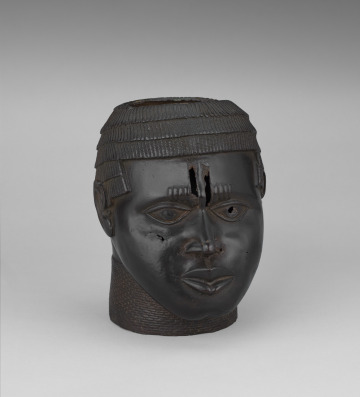
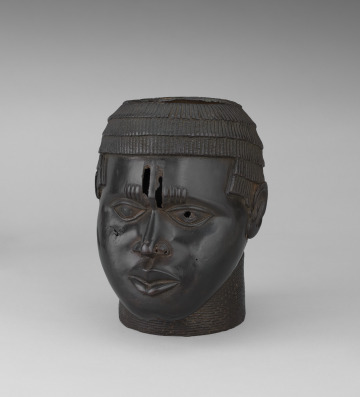
Commemorative Head
- Culture
- Edo artist
- Date
- 15th–18th century
- Material
- Copper alloy, iron
- associated with
- Benin City, Edo state, Nigeria, Africa
- Classification
- Metalwork, sculpture
- Collection
- Arts of Africa, Oceania, and the Americas
- Current Location
- On View, Gallery 117
- Dimensions
- 7 11/16 x 7 1/8 x 6 7/8 in. (19.5 x 18.1 x 17.5 cm)
- Credit Line
- Museum Purchase
- Rights
- Public Domain
- Object Number
- 12:1936
NOTES
In 1936, this sculpture was the first example of sub-Saharan African art to enter the Saint Louis Art Museum’s collection. This work’s high degree of naturalism and fine casting captivated Museum leaders and visitors at a time when few American art museums collected art from sub-Saharan Africa. This bronze had previously been shown in a landmark traveling exhibition of African art organized by the Museum of Modern Art in 1935.
Bronze heads, such as this example, were placed on palace shrines to honor a Benin king’s royal predecessor and ancestors. Heads in this style, with minimal headdress, have also been interpreted as “trophy heads,” said to represent the head of an important defeated enemy to commemorate the victory.
Benin Kingdom Arts in Global Context
The copper alloy material comprising this sculpture originated from manillas, currency pieces Portuguese traders imported to the area after 1489.
The Benin Kingdom’s engagement with Europeans intensified over 300 years from the late 15th to 19th centuries. The kingdom received foreign products like manillas, guns, and cloth in exchange for ivory, palm oil, and pepper. During the 15th and 18th to 19th centuries, this commerce included captive people destined for trade as enslaved Africans.
Benin Kingdom art in European and American museum collections largely originates from a raid on Benin City in 1897. The British military burned the palace, confiscated the royal arts, and exiled the king (oba), Oba Ovonramwen. Much of this art then entered the market. The Benin Kingdom was reinstated in 1914 under British colonial rule until Nigeria’s independence in 1960. The current oba is Ewuare II.
Bronze heads, such as this example, were placed on palace shrines to honor a Benin king’s royal predecessor and ancestors. Heads in this style, with minimal headdress, have also been interpreted as “trophy heads,” said to represent the head of an important defeated enemy to commemorate the victory.
Benin Kingdom Arts in Global Context
The copper alloy material comprising this sculpture originated from manillas, currency pieces Portuguese traders imported to the area after 1489.
The Benin Kingdom’s engagement with Europeans intensified over 300 years from the late 15th to 19th centuries. The kingdom received foreign products like manillas, guns, and cloth in exchange for ivory, palm oil, and pepper. During the 15th and 18th to 19th centuries, this commerce included captive people destined for trade as enslaved Africans.
Benin Kingdom art in European and American museum collections largely originates from a raid on Benin City in 1897. The British military burned the palace, confiscated the royal arts, and exiled the king (oba), Oba Ovonramwen. Much of this art then entered the market. The Benin Kingdom was reinstated in 1914 under British colonial rule until Nigeria’s independence in 1960. The current oba is Ewuare II.
Provenance
by 1932 -
Charles Ratton, Paris, France [1]
by 1934 - 1936
Louis Carré (1897-1977), Paris, France [2]
1936 -
Saint Louis Art Museum, purchased from Louis Carré through agent M. Knoedler & Co., Inc. [3]
Notes:
[1] An image of this object is included in an article titled "Les bronzes du Bénin" by Charles Ratton in a 1932 issue of Cahiers d'Art (no. 3-5). The object is cited as belonging to the collection of Charles Ratton [copy in SLAM document files].
[2] In a letter dated November 23, 1934 from Louis Carré to the City Art Museum, Carré states his Benin collection of bronzes is the “finest collection ever known.” Carré mentioned his plans to have an exhibition in the US and “dispose of certain pieces.” Carré's collection was exhibited at M. Knoedler & Co., Inc., from November 25 to December 14, 1935 ["Bronzes and Ivories from the Old Kingdom of Benin: Exhibition from November 25 to December 14, 1935 : At the Galleries of M. Knoedler and Company ... New York City" [SLAM document files]; see also "Carré Shows Benin Bronzes and Ivories at Knoedler's" in The Art News dated November 30, 1935 [SLAM document files]. Letters between Meyric Rogers, director of the City Art Museum, and Charles Henschel of M. Knoedler & Co. Inc. dated March 6, March 9, March 12, and April 3, 1936, identify Louis Carré's ownership of the object [SLAM document files].
[3] In a letter dated March 6, 1936 from Rogers to Henschel, Rogers asks Henschel to contact Carré regarding this object. A letter dated March 12, 1936 from H. Jansen of M. Knoedler & Co., Inc. to Rogers contains a cable sent to M. Knoedler & Co. from Carré confirming a reduction in price. Additional correspondence between Rogers and Henschel document the role of M. Knoedler & Co. as agent in the purchase. An invoice dated April 6, 1936 from M. Knoedler & Co., Inc. to the City Art Museum documents the purchase of this object, listed as "Benin Bronze...Portrait of a Youth" [SLAM document files]. Minutes of the Administrative Board of Control of the City Art Museum, March 5, 1936.
Charles Ratton, Paris, France [1]
by 1934 - 1936
Louis Carré (1897-1977), Paris, France [2]
1936 -
Saint Louis Art Museum, purchased from Louis Carré through agent M. Knoedler & Co., Inc. [3]
Notes:
[1] An image of this object is included in an article titled "Les bronzes du Bénin" by Charles Ratton in a 1932 issue of Cahiers d'Art (no. 3-5). The object is cited as belonging to the collection of Charles Ratton [copy in SLAM document files].
[2] In a letter dated November 23, 1934 from Louis Carré to the City Art Museum, Carré states his Benin collection of bronzes is the “finest collection ever known.” Carré mentioned his plans to have an exhibition in the US and “dispose of certain pieces.” Carré's collection was exhibited at M. Knoedler & Co., Inc., from November 25 to December 14, 1935 ["Bronzes and Ivories from the Old Kingdom of Benin: Exhibition from November 25 to December 14, 1935 : At the Galleries of M. Knoedler and Company ... New York City" [SLAM document files]; see also "Carré Shows Benin Bronzes and Ivories at Knoedler's" in The Art News dated November 30, 1935 [SLAM document files]. Letters between Meyric Rogers, director of the City Art Museum, and Charles Henschel of M. Knoedler & Co. Inc. dated March 6, March 9, March 12, and April 3, 1936, identify Louis Carré's ownership of the object [SLAM document files].
[3] In a letter dated March 6, 1936 from Rogers to Henschel, Rogers asks Henschel to contact Carré regarding this object. A letter dated March 12, 1936 from H. Jansen of M. Knoedler & Co., Inc. to Rogers contains a cable sent to M. Knoedler & Co. from Carré confirming a reduction in price. Additional correspondence between Rogers and Henschel document the role of M. Knoedler & Co. as agent in the purchase. An invoice dated April 6, 1936 from M. Knoedler & Co., Inc. to the City Art Museum documents the purchase of this object, listed as "Benin Bronze...Portrait of a Youth" [SLAM document files]. Minutes of the Administrative Board of Control of the City Art Museum, March 5, 1936.
We regularly update records, which may be incomplete. If you have additional information, please contact us at provenance@slam.org.