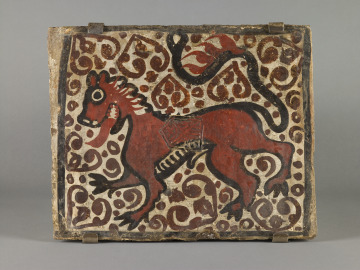
Ceiling Tile (socarrat) with Design of a Lion
- Culture
- Spanish
- Associated
- Mudéjar period, c.1100–c.1499
- Date
- second half of the 15th century
- made in
- Paterna, Valencia region, Spain, Europe
- Classification
- Architectural elements, ceramics
- Collection
- Islamic Art
- Current Location
- On View, Gallery 237
- Dimensions
- 14 x 17 5/16 x 15/16 in. (35.5 x 44 x 2.4 cm)
- Credit Line
- Museum Purchase
- Rights
- Public Domain
- Object Number
- 37:1939
NOTES
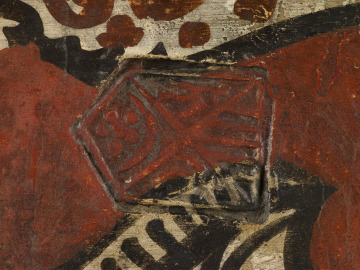
Overlaying the lively animal decorating the surface, this tile bears the stamp of the kilns at Paterna, just outside Valencia, Spain. It would have decorated a ceiling inside a local building, suspended between wooden rafters. The term for such ceiling tiles is socarrat, which means “burnt” in the local dialect, referring to the process of baking in the kiln. Before they were baked, such tiles were painted with a white slip (clay thinned with water) and then with black and red pigments derived from manganese and iron. They were not glazed. The lion on this tile appears to be panting, while his tail swishes through the air.
Provenance
- 1924
Casa del Delme, 13 calle Mayor, Paterna, Valencia, Spain [1]
1924
Sale of objects from the Casa del Delme, 13 calle Mayor, Paterna, Valencia, Spain, purchased by Arnold Seligmann, Rey & Co. [2]
1924 - 1928
Arnold Seligmann, Rey & Co. [Arnold Seligmann (1870–1932) and Germain Seligmann (later Germain Seligman 1893–1978)], New York, NY, USA [3]
1928 - 1939
William Randolph Hearst (1863–1951), San Simeon, CA and New York, NY, USA, purchased from Arnold Seligmann, Rey & Co. [4]
1939 -
Saint Louis Art Museum, purchased from William Randolph Hearst through his agent Parish-Watson & Co., Inc. [Clarence Lisle MacDermid Parish-Watson (1879–1941)], New York, NY, USA [5]
Notes:
This tile is part of a group of three related Valencia tiles (35–37:1939) with the same provenance.
[1] As the Duke of Segorbe from 1469–1522, Enrique de Aragón y Pimentel (1445–1522) was also lord of the nearby towns of Paterna and Manises, centers of flourishing ceramic manufacture, from the taxation of which he derived handsome profit. The residence of the duke's representative in Paterna was appropriately known as the "Tax House" or "Tithe House" (Casa del Delme), located at 13 calle Mayor in Paterna. Some two hundred ceiling tiles, this one possibly among them, decorated the building until they were sold and dispersed in 1924. See Francisco Almarche Vazquez, "Cerámica de Paterna 'Els socarrats,'" Archivo de Arte Valenciano, no. 10 (1924), pp. 30–58, esp. pp. 44–49.
[2] See note [1].
[3] Inventory document, photograph, and purchase and sale record from Hearst's warehouse in South Bronx, New York, published in Taylor Coffman, ed., The William Randolph Hearst Collection: Photographs and Aquisition Records on Microfiche (New York: Published with the kind cooperation of The Library of the C. W. Post Campus of Long Island University by Clearwater Publishing Company, Inc., 1987), vol. 38.
[4] The tiles appear to have remained in Hearst's South Bronx warehouse, and never went to his residence in San Simeon. See note [3]. Hearst began collecting Spanish material in earnest in 1921, when construction began on Hearst Castle, his Spanish-themed residence on the California coast. He continued his Spanish acquisitions until the mid-1930's, and was still buying substantial architectural elements in 1935. See Mary L. Levkoff, Hearst the Collector (New York: Abrams, 2008), pp. 60–64. Hearst was forced to sell about two thirds of his collection in the late 1930s due to financial difficulties. He used Parish-Watson & Co. as dealers from 1937 to 1939. See Mary L. Levkoff, Hearst the Collector (New York: Abrams, 2008), pp. 128–130.
[5] Invoice from Parish-Watson & Co. dated March 27, 1939 [SLAM document files]. Minutes of the Administrative Board of Control of the City Art Museum, March 15, 1939.
Casa del Delme, 13 calle Mayor, Paterna, Valencia, Spain [1]
1924
Sale of objects from the Casa del Delme, 13 calle Mayor, Paterna, Valencia, Spain, purchased by Arnold Seligmann, Rey & Co. [2]
1924 - 1928
Arnold Seligmann, Rey & Co. [Arnold Seligmann (1870–1932) and Germain Seligmann (later Germain Seligman 1893–1978)], New York, NY, USA [3]
1928 - 1939
William Randolph Hearst (1863–1951), San Simeon, CA and New York, NY, USA, purchased from Arnold Seligmann, Rey & Co. [4]
1939 -
Saint Louis Art Museum, purchased from William Randolph Hearst through his agent Parish-Watson & Co., Inc. [Clarence Lisle MacDermid Parish-Watson (1879–1941)], New York, NY, USA [5]
Notes:
This tile is part of a group of three related Valencia tiles (35–37:1939) with the same provenance.
[1] As the Duke of Segorbe from 1469–1522, Enrique de Aragón y Pimentel (1445–1522) was also lord of the nearby towns of Paterna and Manises, centers of flourishing ceramic manufacture, from the taxation of which he derived handsome profit. The residence of the duke's representative in Paterna was appropriately known as the "Tax House" or "Tithe House" (Casa del Delme), located at 13 calle Mayor in Paterna. Some two hundred ceiling tiles, this one possibly among them, decorated the building until they were sold and dispersed in 1924. See Francisco Almarche Vazquez, "Cerámica de Paterna 'Els socarrats,'" Archivo de Arte Valenciano, no. 10 (1924), pp. 30–58, esp. pp. 44–49.
[2] See note [1].
[3] Inventory document, photograph, and purchase and sale record from Hearst's warehouse in South Bronx, New York, published in Taylor Coffman, ed., The William Randolph Hearst Collection: Photographs and Aquisition Records on Microfiche (New York: Published with the kind cooperation of The Library of the C. W. Post Campus of Long Island University by Clearwater Publishing Company, Inc., 1987), vol. 38.
[4] The tiles appear to have remained in Hearst's South Bronx warehouse, and never went to his residence in San Simeon. See note [3]. Hearst began collecting Spanish material in earnest in 1921, when construction began on Hearst Castle, his Spanish-themed residence on the California coast. He continued his Spanish acquisitions until the mid-1930's, and was still buying substantial architectural elements in 1935. See Mary L. Levkoff, Hearst the Collector (New York: Abrams, 2008), pp. 60–64. Hearst was forced to sell about two thirds of his collection in the late 1930s due to financial difficulties. He used Parish-Watson & Co. as dealers from 1937 to 1939. See Mary L. Levkoff, Hearst the Collector (New York: Abrams, 2008), pp. 128–130.
[5] Invoice from Parish-Watson & Co. dated March 27, 1939 [SLAM document files]. Minutes of the Administrative Board of Control of the City Art Museum, March 15, 1939.
We regularly update records, which may be incomplete. If you have additional information, please contact us at provenance@slam.org.