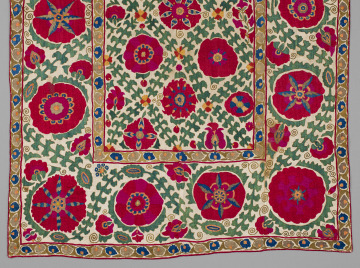
Rectangular Hanging or Cover (suzani)

Culture
Uzbek
Culture
Central Asian
Date
late 19th century
Material
Silk on linen
made in
Uzbekistan, Asia
Collection
Islamic Art
Current Location
Not on view
Dimensions
62 1/4 × 43 1/2 in. (158.1 × 110.5 cm)
Credit Line
Gift of Mrs. George O. Carpenter
Rights
Public Domain
Object Number
75:1941
NOTES
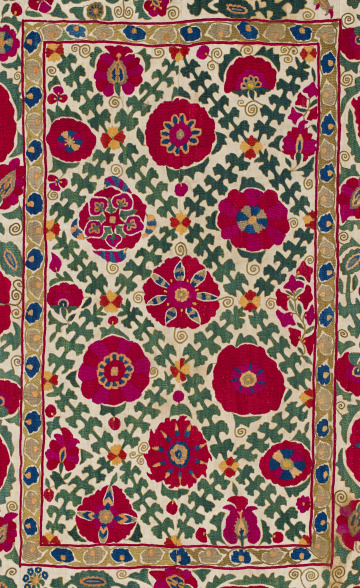
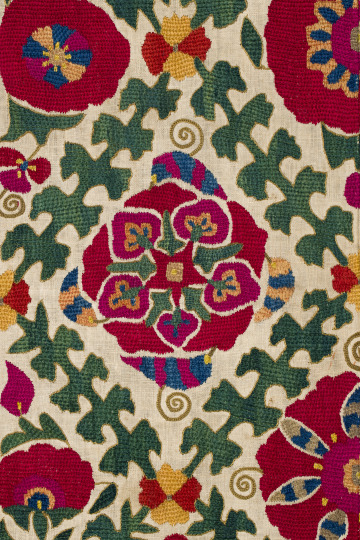
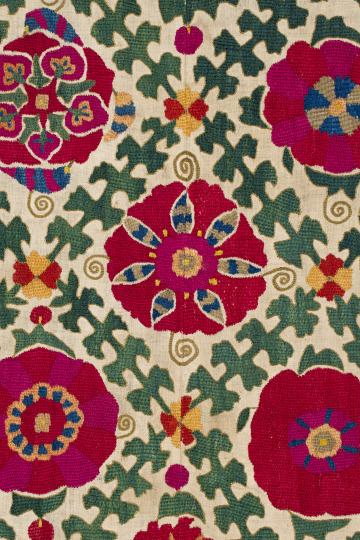
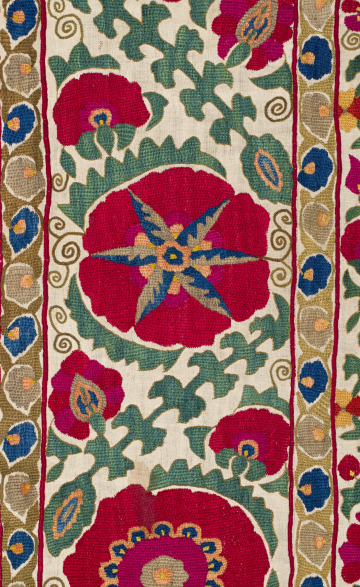
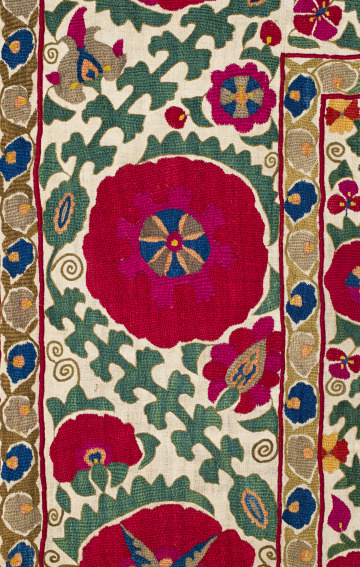
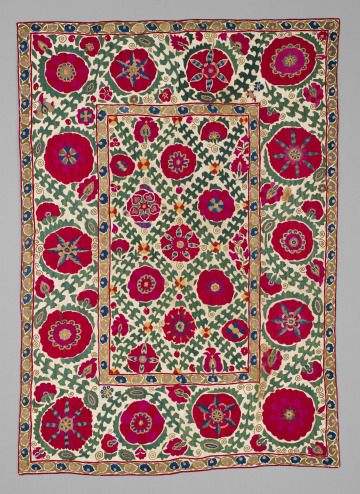
Large geometric floral rosettes in red against a lattice of green leaves with tiny red and yellow rosettes dominate this textile. The border is enclosed by strips of alternating blue and gray flowers on a brown arabesque scroll between thin red lines. This "suzani" textile was most likely made in Bukhara or Shahrisabz, located in present-day Uzbekistan. The term suzani derives from the Persian word for needle, but in Central Asia it specifically refers to large, spectacularly colorful textiles embroidered in silk. These textiles were traditionally used as wall hangings or as covers to wrap bedding and clothing. Produced by women, they were an integral component of a wedding dowry. Suzani consist of several widths of narrow cloth attached to a base. The artist would have laid out the base fabric and drawn the design on top. Widths of cloth were then embroidered separately before being assembled.
- 1941
Mrs. George O. Carpenter [Caroline G. Carpenter (1858–1948)], St. Louis, MO

1941 -
Saint Louis Art Museum, given by Mrs. George O. Carpenter [1]


Notes:
[1] Minutes of the Administrative Board of Control of the City Art Museum, November 6, 1941.

We regularly update records, which may be incomplete. If you have additional information, please contact us at provenance@slam.org.
Scroll back to top