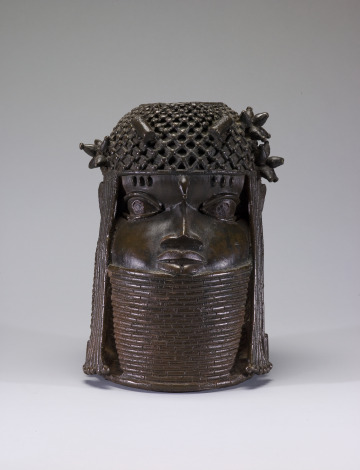
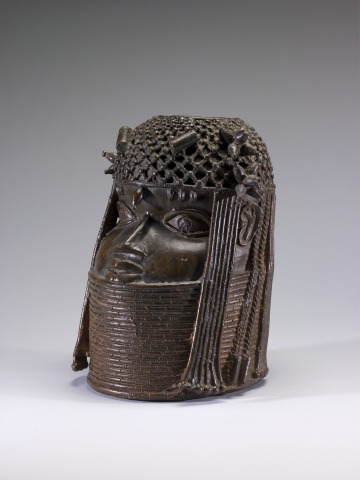
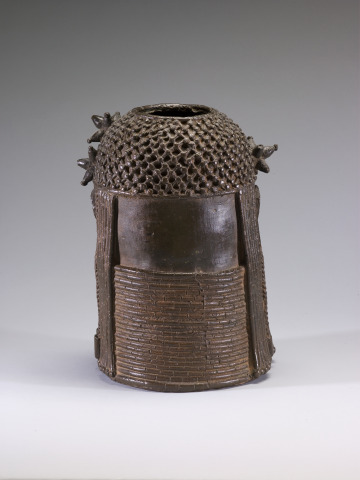
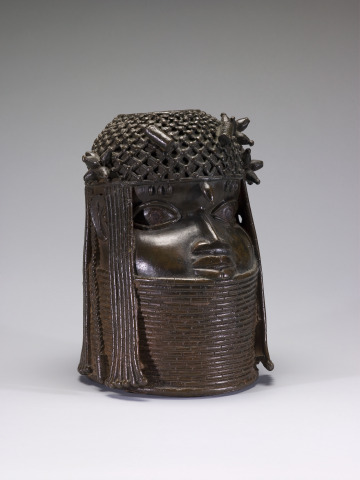
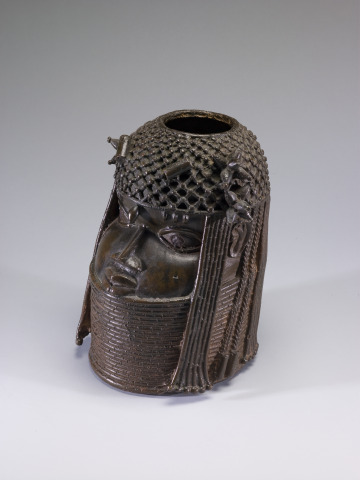
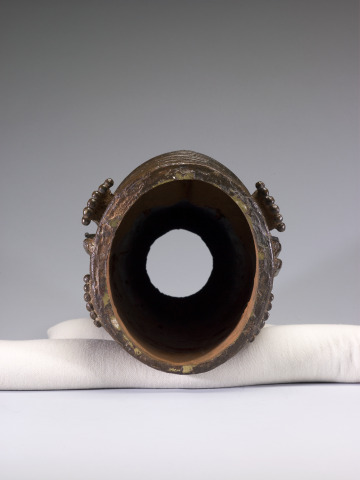
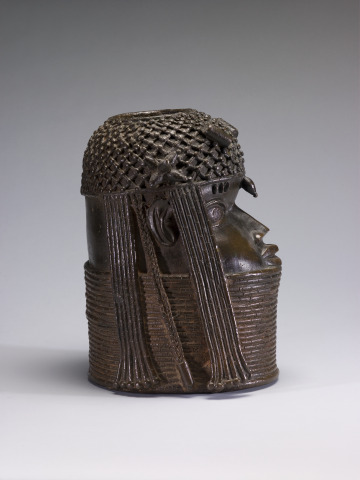
Commemorative Head (uhunmwun elao) Portraying a King
- Culture
- Edo artist
- Date
- 17th century
- Material
- Copper alloy
- associated with
- Benin City, Edo state, Nigeria, Africa
- Classification
- Metalwork, sculpture
- Collection
- Arts of Africa, Oceania, and the Americas
- Current Location
- Not on view
- Dimensions
- 11 1/2 x 8 1/8 x 8 3/4 in. (29.2 x 20.6 x 22.2 cm)
- Credit Line
- Museum Purchase
- Rights
- Public Domain
- Object Number
- 674:1949
NOTES
Embedded with materials exclusive to royalty, this sculpture served as an idealized portrait of a past Benin oba (king). The use of highly valuable bronze and the depiction of precious coral beads that nearly consume the oba’s face, convey great power and luxury. This oba wears a beaded mesh cap, accentuated with large single beads and clusters, and a tall beaded collar that covers his chin and jaw. This portrait head was placed on a royal altar and also served as a pedestal for a carved ivory tusk, another costly substance that only the oba could access. In Edo belief, the head is the symbol of one’s well-being and spiritual destiny. Upon installation as king, an oba would commission a bronze head such as this in honor of his predecessor to maintain the bonds of ritual communication with royal ancestors.
Benin Kingdom Arts in Global Context
The copper alloy material comprising this sculpture originated from manillas, currency pieces Portuguese traders imported to the area after 1489.
The Benin Kingdom’s engagement with Europeans intensified over 300 years from the late 15th to 19th centuries. The kingdom received foreign products like manillas, guns, and cloth in exchange for ivory, palm oil, and pepper. During the 15th and 18th to 19th centuries, this commerce included captive people destined for trade as enslaved Africans.
Benin Kingdom art in European and American museum collections largely originates from a raid on Benin City in 1897. The British military burned the palace, confiscated the royal arts, and exiled the king (oba), Oba Ovonramwen. Much of this art then entered the market. The Benin Kingdom was reinstated in 1914 under British colonial rule until Nigeria’s independence in 1960. The current oba is Ewuare II.
Benin Kingdom Arts in Global Context
The copper alloy material comprising this sculpture originated from manillas, currency pieces Portuguese traders imported to the area after 1489.
The Benin Kingdom’s engagement with Europeans intensified over 300 years from the late 15th to 19th centuries. The kingdom received foreign products like manillas, guns, and cloth in exchange for ivory, palm oil, and pepper. During the 15th and 18th to 19th centuries, this commerce included captive people destined for trade as enslaved Africans.
Benin Kingdom art in European and American museum collections largely originates from a raid on Benin City in 1897. The British military burned the palace, confiscated the royal arts, and exiled the king (oba), Oba Ovonramwen. Much of this art then entered the market. The Benin Kingdom was reinstated in 1914 under British colonial rule until Nigeria’s independence in 1960. The current oba is Ewuare II.
Provenance
by February 9, 1897 -
Oba Ovonramwen Nogbaisi (c.1857–c.1914), Benin Kingdom
- 1949
Josef von Sternberg (1894–1969)
1949/11/22 -
Saint Louis Art Museum, purchased at auction, "Josef von Sternberg: Collection of Modern Paintings; Drawings; Modern, African, Asiatic Sculptures," Parke-Bernet Galleries, Inc., New York, November 22, 1949, lot no. 43 [1]
Notes:
[1] An invoice dated November 22, 1949 from Parke-Bernet Galleries, Inc. to the City Art Museum documents the purchase of this object, listed as "Number 43 Head of a Warrior" [SLAM document files]. Minutes of the Administrative Board of Control of the City Art Museum, December 8, 1949.
Oba Ovonramwen Nogbaisi (c.1857–c.1914), Benin Kingdom
- 1949
Josef von Sternberg (1894–1969)
1949/11/22 -
Saint Louis Art Museum, purchased at auction, "Josef von Sternberg: Collection of Modern Paintings; Drawings; Modern, African, Asiatic Sculptures," Parke-Bernet Galleries, Inc., New York, November 22, 1949, lot no. 43 [1]
Notes:
[1] An invoice dated November 22, 1949 from Parke-Bernet Galleries, Inc. to the City Art Museum documents the purchase of this object, listed as "Number 43 Head of a Warrior" [SLAM document files]. Minutes of the Administrative Board of Control of the City Art Museum, December 8, 1949.
We regularly update records, which may be incomplete. If you have additional information, please contact us at provenance@slam.org.