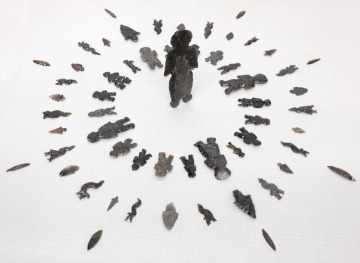
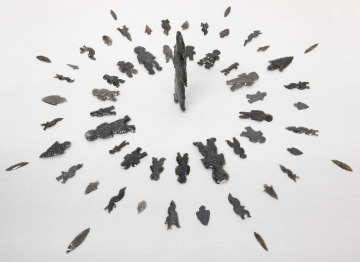
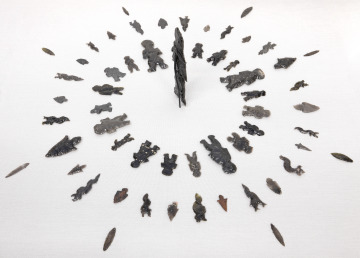
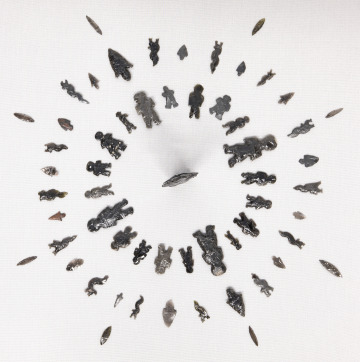
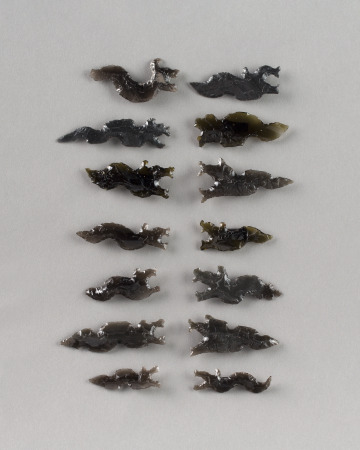
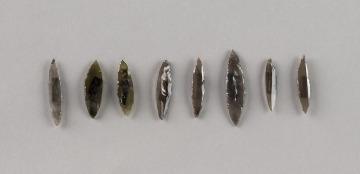
Assemblage of Projectile Points, Blades, Eccentrics, and Figurines

Culture
Teotihuacan
Date
c.300–550 CE
Material
Obsidian
Current Location
Not on view
Credit Line
Gift of Morton D. May
Rights
Public Domain
Object Number
135:1980.1-.58
NOTES
This rare assemblage of 58 individually carved obsidian objects includes miniature versions of blades, arrowheads, humans, and serpents. Obsidian was an important commodity in Teotihuacan’s economy. Its production and export as a cutting tool accounts in part for the city’s meteoric rise in roughly the 1st to 3rd centuries CE. Symbolically, obsidian came to represent Teotihuacan’s expanding military presence in other parts of Mesoamerica. The hypothetical arrangement seen here is based on offerings from one of Teotihuacan’s main pyramids, where larger blades and serpents surround a central figure. Circular patterns found at Teotihuacan often relate to the overall alignment of the city’s grid at 15.5 degrees east of north. An offering such as this may have expressed a shared ideology between Teotihuacan and an allied center in the Valley of Mexico.
- 1970
Valetta Malinowska (1904–1973), Mexico City, Mexico

1970 - 1980
Morton D. May (1914-1983), St. Louis, MO, USA, purchased from Valetta Malinowska [1]

1980 -
Saint Louis Art Museum, given by Morton D. May [2]


Notes:
[1] An invoice dated April 25, 1970 from Valetta Malinowska to Morton D. May documents this purchase [May Archives, Saint Louis Art Museum].

[2] A letter dated April 3, 1980 from Morton D. May to John Peters MacCarthy, president of the Saint Louis Art Museum Board of Commissioners, records this donation [SLAM document files]. Minutes of the Acquisitions and Loans Committee of the Board of Trustees, Saint Louis Art Museum, June 6, 1980.

We regularly update records, which may be incomplete. If you have additional information, please contact us at provenance@slam.org.