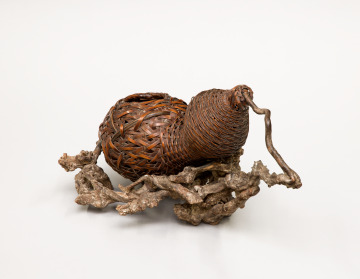
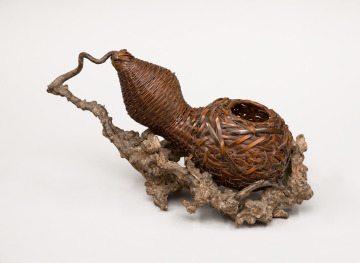
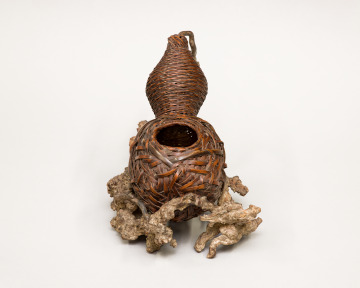
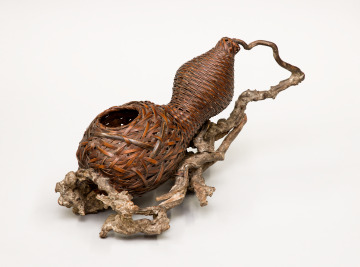
Flower Basket (hanakago) in the Form of a Double Gourd with Rootwood Stand

Culture
Japanese
Date
late 19th–early 20th century
made in
Japan, Asia
Classification
Basketry, containers
Collection
Asian Art
Current Location
Not on view
Dimensions
11 × 20 3/4 × 10 1/2 in. (27.9 × 52.7 × 26.7 cm)
Credit Line
The Nancy Jane Davidson Shestack Collection, bequest of Alan Shestack
Rights
Public Domain
Object Number
232:2020
NOTES
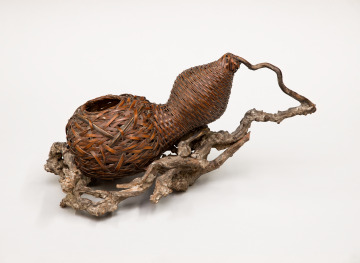
This bamboo basket is shaped like a natural double gourd. An opening in the larger section allows for the placement of a cylindrical insert to hold water and flowers. Several sections of gnarled wisteria root wood, secured to the basket with bamboo ties, form a stand while branching up and around the rear of the double gourd. Three main types of plaiting methods were used to produce this hand-split bamboo object: irregular plaiting ("midare ami") in the larger section containing the opening; mat plaiting ("gozame ami") in the constricted neck of the double gourd form; and pine-needle plaiting ("matsuba ami") in the smaller section. Bamboo baskets of this kind were used to display seasonal floral arrangements, often in connection with Japanese tea ceremonies. They would have been placed within an alcove space beneath a painting or calligraphy scroll that was appropriate for the season.

We regularly update records, which may be incomplete. If you have additional information, please contact us at provenance@slam.org.
Scroll back to top