
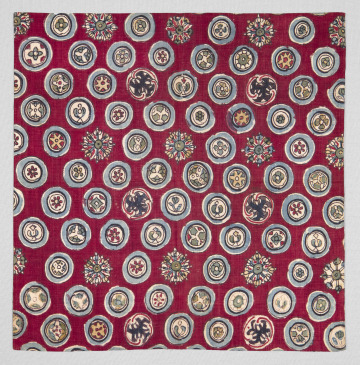
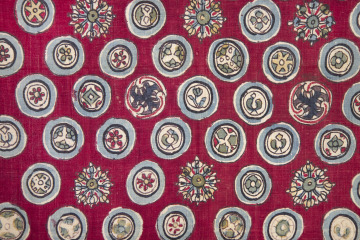
Chintz Textile Panel with Design of Decorative Roundels and Rosettes

Culture
Indian
Date
18th century
made in
India, Asia
associated with
Japan, Asia
Classification
Textiles
Collection
Asian Art
Current Location
Not on view
Dimensions
textile: 10 5/8 × 10 7/8 in. (27 × 27.6 cm)
presentation box: 1 1/4 × 6 1/4 × 6 in. (3.2 × 15.9 × 15.2 cm)
Credit Line
Gift of Mr. and Mrs. Charles A. Lowenhaupt
Rights
Public Domain
Object Number
17:2022
NOTES
Indian chintz, or sarasa, was exported to Japan starting from the latter half of the 16th century. Although the fabric was made in India, the repeating pattern of regularly spaced rosettes and roundels seen here was based on Japanese sources. The motifs evoke Japanese Buddhist iconography—the lotus and the Dharma wheel—as well as the traditional chrysanthemum.

This type of design is present in late 18th-century Japanese sarasa manuals published in Edo, Kyōto, and Ōsaka. These manuals, with color directives encouraging Japanese textile printers to copy the Indian designs, confirm that sarasa were widely circulated even before such publications appeared.

We regularly update records, which may be incomplete. If you have additional information, please contact us at provenance@slam.org.
Scroll back to top