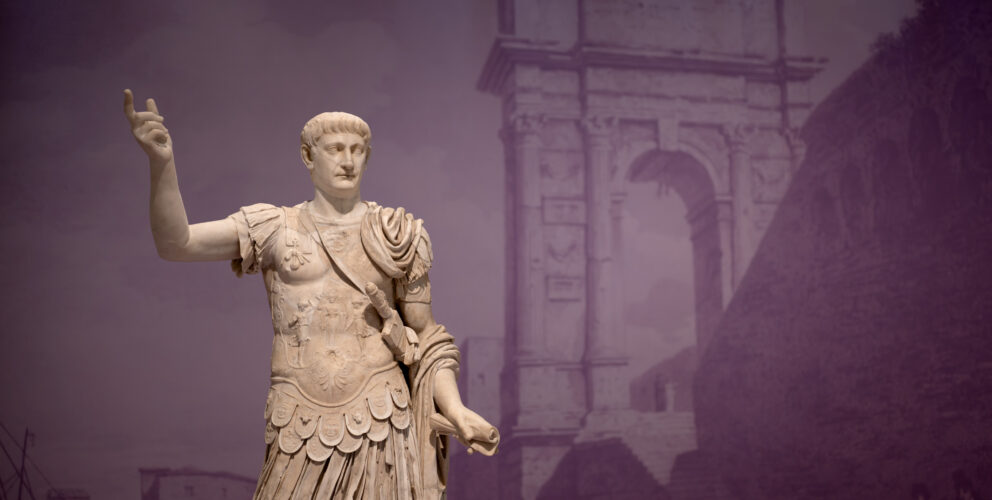
Installation view of Ancient Splendor: Roman Art in the Time of Trajan
From the commanding, seven-foot-tall statue of the emperor Trajan to more modest works like a statue of a young Roman boy, Ancient Splendor: Roman Art in the Time of Trajan contains several marble full-figure sculptures.
As part of a spring 2026 writing-intensive course, Washington University students produced the following descriptions of two of the exhibition’s sculptural works. This blog is part of a series of posts from students about the exhibition, which is on view through August 16.

Apollo, 1st century CE; Roman, Imperial period; marble; 42 x 13 3/8 x 13 3/8 inches; The National Archaeological Museum of Naples, 6277 2026.25
Apollo
The statue of Apollo Lykeios is a key representation of ancient elegance, as his contrapposto pose reflects a state of active rest. Apollo has his left arm leaning against the tree trunk and rests his right above his head, holding a calm demeanor. This style of pose is referred to in figural sculpture as “contrapposto,” as Apollo’s legs stand apart from each other, and weight lies heavily on his front leg. His natural expression, combined with his natural body posture humanizes him, mirroring his characteristics to that of a real person. He sports a krobylos, a common hairstyle for young men at the time. In an ancient setting, this statue could have been found in Greek and Roman contexts; its Greek origins likely influenced its Roman copies, both having different interpretations in each society. Apollo intentionally holds a relaxed pose while relieving some tension in a moment of relief after exercise. The weight of the marble trunk acts as a counterweight to keep him from breaking at the ankles. The statue symbolized leisure and social standing through its physiology and placement in the garden, signaling otium to visitors.
— Arnav Koul graduated from WashU in May 2026, where he majored in psychological and brain sciences with a minor in medical humanities.

Sabina as Ceres, 137–138 CE; Roman, Imperial period; marble; 77 15/16 x 24 13/16 x 15 3/4 inches; Archaeological Park of Ostia Antica, Rome 2026.81
Sabina as Ceres
Depicted in this sculpture is the Roman empress Sabina, grandniece of the emperor Trajan and wife of his successor, Hadrian. Her wide-set eyes and full cheeks correspond to other depictions of Sabina, and the consistent features across Sabina’s many portraits set them apart from the conformity and abstraction of identity exhibited in previous and contemporary Roman women’s portraiture. Sabina’s wavy, centrally parted hairstyle in this depiction matches that of the principal type of her portraiture. While the style’s textured curls resemble the appearance of Greek goddesses, it remains distinct from them, prioritizing Sabina’s selfhood over the features of divinity. Sabina also holds poppies and grain in her left hand. These represent the Roman goddess of agriculture, Ceres, and indicate that the sculpture also belongs to the Ceres sculptural type. The Ceres type enabled Roman women’s images to appear in public spaces—which Rome’s gender-based social restrictions usually barred them from—by assuming divine traits. This sculpture was found in the Baths of Neptune at Ostia, a large, public, and likely government-sponsored construction project built during Hadrian’s reign. The presence of Sabina as Ceres in such a location attests to the effectiveness and subversiveness of the Ceres sculptural type.
— Darcy Lee is a rising senior majoring in communication design with a minor in ancient studies.
Writing Intensive Topics: Exhibiting Rome in the Time of Trajan was cotaught by Nathaniel Jones and doctoral candidate Claire Lyman (also a curatorial research intern at SLAM) of the Department of Art History & Archaeology at Washington University in St. Louis. Centered around SLAM’s exhibition, the course gave students an opportunity to see what goes into the planning and curation of a large museum exhibition. Each student selected a primary object of study from the show, giving an in-gallery presentation and ultimately producing a longer research paper about the chosen work of art. The short descriptions in this blog series are a distillation of these papers, resulting from close-looking and academic research done over the course of the semester.