Installation view of Ancient Splendor: Roman Art in the Time of Trajan
Alongside a larger-than-life statue of the emperor Trajan, the opening gallery of Ancient Splendor: Roman Art in the Time of Trajan features a series of busts depicting members of the Imperial family.
As part of a spring 2026 writing-intensive course, Washington University students produced the following descriptions of two Imperial portraits. This blog is part of a series of posts from students about the exhibition.
Ancient Splendor is on view at the Saint Louis Art Museum through August 16.

Installation view of Ancient Splendor: Roman Art in the Time of Trajan
Head of Sabina Wearing a Veil
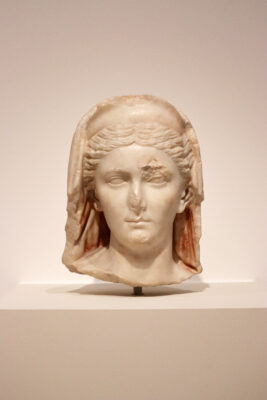
This head represents Sabina, Salonia Matidia’s daughter and Trajan’s grandniece. She married the emperor Hadrian. They had a volatile relationship, likely because of Hadrian’s travels and his relationship with his lover, Antinous, and they ultimately did not produce children. She is represented with wavy, middle-parted hair that has specks of brown paint still visible, topped with a diadem, or a tiara, and a veil. The top of her head also has a slot carved into the top, which could have been used to insert jewelry or hair adornments. Early sculptures and coins of Sabina represent her with elaborate, Flavian curls piled atop her head, but artists started representing her with a simple hairstyle and a diadem after her husband, Hadrian, granted her the title Augusta, an honorific given to Roman empresses, in 128 CE. Artistic representations of Sabina after her death and deification depict her with a veil, similar to this sculpture, and are part of the “deified Sabina style.” Sculptures and coinage all depict her in the same way, suggesting the artists were influenced by the same common model of her appearance.
— Cecilia Burke graduated from WashU in May 2026, where she double majored in art history & archaeology and anthropology with a minor in ancient studies.
Matidia as Thalia, Muse of Comedy
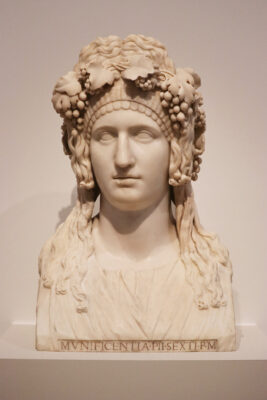
This colossal marble bust, entitled Matidia as Thalia, Muse of Comedy, has been identified as a representation of Matidia, beloved niece of the emperor Trajan and mother-in-law to his successor, Hadrian. Unlike the other imperial portraits in this room, this piece reimagines Matidia as Thalia, the Greek muse of comedy. Rather than reflecting her physical likeness, it adopts mythological elements, such as a crown of vines and grapes. The bust was discovered at Hadrian’s Villa, an expansive imperial retreat for the emperor in modern-day Tivoli, Italy. Paired with a depiction of the Greek muse of tragedy, it likely stood at the entrance to the villa’s Maritime Theater, an exclusive residential space within the greater complex. Alluding to a mythological figure, the sculpture suggests an audience familiar with Greek culture, contributing to an environment of intellectual stimulation. In presenting Matidia as a muse, she is transformed from imperial figure into a symbol of cultivated entertainment and elite leisure. Its creation may reflect Hadrian’s affection for his mother-in-law, matching her to an esteemed mythological character, while reinforcing the villa as a space of cultural refinement.
— Anna Miller is a rising junior majoring in art history & archaeology and studio art with a minor in business of the arts.
Writing Intensive Topics: Exhibiting Rome in the Time of Trajan was cotaught by Nathaniel Jones and doctoral candidate Claire Lyman (also a curatorial research intern at SLAM) of the Department of Art History & Archaeology at Washington University in St. Louis. Centered around SLAM’s exhibition, the course gave students an opportunity to see what goes into the planning and curation of a large museum exhibition. Each student selected a primary object of study from the show, giving an in-gallery presentation and ultimately producing a longer research paper about the chosen work of art. The short descriptions in this blog series are a distillation of these papers, resulting from close–looking and academic research done over the course of the semester.