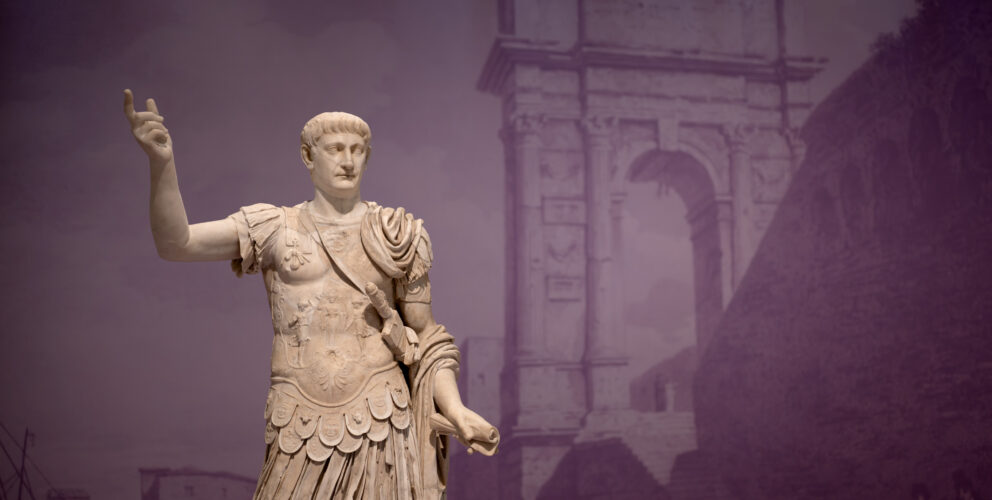
Installation view of Ancient Splendor: Roman Art in the Time of Trajan
The Roman convivium, or banquet, was no ordinary dinner party. Translating to “living together,” it was a significant ritual that solidified familial bonds and community relationships as well as social rank.
An entire gallery in SLAM’s current ticketed exhibition, Ancient Splendor: Roman Art in the Time of Trajan, offers a glimpse into these lavish gatherings, in which guests often enjoyed musical, theatrical, and even acrobatic performances alongside being wined and dined.
As part of a spring 2026 writing-intensive course, Washington University students produced the following descriptions of three works on view in the banquet-themed gallery. This blog is part of a series of posts from students about the exhibition.

Statue of a Satyr, 1st century CE; Roman, Imperial period; marble; 72 x 27 x 15 inches; The National Archaeological Museum of Naples, 6325 2026.21
Statue of a Satyr
This statue of a satyr represents nature and is a worshipper of the god of revelry, Dionysus (Roman: Bacchus). Much of the decoration that adorns this figure indicates his devotion to Dionysus, and the creature’s state of intoxication. His leaning posture, his cheeky expression, and the bunch of grapes toppling out of the goatskin slung across his shoulders are all attributes of the revelry and intoxication of the untamed satyr. Although he is not sporting the goat legs associated with satyrs, this statue does have two horns nestled in his hairline, along with a goat tail on the rear. What is particularly unique about this sculpture compared to others that are similar to it is the face. While the rest of the body is naturalistic and idealized, the facial expression featuring a wide smile, pointed nose and ears, along with squinted eyes, looks more like a theater mask than a real person. What would have brought this sculpture to life were vibrant pigments applied to the surface. How opaque the paint would have been is unknown, but we should imagine this sculpture not in cream colored marble but instead decorated with a rainbow of lively hues.
— Olivia Hart is a rising junior double majoring in art history & archaeology and studio art.

Mosaic with Fish, end of the 2nd through beginning of the 3rd century CE; Roman, Imperial period; 23 1/2 x 21 x 1 3/8 inches; The National Roman Museum 2026.100
Mosaic with Fish
Mosaic squares, like in this work, were the central floor decoration of the Roman dining room (triclinium). Wealthy Romans hosted dinner parties (convivium/a) here, in one of the more elaborate spaces in an elite Roman home. There were wall paintings, expensive tableware, and, of course, mosaics. Mosaic with Fish is a unique version of these triclinia mosaic squares. Three pairs of fish, Umbrina (Umbrina ronchus), Mediterranean brown trout (Salmo trutta fario), and red mullet (Mullus surmuletus), lie on a white background. Fish, especially red mullet, were among the most expensive ingredients a Roman could buy. By depicting these fish in an equally expensive art form, the patron of the work wanted to emphasize his ability to provide the most lavish dining experience. However, these fish pairs are not just an expression of wealth but of intellect. Each fish depiction is different, depending on its sex. While these fish only partially replicate the real anatomy, they are meant as a scientific reference. Much like a coffee table book on popular science today, the fish mosaic functioned as an expression of the owner’s intellect and, perhaps, a conversation starter at his convivium, all while acting as an integral part of the room.
— Margaret Culuris-Harp is a doctoral student in the Department of Art History & Archaeology.

Banquet Scene, 1st century CE; Roman, Imperial period; fresco on plaster; 30 11/16 x 29 1/2 x 3 9/16 inches; The National Archaeological Museum of Naples, 120029 2026.38
Banquet Scene
Painted in the first century CE, this fresco illustrates the excess of Roman banqueting culture. From the east wall of a dining room in the House of the Triclinium at Pompeii, it depicts four male guests reclining on couches while smaller servants move through the scene. One servant serves wine, another cleans a guest’s shoe, and another supports a guest who has had too much to drink. After the fresco was completed, letters were scratched above several figures, showing that people continued to interact with it. Reclining was a meaningful posture in Roman culture, which often associated it with higher social status and leisure, while the servants are standing, moving, and working around the scene. Because the ancient viewers would see this image while dining, the fresco likely reinforced the established social order and authority of the patron of the house.
— Jack Zhou graduated from WashU in May 2026, where he double majored in psychological & brain sciences and computer science.
Writing Intensive Topics: Exhibiting Rome in the Time of Trajan was cotaught by Nathaniel Jones and doctoral candidate Claire Lyman (also a curatorial research intern at SLAM) of the Department of Art History & Archaeology at Washington University in St. Louis. Centered around SLAM’s exhibition, the course gave students an opportunity to see what goes into the planning and curation of a large museum exhibition. Each student selected a primary object of study from the show, giving an in-gallery presentation and ultimately producing a longer research paper about the chosen work of art. The short descriptions in this blog series are a distillation of these papers, resulting from close-looking and academic research done over the course of the semester.