Judgment of Paris (detail), 1st century CE; Roman, Imperial period; fresco on plaster; 24 x 23 1/4 x 2 1/2 inches; The National Archaeological Museum of Naples, 119691 2026.28
Most of the world’s surviving frescoes from ancient Rome were discovered in the ruins of Pompeii and Herculaneum, preserved in ash from Mount Vesuvius’s eruption.
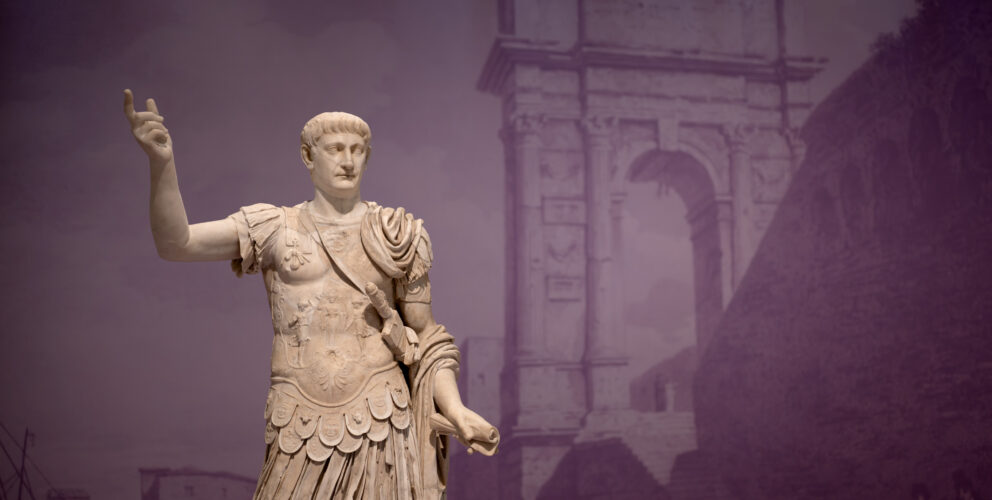
Ancient Splendor: Roman Art in the Time of Trajan features numerous frescoes—or mural paintings done on wet plaster—many of which were lent from the National Archaeological Museum of Naples. These vividly colored works depict mythological stories and scenes from daily life in ancient Rome.
As part of a spring 2026 writing-intensive course, Washington University students produced the following descriptions of three of the exhibition frescoes. This blog is part of a series of posts from students about the exhibition, which is on view through August 16.

Garden Scene, 1st century CE; Roman, Imperial period; fresco on plaster; 26 x 45 x 3 5/8 inches; The National Archaeological Museum of Naples, 8763 2026.35
Garden Scene
Painted in the first century CE in Herculaneum—the quieter, wealthier neighbor of Pompeii—Garden Scene depicts three birds alongside two flowering plants and a small sculptural marker. The bird paintings seem to represent a nightingale, a great blue heron, and a white peacock at the center. Together, they are not decoration but a statement of status. White peacocks are genetic anomalies, impossible to breed reliably (meaning no amount of money could guarantee one). The nightingale was so prized for its song that ancient sources record individual birds selling for extremely high prices, and the heron, a native Italian bird, completes the picture: wild, cultivated, and exotic, all in one frame. The oleander in bloom and the migratory nightingale both belong to the same season—late spring and early summer in Italy. The fresco freezes that moment permanently. The garden outside would fade, but this indoor summer would last. What you are looking at is a Roman household’s vision of itself: in control of nature, in possession of rarities, and confident that the splendor of their lives would be understood by anyone who walked through the door.
— Olyvia Rue is a rising junior majoring in art history and archaeology with a minor in business of the arts.

Selene and Endymion, 1st century CE; Roman, Imperial period; fresco on plaster; 28 3/16 x 28 x 2 1/2 inches; The National Archaeological Museum of Naples, 9245 2026.32
Selene and Endymion
In this first-century Pompeian fresco, the moon goddess, Selene, descends from the night sky toward the sleeping mortal Endymion, her gaze fixed upon him as he lies unconscious on a rock. This Fourth Style painting, once adorning the inner walls of a Pompeian home, draws on the transcendent love story of a mortal and a goddess. Selene, captivated by the beauty of Endymion, visits him each night on Earth as he rests in an eternal slumber. To Roman viewers, this myth may have represented the ultimate demonstration of devotion, a love so enduring it persists across the boundary between mortal and divine. However, this rendition introduces an unusual power dynamic. In Roman domestic painting, erotic scenes typically present a female figure as passive, available to the male gaze; but here that convention is reversed. Selene is the one who desires Endymion, while he remains entirely unaware of her presence, his exposed body displayed as spectacle, while hers conveys motion and intention. The fresco’s presence in this exhibition invites us to consider how domestic Roman art could both reflect and challenge the gender expectations of its time.
— Addy Steinberg is a rising junior majoring in art history and archaeology with minors in business of the arts and French.

Judgment of Paris, 1st century CE; Roman, Imperial period; fresco on plaster; 24 x 23 1/4 x 2 1/2 inches; The National Archaeological Museum of Naples, 119691 2026.28
Judgment of Paris
This first-century mythological fresco of the Judgment of Paris, found in the House of Jupiter in Pompeii, reflects the role of myth in constructing Roman nationalism. In the scene, the young Paris, son of the king of Troy, is chosen by the gods to decide which goddess is most beautiful. The consequences of his choice lead to the Trojan War, after which the surviving Trojans flee to found Rome. The fresco depicts Hera, Athena, and Aphrodite awaiting Paris’s judgment. Despite the “beauty contest” nature of the scene, all three figures are rendered similarly, with the artist focused on portraying each goddess’s identity rather than physical attractiveness. They are joined by Hermes, the messenger god, who looks toward the seated Paris. Paris wears clothing that a Roman would have interpreted as eastern and holds a shepherd’s staff. His positioning creates suspense as he remains deep in thought. This fresco invites viewers to reimagine the repercussions of the well-known scene, suspending them in a brief moment of calm before the Trojan War unfolds. This pause forces the viewer to mentally complete the narrative and consider its place within Roman history, making the scene an inherently nationalistic act that honors Rome’s origin myth.
— Riley Meltz is a rising junior majoring in art history and archaeology with minors in English and business of the arts.
Writing Intensive Topics: Exhibiting Rome in the Time of Trajan was cotaught by Nathaniel Jones and doctoral candidate Claire Lyman (also a curatorial research intern at SLAM) of the Department of Art History & Archaeology at Washington University in St. Louis. Centered around SLAM’s exhibition, the course gave students an opportunity to see what goes into the planning and curation of a large museum exhibition. Each student selected a primary object of study from the show, giving an in-gallery presentation and ultimately producing a longer research paper about the chosen work of art. The short descriptions in this blog series are a distillation of these papers, resulting from close-looking and academic research done over the course of the semester.