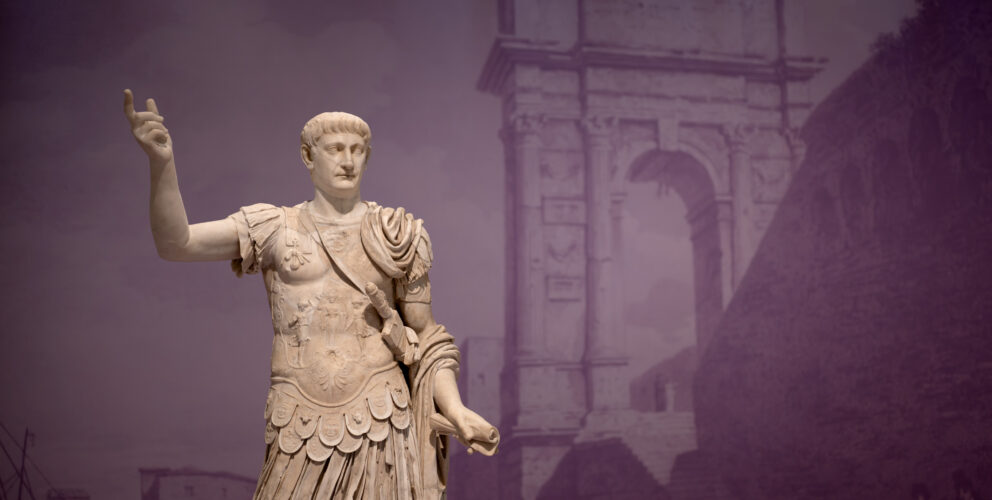
Installation view of Ancient Splendor: Roman Art in the Time of Trajan
Busts in ancient Rome were a common form of portraiture, made in various sizes for a range of purposes. The marble heads on display in Ancient Splendor: Roman Art in the Time of Trajan range from an 8-inch-tall herm—which was a carved head predominantly used as a decorative element in a courtyard or garden as a boundary marker—to colossal, 50-inch-tall busts of Trajan and his wife, Plotina, that were made after their deaths, portraying them as benevolent leaders.
As part of a spring 2026 writing-intensive course, Washington University students produced the following descriptions of two busts—a herm showing the nymph Io and the Colossal Head of a Barbarian.
These are two of the numerous heads on display in the exhibition, which is on view through August 16 at the Saint Louis Art Museum, before the works return home to Italy.

Installation view of Ancient Splendor: Roman Art in the Time of Trajan
Herm with the Nymph Io, 1st–2nd century CE; Roman, Imperial period; marble; 5 7/8 x 8 11/16 x 3 9/16 inches; The National Archaeological Museum of Naples, 119584 2026.45
Herm with Dionysus, 1st–2nd century CE; Roman, Imperial period; marble; 21 5/8 x 4 3/4 x 5 7/8 inches; The National Archaeological Museum of Naples, 120427 2026.43
Herm with the Nymph Io
According to myth, Jupiter abducted the nymph Io after falling in love with her. When Juno discovered her husband’s infidelity, Jupiter turned Io into a cow to disguise her identity. Escaping the goddess’s wrath, Io fled to the Nile River, where she was returned to human form by the Egyptian goddess Isis. This bust, which would have sat on a rectangular pillar, was originally located in the garden of a Pompeian home. Pompeian gardens were open spaces located within the home, providing cool air and reprieve in the dense city. During the early empire, they commonly featured Egyptian decoration and references to water as ways to enhance their wild, exotic feeling. Io’s sculpture might have been chosen for this space because her myth revolves around the Nile River and the power of Isis. Her inclusion also attests to the tensions experienced within Roman gardens between indoor and outdoor, domestic and wild, public and private, religious and secular, and ultimately—Roman and Egyptian.
— Liz Pollock graduated from WashU in May 2026, where she majored in art history and archaeology with a minor in studio art.

Colossal Head of a Barbarian, 117–138 CE; Roman, Imperial period; marble; 42 x 13 3/4 x 13 3/4 inches; Vatican Museums, Pio Clementino Museum, Vatican City, 651 2026.13
Colossal Head of a Barbarian
The Colossal Head of a Barbarian, made sometime in the 2nd century during the reign of Hadrian, likely depicts a captured Dacian. The word barbarian is an umbrella term for all non-Romans. Hadrian’s predecessor, Trajan, was known for conquering Dacia, located in modern-day Romania. After wars, Romans typically captured and enslaved many inhabitants of the conquered land, bringing them back to Rome. It is likely that the head is a fragment of a large, full-body sculpture of a captured barbarian from the Forum of Trajan, which was completed under Hadrian. However, the statue was found at the base of the 4th-century Arch of Constantine. Notably, this colossal head does not have many features that point to his submissive position. The hat is a pileus cap, which was used to mark enslaved people and others, but the Dacian’s determined gaze and heavy brow communicate strength, not capture. This is the result of Trajan’s intentional shift to commissioning depictions of strong enslaved barbarians. This nonsupplicant visualization of an “other” enemy serves the additional purpose of promoting the power of the Roman Empire, military, and people.
— Annique Bien-Aime is a rising senior double majoring in art history and archaeology and marketing.
Writing Intensive Topics: Exhibiting Rome in the Time of Trajan was cotaught by Nathaniel Jones and doctoral candidate Claire Lyman (also a curatorial research intern at SLAM) of the Department of Art History & Archaeology at Washington University in St. Louis. Centered around SLAM’s exhibition, the course gave students an opportunity to see what goes into the planning and curation of a large museum exhibition. Each student selected a primary object of study from the show, giving an in-gallery presentation and ultimately producing a longer research paper about the chosen work of art. The short descriptions in this blog series are a distillation of these papers, resulting from close-looking and academic research done over the course of the semester.